
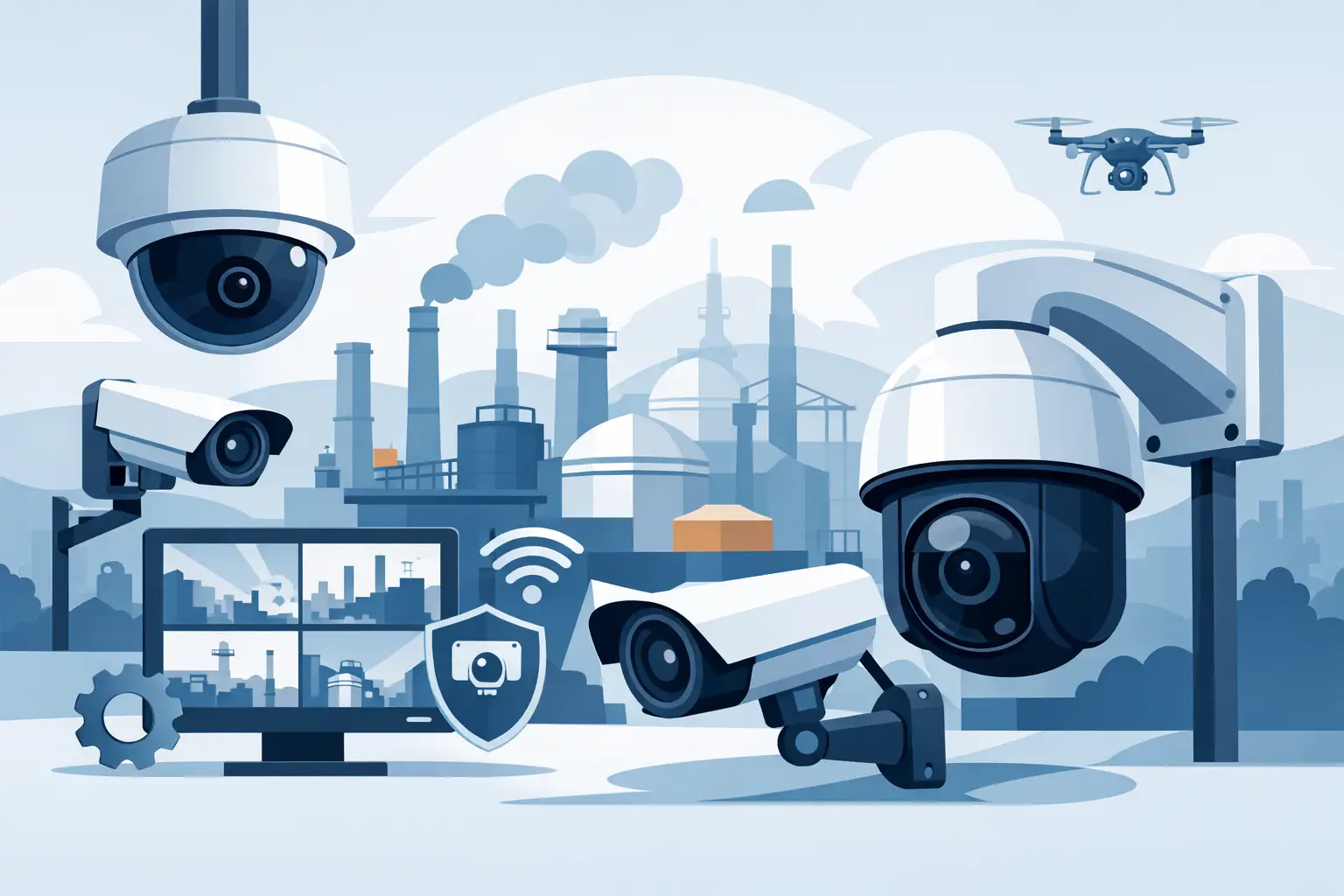
A camera that performs well at a warehouse entrance can fail quickly on a salt-exposed vessel deck, beside a flare stack, or inside a classified refinery area. This industrial surveillance camera buyer guide is built for buyers who need more than a camera count and a low unit price. The right system must provide usable evidence, support operations at a distance, tolerate the installed environment, and fit the site network without creating another maintenance burden.
For procurement managers and operations leaders, the buying decision is rarely just about surveillance. Cameras may support perimeter security, process observation, safety investigations, vessel operations, leak response, and remote engineering support. That broader role changes how equipment should be specified.
Start With the Operating Risk, Not the Camera Model
The most costly mistake is selecting hardware before defining the risk it must address. A fixed camera aimed at a gate answers a different requirement from a thermal camera monitoring a tank farm perimeter or an optical gas imaging system used to identify hydrocarbon emissions.
Begin by separating security coverage from operational visibility. Security coverage typically focuses on access points, fence lines, loading areas, and restricted zones. Operational visibility may include offshore subsea inspection, crane activity, marine navigation areas, pump stations, or hazardous process equipment. One platform can often manage both functions, but the camera type, lens, mounting position, recording settings, and alarm logic may differ substantially.
Ask what an operator must be able to see when an incident occurs. Detecting that a person entered a zone is not the same as identifying that person. Observing a vapor plume is not the same as confirming a gas leak source. Reading a vessel name, container marking, gauge, or valve position requires defined detail at a known distance. These answers should set resolution and lens requirements before any quotation is compared.
Match the Camera to the Environment
Industrial sites punish weak specifications. Heat, vibration, abrasive dust, marine salt spray, washdown, corrosive chemicals, low light, and electrical interference all affect service life and image quality. An enclosure rating is relevant, but it is only one part of the selection.
For outdoor refineries, power plants, and chemical facilities, confirm the temperature range at the mounting point rather than relying on local weather averages. Direct sun exposure, radiant heat, and enclosed equipment spaces can push a camera beyond its rated limit. Where corrosive gases or coastal air are present, housing material, fasteners, cable glands, and mounting hardware matter as much as the camera body.
Marine installations require particular discipline. A camera may need marine-grade construction, vibration tolerance, protected connectors, and a mounting arrangement that prevents cable strain. Salt residue on a lens window can reduce visibility long before the camera itself fails, so consider cleaning access, wipers, washers, or protective housings where conditions justify them.
Hazardous locations require formal attention. If a camera will be installed where flammable gas, vapor, dust, or combustible material may be present, verify the applicable hazardous-area certification for the exact zone or division and the exact installation region. Do not assume a weatherproof camera is suitable for a classified area. The wrong certification can delay commissioning, create compliance exposure, and force expensive replacement work after installation.
Choose Imaging Performance for the Job
Higher resolution is valuable only when storage, bandwidth, lens quality, lighting, and viewing distance support it. A high-resolution stream sent across a constrained marine network may create delays that limit its usefulness during a live event. Conversely, an under-specified camera at a vehicle entrance can leave teams with footage that proves activity occurred but cannot support identification.
Fixed cameras are usually the best value for persistent coverage of entrances, corridors, critical equipment, and defined work zones. Pan-tilt-zoom units serve broad yards, jetties, perimeter lines, and offshore decks where an operator needs to investigate an event in real time. They should not replace fixed coverage at a critical point, because a moving camera can be looking elsewhere when an incident begins.
Low-light performance needs a practical assessment. Infrared illumination can support nighttime observation, but reflective surfaces, fog, rain, steam, and long distances can limit results. Thermal imaging is often the stronger choice for wide-area detection in darkness or difficult weather, particularly where the goal is to identify people, vehicles, or heat anomalies. It generally does not replace visible-light imaging when color, facial detail, labels, or documentation are needed.
For oil and gas operations, optical gas imaging should be evaluated as a specialized detection tool rather than a general security camera. Its value lies in helping teams visualize certain gas emissions and prioritize response activity. Performance depends on the target gas, background conditions, distance, wind, temperature contrast, operator training, and site procedures. Specify the operational use case clearly so the system is selected and deployed for defensible results.
Build the Network and Recording System Around Reality
A surveillance system is only as dependable as the network, power, recording, and remote access behind it. Remote facilities often have limited backhaul capacity, intermittent links, or shared networks that cannot absorb unrestricted video traffic. This is common on vessels, offshore assets, pipelines, and remote energy sites.
Calculate expected bandwidth by stream, not by camera count. Resolution, frame rate, compression, scene motion, and simultaneous viewing all affect traffic. Use lower-bandwidth substreams for remote live viewing where appropriate, while retaining higher-quality primary streams for recording. This approach can protect network performance without sacrificing incident evidence.
Storage must be based on retention policy and risk. A site recording continuous high-resolution video for 30 days has a different requirement from a system recording motion events for seven days. Include camera bitrate, the number of streams, redundancy, export requirements, and expected growth. A recorder that is full at commissioning is not a cost-saving decision.
Cybersecurity also belongs in the purchase specification. Require managed user access, unique credentials, encrypted communications where supported, current firmware practices, network segmentation, audit capability, and a defined process for remote support. Industrial surveillance equipment should strengthen situational awareness without becoming an unmanaged entry point into operational networks.
Compare Total Installed Cost, Not Unit Price
A low camera price can conceal high costs in brackets, certified housings, cabling, switching, wireless bridges, storage, installation labor, commissioning, and future service. This is especially true for hazardous locations, offshore sites, subsea applications, and long-distance perimeter deployments.
When comparing proposals, require each supplier to state what is included. The scope should address mounting hardware, power method, network equipment, recording licenses, configuration, training, acceptance testing, and warranty support. If a proposal includes analytics, clarify whether the feature is licensed per camera, per server, or per site, and whether it operates at the edge or requires additional computing capacity.
Availability is another commercial factor. For sites that cannot tolerate long outages, ask about spare units, replacement lead times, repair procedures, and technical support escalation. The best service provider is not simply the supplier with the largest catalog. It is the supplier that can provide equipment suited to the application and support the system after it enters service.
Industrial Surveillance Camera Buyer Guide: A Practical Site Checklist
Before releasing a purchase order, confirm that the specification answers these questions:
- What event, asset, or work area must each camera cover, and at what distance?
- Is the camera intended for detection, recognition, identification, process observation, or gas leak visualization?
- What temperature, corrosion, vibration, weather, and hazardous-area conditions exist at the mount?
- How will power, data, wireless backhaul, recording, and remote viewing be provided?
- How long must footage be retained, who can access it, and how will evidence be exported?
- What maintenance access, cleaning schedule, spare strategy, and support response are required?
These questions expose gaps early, when they are inexpensive to correct. They also make vendor comparisons fairer because every supplier is pricing the same operational requirement rather than interpreting a broad request differently.
Specify for Expansion Without Overbuying
Industrial sites change. A new berth, process unit, gate, tank, or contractor access route can quickly alter coverage priorities. Choose an architecture that allows additional cameras, storage, and network capacity, but avoid buying oversized infrastructure solely for a hypothetical expansion years away. The right balance depends on capital budget, project certainty, and the cost of adding capacity later.
Standardizing camera families and management platforms across facilities can reduce training time, simplify spare holdings, and make remote support more efficient. Yet standardization should not force unsuitable hardware into a specialized setting. A marine-grade PTZ, an explosion-protected fixed camera, a subsea imaging system, and a gas detection camera each exist for different reasons.
Revlight Security helps industrial operators turn these requirements into deployment-ready surveillance specifications. A disciplined selection process protects capital, improves response capability, and gives your team footage that remains useful when conditions are at their worst.
🛡️ Secure Your Home or Business Today
Protect your home, office, shop, or business with reliable CCTV security cameras. Explore our range of CCTV cameras and find the right security solution for your needs.
Explore CCTV Cameras ✉️ Email Us

 Singapore :
+65-6708-9302
Singapore :
+65-6708-9302