
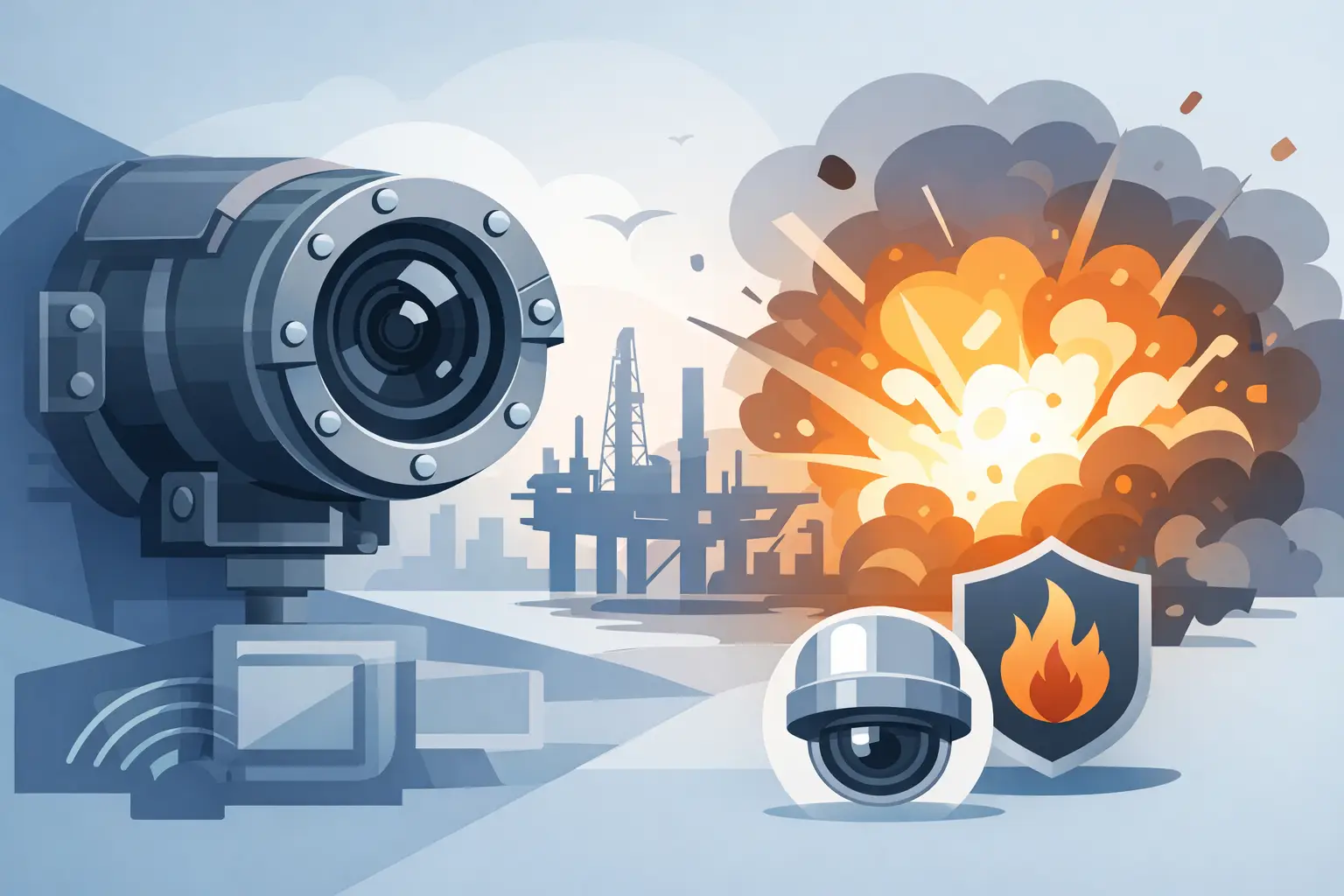
A camera failure near a vapor release, a loading rack, or a chemical processing line is more than a maintenance issue. It can introduce an ignition source into an area where a single spark has serious consequences. So, what is an explosion proof camera? It is a surveillance camera built and certified for hazardous locations where flammable gases, vapors, dusts, or fibers may be present.
For refinery operators, offshore asset managers, ship engineers, and industrial procurement teams, the term is often used too broadly. An explosion proof camera is not simply a camera in a heavy metal enclosure. Its housing, cable entries, electrical components, operating temperature, and certification must work together to prevent the equipment from igniting the surrounding atmosphere.
What Is an Explosion Proof Camera Designed to Do?
An explosion proof camera is designed to contain any internal ignition and prevent flames, hot gases, sparks, or excessively hot surfaces from reaching a hazardous atmosphere outside the enclosure. In many applications, the camera is installed in locations where hydrocarbons, solvent vapors, combustible dust, or other ignitable materials may be released during normal operations or abnormal events.
The camera itself still performs familiar surveillance tasks: live monitoring, video recording, playback, remote viewing, and integration with a network video recorder or control room platform. The difference is the engineered protection around those functions. A properly selected unit allows operators to monitor critical process areas without placing standard electronic equipment where it does not belong.
This distinction matters commercially as well as operationally. Selecting a standard outdoor-rated unit for a classified location can create compliance exposure, delay commissioning, increase replacement costs, and leave the facility vulnerable after an inspection. Selecting a certified model with a rating beyond the actual hazard can also waste capital. The best specification matches the verified area classification, operating environment, and surveillance objective.
Explosion Proof Is Not the Same as Weatherproof
Weather resistance and hazardous-area protection solve different problems. A camera with a high IP rating may resist water, dust, salt spray, and washdown conditions, but that rating alone does not establish that it is safe around flammable gas or combustible dust.
Likewise, a certified explosion proof enclosure may be suitable for a classified process zone but still require additional consideration for corrosion, vibration, solar loading, low temperatures, or marine exposure. Offshore and coastal installations frequently need marine-grade materials, corrosion-resistant fasteners, protected cable glands, and durable coatings in addition to hazardous-location certification.
Buyers should avoid assuming that one label covers every risk. For example, a stainless-steel PTZ camera may be an excellent choice for a corrosive offshore deck, but its suitability still depends on the gas group, temperature class, and approval required for that exact installation area.
How Explosion Proof Camera Protection Works
In a traditional explosion proof design, the enclosure is constructed to withstand an internal ignition event. If flammable gas enters the housing and ignites, the enclosure contains the pressure. Carefully engineered flame paths cool escaping gases so they cannot ignite the atmosphere outside the unit.
Other protection concepts may be used depending on the equipment design and certification method. These can include increased safety, intrinsic safety, pressurization, encapsulation, or restricted-breathing methods. Procurement teams do not need to engineer these protection methods themselves, but they do need to confirm that the supplier documentation matches the approved method required by the site.
Temperature control is equally important. Electrical equipment can become an ignition source without producing a visible spark if its surface temperature exceeds the ignition temperature of the gas or dust present. This is why temperature classes appear in certification documents. A camera approved for one temperature class may not be acceptable where a lower maximum surface temperature is required.
Hazardous-Area Ratings Buyers Need to Check
The right camera begins with the area classification issued by the facility, engineering consultant, or governing authority. In the United States, facilities commonly use the Class and Division system under the National Electrical Code. Many global projects also use Zone classifications and IECEx or ATEX approvals.
Class I locations involve flammable gases or vapors, which is common in oil and gas, petrochemical, fuel handling, and solvent processing environments. Class II locations concern combustible dust, while Class III addresses ignitable fibers and flyings. Divisions identify how likely a hazardous material is to be present, while Zone systems provide a more detailed classification based on frequency and duration.
A specification should also account for gas or dust group and temperature class. These details are not paperwork to be handled after the purchase order. They define whether the equipment is suitable for the actual material hazard. A camera approved for a particular gas group may not be suitable for another group with more demanding ignition characteristics.
For international fleets, offshore projects, or multinational operators, approval requirements may differ by flag state, country, insurer, client standard, or project owner. UL, CSA, ATEX, and IECEx markings are not interchangeable by assumption. Confirm the accepted certification before equipment is selected, shipped, or installed.
Selecting the Right Explosion Proof Camera System
Once the hazardous-area requirement is clear, the surveillance requirement comes next. Fixed cameras are well suited to entrances, valves, manifolds, loading points, and other defined fields of view. PTZ cameras provide wider coverage and allow operators to inspect remote equipment, vessel approaches, tank farms, or perimeter activity from a control room.
Image quality should be specified for the decision being made, not simply by the highest resolution available. Identifying a person at an access point, observing a pressure gauge, reviewing an incident, and monitoring a flare area each require different lens selection, illumination, frame rate, and placement. In low-light or no-light environments, infrared capability or thermal imaging may be the stronger option.
Network design deserves equal attention. High-resolution streams, PTZ control, recording retention, and remote access place demands on switches, fiber runs, wireless backhaul, PoE budgets, and storage. In remote marine and offshore sites, the camera system must also tolerate intermittent communications without losing critical evidence. Local recording, health monitoring, and disciplined network segmentation can protect continuity when a link is unstable.
There are trade-offs. A powerful optical zoom helps monitor distant assets but may narrow the field of view. Thermal imaging can reveal heat anomalies and support perimeter monitoring in darkness, yet it does not replace visible-light footage when operators need fine visual detail. A fully integrated explosion proof PTZ can reduce installation complexity, while a separate certified enclosure and camera assembly may offer more component flexibility. The correct choice depends on the site, maintenance strategy, and approved design basis.
What to Include in Your Purchase Specification
A clear purchase specification prevents costly assumptions between operations, engineering, integrators, and suppliers. Before comparing models, document these requirements:
- Hazardous-area classification, including Class/Division or Zone, gas or dust group, and temperature class.
- Required certifications for the project location, customer standard, and authority having jurisdiction.
- Camera format, coverage objective, image resolution, lens range, low-light performance, and any thermal capability.
- Environmental exposure, including salt spray, humidity, washdown, vibration, ambient temperature, and wind loading.
- Network interface, power method, cable entry requirements, recording retention, cybersecurity controls, and system integration needs.
Also request complete certification documentation, installation instructions, dimensional drawings, power consumption data, and environmental limits before final approval. The lowest equipment price is rarely the lowest installed cost if the camera requires unplanned adapters, incompatible glands, additional power infrastructure, or replacement after a failed compliance review.
Installation and Maintenance Affect Compliance
Even top-of-the-line certified equipment can lose its protection if it is installed incorrectly. Approved cable glands, correct conduit methods, sealed entries, grounding, and torque requirements are part of the hazardous-area system. Substituting an unapproved fitting or opening an enclosure in the wrong conditions can compromise certification and create a serious site risk.
Maintenance teams should inspect housings for corrosion, damaged seals, loose hardware, moisture ingress, and lens contamination. PTZ functions, heater operation, video streams, recording status, and remote control should be tested under the facility’s maintenance schedule. On offshore platforms and exposed marine assets, cleaning and inspection intervals may need to be more frequent because salt deposits and weather can quickly affect visibility and mechanical performance.
Revlight Security supports industrial buyers who need surveillance infrastructure aligned with demanding operating conditions, from hazardous process monitoring to marine and offshore network environments. The strongest result comes from defining the hazard first, then selecting the certified camera, connectivity, and recording system that gives your operators a clear view when it matters most.
🛡️ Secure Your Home or Business Today
Protect your home, office, shop, or business with reliable CCTV security cameras. Explore our range of CCTV cameras and find the right security solution for your needs.
Explore CCTV Cameras ✉️ Email Us

 Singapore :
+65-6708-9302
Singapore :
+65-6708-9302