
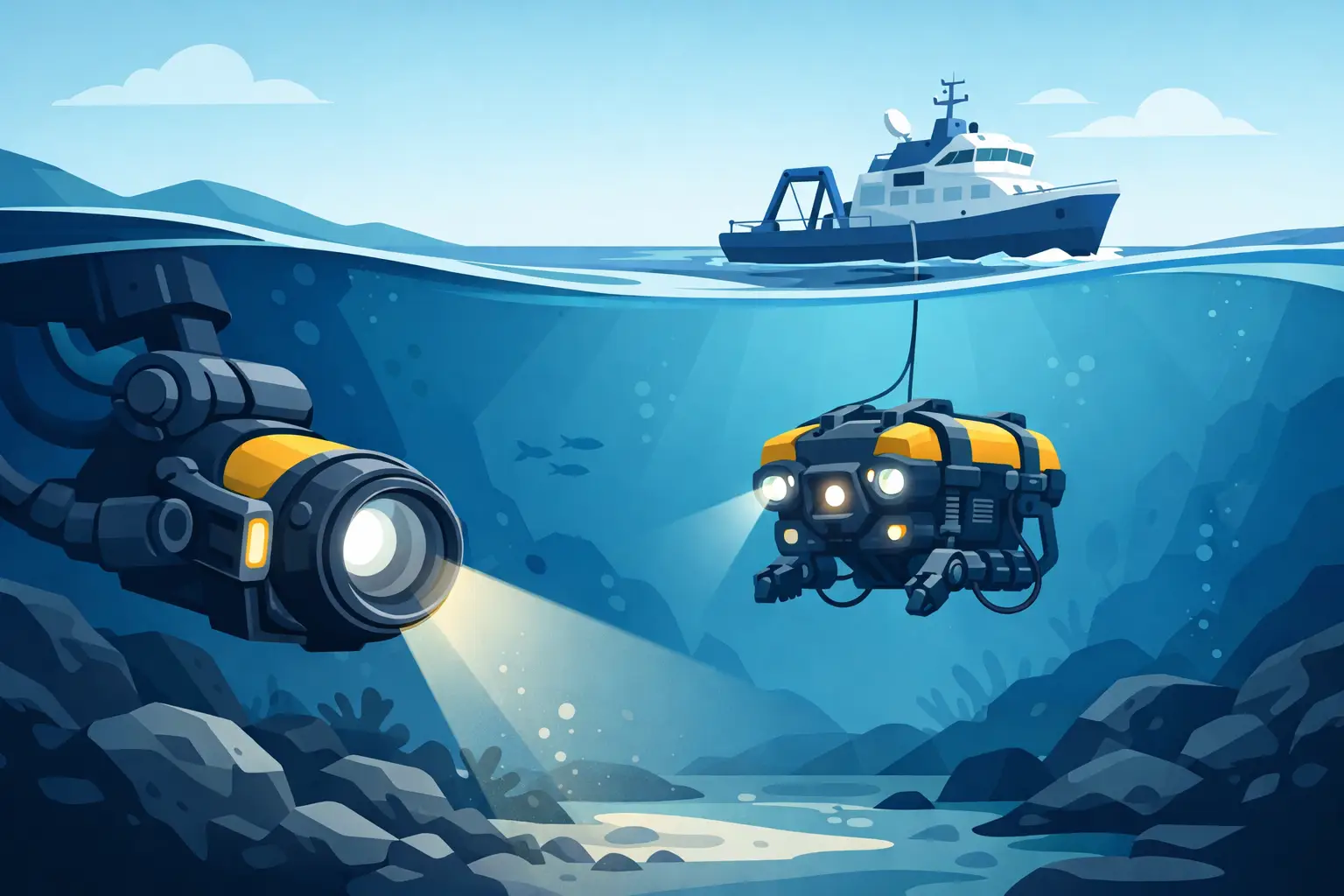
A subsea fault does not wait for a convenient weather window, vessel schedule, or maintenance budget. Deepsea inspection camera systems give offshore operators, marine engineers, and asset managers the visual evidence needed to assess conditions below the surface without sending personnel into unnecessary risk.
For oil and gas, power generation, shipping, and industrial marine operations, the value is not simply seeing underwater. It is gaining usable, recordable evidence that supports a repair decision, verifies contractor work, protects an asset, and creates an audit trail when the condition of a critical structure is questioned later.
What Deepsea Inspection Camera Systems Must Deliver
A serious subsea camera installation is an engineered surveillance component, not an accessory added after the fact. Water depth, pressure, turbidity, ambient light, cable routing, vessel motion, corrosive exposure, and network availability all affect whether footage will be useful when it matters.
The first requirement is image quality under real operating conditions. A camera may produce impressive footage in clean, shallow water and still fail to identify marine growth, coating loss, mooring damage, cracks, or foreign objects in low-light conditions. The right system balances sensor performance, lighting output, lens selection, and image processing for the actual visibility expected at the site.
Pressure rating is equally decisive. Camera housings, seals, connectors, and cable assemblies must be specified for the maximum operating depth, with a suitable margin for the deployment profile. Selecting equipment rated only for nominal depth can create avoidable failure exposure during installation, tidal variation, or a deeper-than-planned inspection route.
Reliable video transport completes the system. Live monitoring is valuable for directing an inspection in real time, while onboard or shore-based recording preserves evidence for maintenance planning, regulatory review, and dispute resolution. Where bandwidth is limited, operators should decide whether their priority is live low-latency viewing, high-resolution recorded footage, or both.
Fixed, Deployable, and Vehicle-Mounted Configurations
The right format depends on how often the asset needs to be viewed and what the inspection must prove. A fixed subsea camera can provide repeatable observation of a defined location, such as an intake, riser area, hull section, dock face, or underwater access point. It is a strong choice where continuous awareness or scheduled checks are required.
Deployable camera systems are better suited to targeted surveys, maintenance campaigns, and locations that change from job to job. They can be configured with armored cable, surface controls, integrated lighting, and recording equipment for practical inspection work from a vessel, platform, or shoreline position. Their advantage is flexibility, but deployment discipline matters. Cable management, stabilization, and lighting angle can determine whether the inspection produces decisive footage or inconclusive video.
Vehicle-mounted systems extend coverage around complex structures and into areas that are difficult to reach from a fixed point. They are often selected for hull surveys, subsea infrastructure, intake channels, and broader underwater searches. The trade-off is greater system complexity. Operators need clear control of position, lighting, recording, and communications to make the additional mobility commercially worthwhile.
The Specifications That Affect Inspection Results
Procurement teams should look beyond a headline resolution figure. Resolution matters, but it cannot compensate for poor illumination, a lens unsuited to the target distance, or video compression that removes the detail needed for engineering review.
Low-light sensitivity is a primary consideration because underwater light falls away quickly. Integrated LEDs or external lighting should be evaluated for output, beam angle, color temperature, heat management, and the likelihood of backscatter in suspended particles. Too much light at the wrong angle can reduce visibility by reflecting off debris in the water column.
The field of view also requires a practical decision. A wide lens gives valuable situational awareness around a structure but can make small defects difficult to assess. A narrower view improves detail at a specific target but requires more precise positioning. Many inspection programs benefit from combining a general overview camera with a focused view for close condition checks.
Cable and connector selection deserves the same scrutiny as the camera body. Marine-grade components must tolerate pressure, saltwater exposure, repeated handling, and the mechanical loading created during deployment. A high-performance camera connected through a weak cable assembly is still a weak system.
For networked installations, confirm compatibility with existing recording platforms, displays, control rooms, and remote-access requirements. Open integration can reduce future expansion costs, while a fully self-contained package may be the faster solution for a dedicated inspection station. There is no universal winner. The correct choice follows the site architecture, cyber controls, and operating model.
Turning Underwater Video Into a Maintenance Advantage
The commercial case for subsea video is strongest when it shortens the path from uncertainty to action. A clear recorded inspection can help an operations team decide whether to mobilize divers, schedule cleaning, isolate equipment, approve a repair, or defer work safely. That prevents expensive responses based on assumption alone.
Repeated visual checks can also reveal change over time. Comparing footage from the same angle and distance makes it easier to track corrosion, sediment buildup, biofouling, coating deterioration, structural movement, and intrusion risk. This is particularly useful for facilities managing aging infrastructure or assets where access is costly.
Recording and playback are not optional extras in this environment. Time-stamped video provides a defensible reference for maintenance records and contractor verification. It also gives engineering teams the ability to review findings after the operation, rather than relying only on verbal observations from the inspection crew.
Remote visibility can improve decision speed, especially when technical stakeholders are located away from the asset. However, remote access should be designed around security and available communications. A high-resolution live stream may not be practical over every offshore connection. A sensible system can prioritize local recording while sending lower-bandwidth live video to decision-makers, then transfer full footage for detailed review.
Planning the Installation Before Equipment Is Ordered
The fastest way to overspend on an inspection system is to select hardware before defining the inspection objective. Begin with the question the camera must answer. Is the requirement to confirm that an intake is clear, inspect a weld, monitor a berth, verify hull condition, investigate a suspected leak path, or document work completion? Each task changes the required depth rating, lens, lighting, deployment method, and recording strategy.
Site conditions should be documented before specification. Include maximum depth, water clarity, current, temperature range, salinity, target size, required working distance, available power, cable route, mounting points, and the distance to the monitoring location. For fixed systems, access for cleaning and maintenance must be considered from the start. A camera installed where fouling cannot be addressed will gradually lose its value.
Integration should be discussed early with operations and IT teams. Video retention periods, user permissions, network segmentation, export formats, and alarm or event requirements can influence the equipment selection. Industrial operators should not accept a camera system that creates a new data-management problem for the site.
Revlight Security supports buyers who need performance-led surveillance equipment matched to demanding marine and industrial environments. The objective is straightforward: specify a system that delivers dependable footage, practical control, and evidence that helps protect high-value assets.
A Better Standard for Subsea Visibility
Deepsea inspection camera systems earn their place when they reduce uncertainty at the point of decision. The best installation is not necessarily the one with the longest specification sheet. It is the one that gives your team clear video at the required depth, in the expected water conditions, with recording and access arrangements that fit the way your operation actually works.
Specify for the inspection task, not the catalog image. When subsea visibility becomes reliable evidence rather than an occasional guess, maintenance planning becomes more controlled, response costs become easier to justify, and critical assets stay under closer watch.
🛡️ Secure Your Home or Business Today
Protect your home, office, shop, or business with reliable CCTV security cameras. Explore our range of CCTV cameras and find the right security solution for your needs.
Explore CCTV Cameras ✉️ Email Us

 Singapore :
+65-6708-9302
Singapore :
+65-6708-9302