
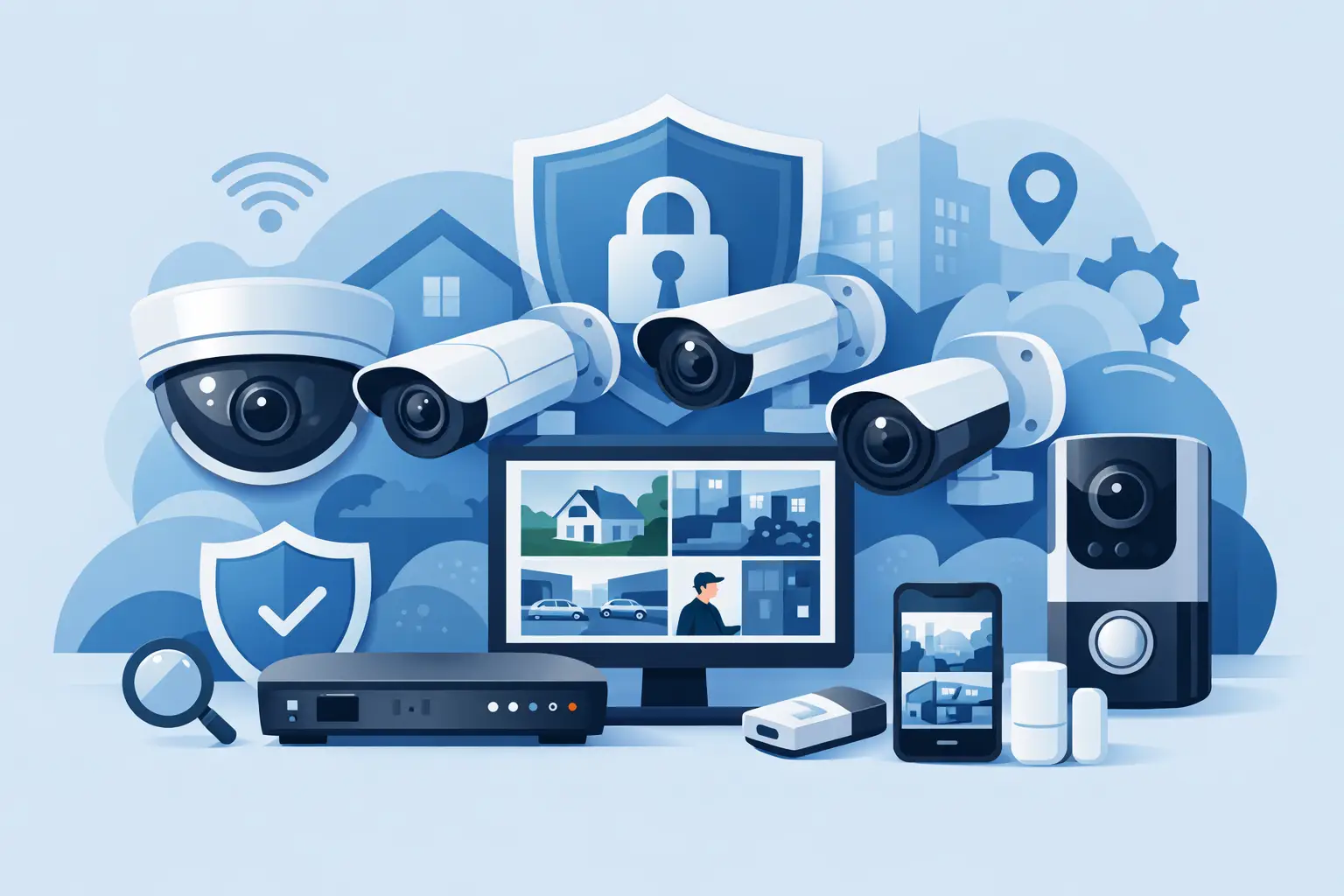
A 16 camera security system is where many industrial buyers stop treating surveillance as a basic add-on and start building real site visibility. At this level, you can cover perimeter gates, loading zones, process areas, control rooms, vessel access points, and critical blind spots without forcing one recorder to do work it was never meant to handle. For refineries, marine operators, energy facilities, and large commercial properties, 16 channels is often the practical threshold between partial coverage and dependable oversight.
That matters because undercoverage is expensive. Missed incidents, unclear footage, weak night performance, and overloaded storage all create risk that shows up later as loss, downtime, disputes, or compliance pressure. A properly specified system gives operators a better record of events, faster review, and stronger remote oversight across a larger footprint.
When a 16 camera security system makes sense
A smaller site with one entry, one yard, and one building may do fine with eight channels. But once operations spread across multiple structures, access roads, dockside areas, tank zones, or machinery corridors, camera counts rise quickly. Sixteen channels gives procurement teams room to cover the obvious areas and still protect secondary points that often get ignored until something goes wrong.
This is also the size where expansion planning becomes more serious. Some buyers choose 16 channels because they already need all sixteen. Others choose it because they need twelve today and do not want to replace the recorder in six months. That is usually the smarter buying decision, especially in industrial environments where installation labor, cable routes, permits, and network configuration cost more than the extra channel capacity.
For marine and offshore applications, the logic is similar. Bridge approaches, deck activity, engine access, cargo zones, stern coverage, and entry points can consume channels quickly. A 16-channel layout allows cleaner segmentation of key operating areas while preserving playback and monitoring quality.
What separates a serious system from a low-grade package
Not every 16-camera package is built for professional use. Many are designed around headline pricing, not long-term performance. For industrial buyers, the recorder, storage design, network stability, and environmental durability matter more than a simple camera count.
The recorder is the heart of the system. A true 16-channel NVR or DVR must be able to manage continuous recording, remote access, playback, and alert handling without lagging under normal use. If multiple operators need to review footage while recording continues, weak hardware becomes obvious very quickly. Better systems use stronger processing, cleaner interfaces, and storage options that support retention targets without constant manual intervention.
Camera construction matters just as much. In an office setting, a standard housing may be enough. In ports, refineries, power plants, and marine environments, buyers should expect more. Weather resistance, corrosion resistance, vibration tolerance, low-light performance, and stable image quality under difficult conditions are not premium extras. They are baseline requirements.
There is also the issue of image usefulness. A camera that technically records but cannot identify faces, plate numbers, PPE compliance, or incident details is not saving money. Resolution should match the scene. Wide yard coverage, gate identification, process monitoring, and confined access points often need different lens choices and placement strategies. One size rarely fits an entire 16-camera deployment.
Designing coverage for industrial operations
The best 16 camera security system is not the one with the longest feature list. It is the one designed around how your site actually operates.
A warehouse distribution yard may prioritize fence lines, truck movement, dock doors, pedestrian access, and after-hours intrusion. A refinery may need overlapping coverage around hazardous process areas, control access zones, flare support areas, and utility corridors. A vessel may focus on gangways, bridge-adjacent views, cargo handling zones, and machinery access. The system should reflect operational risk, not generic layout habits.
That is why camera placement should begin with consequences. Where would an incident create the highest cost, stoppage, or liability exposure? Where do people, vehicles, or contractors move in ways that require verification later? Which areas need live viewing, and which simply need reliable recording for review? Answer those questions first, and the channel plan becomes much easier to justify.
This is also where remote viewing strategy matters. Many operation directors want central visibility across several facilities or vessels. A 16-channel system can support that well, but only if the local network, bandwidth, user permissions, and recorder performance are specified properly. Remote access is valuable, but poorly planned remote access can overload a system or create security gaps.
Storage, playback, and retention are where budgets rise or fail
Buyers often focus heavily on camera pricing and underestimate storage. Yet storage is where many systems either support the operation or become a daily frustration.
A 16-camera system recording continuously at higher resolutions will consume far more space than a light commercial setup using motion-only recording. If your policy requires 30, 60, or 90 days of retention, the storage plan must match that requirement from day one. Compression settings, frame rates, activity levels, and resolution all change the math. So does whether cameras record continuously, on schedule, or by event.
Playback performance also deserves attention. During an investigation, teams may need to review several camera views at once and export usable footage quickly. That process should be fast and straightforward. If retrieval is slow, if timestamps are inconsistent, or if exports are difficult to manage, the system creates delay when time matters most.
For high-value sites, storage resilience should be part of the discussion. Redundancy, drive health monitoring, and stable power protection reduce the chance that a system fails precisely when evidence is needed. These are practical buying points, not technical luxuries.
Choosing between PoE IP and other system formats
For many industrial buyers, IP-based PoE architecture is the stronger long-term fit. It simplifies camera power and data delivery, supports cleaner scaling, and usually gives more flexibility for image quality and remote management. With a 16-camera layout, that efficiency becomes noticeable.
That said, it depends on the site. Existing coax infrastructure may make a hybrid or recorder-based upgrade more cost-effective in some facilities. On older sites, reusing cable routes can reduce installation time and avoid disruption. The correct answer is not always the newest format. It is the format that gives dependable performance with acceptable installation cost and future serviceability.
For marine and corrosive industrial environments, network hardware quality is especially important. Switches, enclosures, connectors, and cable protection all affect uptime. A high-spec camera connected through weak supporting hardware still becomes a weak system.
What buyers should ask before approving a 16-camera package
Procurement teams should push beyond surface-level specifications. Ask what the actual recorder throughput is, not just the channel count. Ask how many days of retention the quoted storage supports under the proposed settings. Ask whether the cameras are appropriate for salt exposure, explosive-risk adjacency, heat, washdown, or vibration if those conditions apply.
It is also worth asking how the system will be used every day. Will local staff monitor live views? Will management rely mostly on remote playback? Will the installation need analytics, alarms, or integration with access control later? Those answers shape the right recorder, display setup, and network design.
Service support is another commercial issue that should not be overlooked. If a site loses a recorder or a critical camera, response time matters. The lowest-priced package can become the highest-cost mistake if spare parts, replacement lead times, or technical support are poor. Serious surveillance infrastructure should be sold and supported like operational equipment, not casual electronics.
Why industrial buyers often outgrow cheap 16-channel systems
The attraction of low entry pricing is obvious, but many low-cost systems reveal their limits quickly. Night images wash out. Weather seals fail. Remote apps become unreliable. Storage fills faster than expected. Playback is clumsy. Expansion options are limited. The system appears acceptable on a specification sheet and disappointing in service.
For industrial and marine operations, that trade-off rarely holds up. A stronger 16 camera security system costs more upfront, but it usually saves more through better uptime, longer service life, clearer incident evidence, and fewer replacement cycles. That is the commercial argument experienced buyers understand well.
Revlight Security works in categories where performance is not theoretical. Surveillance on offshore, marine, energy, and industrial sites has to function under pressure, under weather, and under operational scrutiny. That is exactly why specification quality matters more than package marketing.
If you are buying a 16-channel system, buy it as infrastructure. Build for the environment, the retention target, the network load, and the operational risk profile you actually have. The right system will not just add cameras – it will give your team better control over what happens on site when the stakes are high.
The smartest purchase is usually the one that still looks like a good decision two years after installation, when the footage is clear, the recorder is stable, and the system is doing its job without excuses.
🛡️ Secure Your Home or Business Today
Protect your home, office, shop, or business with reliable CCTV security cameras. Explore our range of CCTV cameras and find the right security solution for your needs.
Explore CCTV Cameras ✉️ Email Us



 Singapore :
+65-6708-9302
Singapore :
+65-6708-9302