
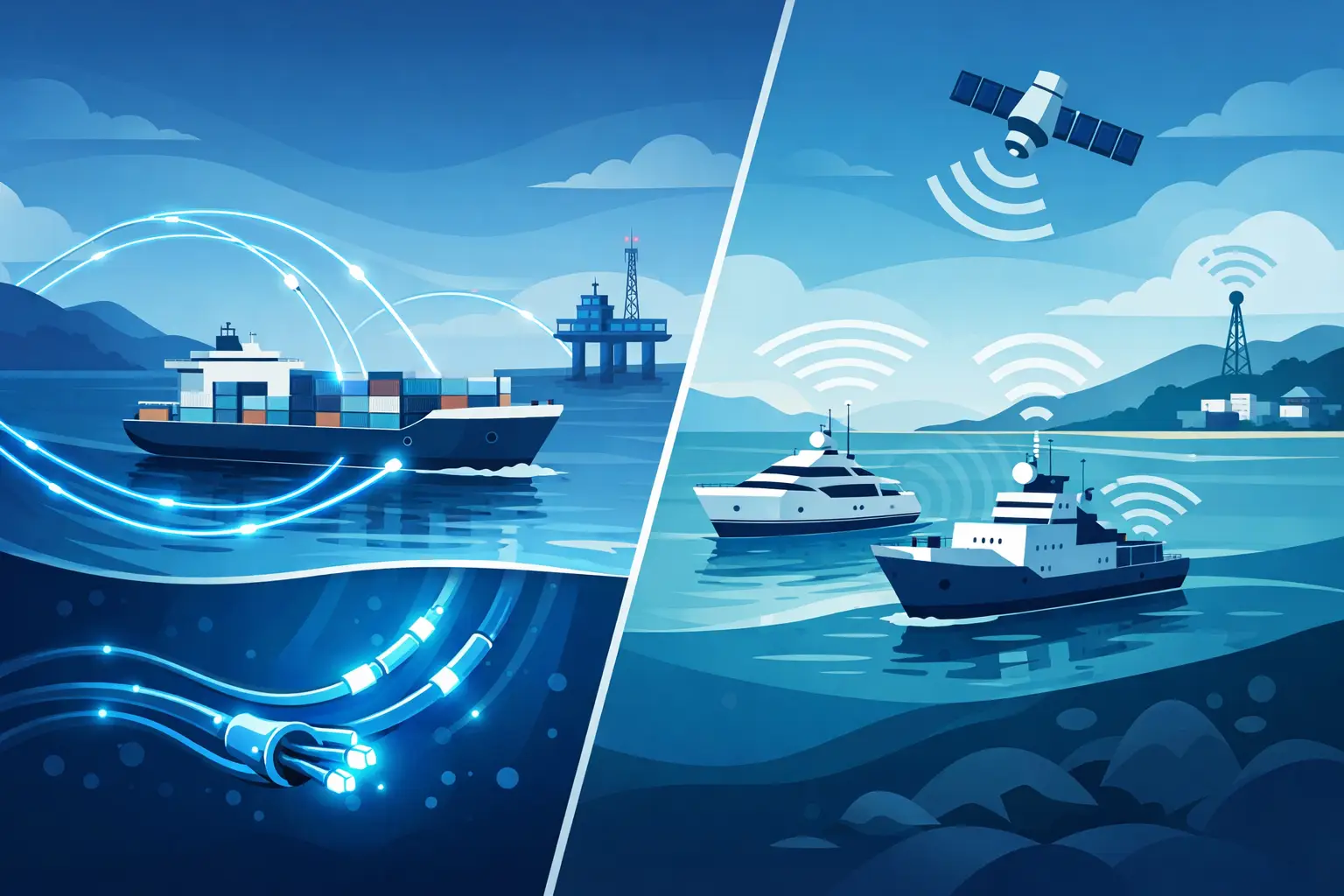
A dropped video feed at the engine room, delayed alarm footage on the bridge, or a dead zone at the stern is not a minor IT issue. It is an operational exposure. The decision between fiber vs wireless vessel networks determines how reliably surveillance, access control, crew communications, maintenance systems, and remote support perform when the vessel is moving, vibrating, and operating far from shore.
For most commercial vessels, the strongest answer is not a simple fiber-or-wireless choice. Fiber provides the high-capacity backbone. Marine wireless fills the places where running cable is impractical, expensive, or operationally disruptive. The right design starts with critical traffic, vessel layout, and the real consequences of network downtime.
Fiber vs Wireless Vessel Networks: The Core Difference
Fiber optic cabling transmits data as light through glass or plastic strands. It is built for high bandwidth, long cable runs, and resistance to electromagnetic interference. On a vessel, that makes fiber particularly valuable between communications rooms, bridge systems, machinery spaces, security recording locations, and major deck zones.
Wireless networks use radio signals to connect devices without a physical data cable to every endpoint. Properly specified marine WiFi can extend connectivity to crew areas, open decks, cargo spaces, gangways, temporary work areas, and locations where routing new cable would require major steelwork or downtime.
The practical distinction is straightforward: fiber offers predictable, dedicated transport capacity; wireless offers speed of deployment and physical flexibility. Procurement teams should evaluate both against the traffic that must work every day, not against a headline speed rating.
Why Fiber Remains the Vessel Backbone
A fiber backbone is the preferred foundation when a vessel carries multiple IP cameras, high-resolution video recording, thermal surveillance, radar integrations, access control systems, voice communications, and operational data on one network. Video is especially demanding. A single camera may be manageable over a marginal connection, but dozens of cameras recording continuously can quickly expose weak links, poor switching capacity, or oversubscribed wireless access points.
Fiber supports high throughput with low latency and does not pick up electrical noise from generators, motors, variable-frequency drives, radar equipment, or heavy industrial machinery. That matters in engine rooms, pump rooms, offshore support vessels, tankers, and vessels with dense electrical infrastructure.
It also gives engineers clearer fault isolation. A professionally designed fiber system can be segmented through managed switches, VLANs, redundant paths, and dedicated ports for security equipment. If crew internet usage rises during a port call, it should not reduce the bandwidth available to camera recording or alarm transmission.
Fiber is not maintenance-free. Connectors require clean installation, terminations must be protected, and cable routes need appropriate marine-rated armor and environmental sealing. Damage can be more specialized to repair than copper cable damage. However, where network availability is critical, these installation requirements are part of a sound long-term investment, not a reason to avoid fiber.
Best applications for fiber on board
Fiber is the best fit for fixed, high-priority connections such as bridge-to-server-room links, network video recorder locations, machinery control spaces, long runs between vessel sections, and camera aggregation points. It is also the right choice when the vessel needs a clear upgrade path for additional cameras, higher-resolution streams, or future detection equipment.
For a new build or major refit, installing spare fiber capacity is commercially sensible. Pulling additional strands during construction costs far less than reopening cable routes after the vessel enters service.
Where Wireless Delivers More Value
Wireless has a different job. It is often the fastest way to connect areas that change, move, or are difficult to cable. A properly designed marine WiFi system can support mobile engineering tablets, crew access, temporary inspection equipment, dockside connectivity, and selected cameras where a permanent cable route is not justified.
On workboats, offshore vessels, and ships undergoing phased upgrades, wireless can reduce installation time substantially. There is no need to route every connection through bulkheads, cable trays, and watertight penetrations. That means less disruption to operations and fewer labor hours during a tight maintenance window.
Wireless is also useful as a secondary communications path. If a primary cable route is damaged, a wireless bridge between strategic vessel areas can maintain access to selected systems while repairs are completed. It should not be treated as a substitute for a redundant critical backbone unless the equipment, spectrum plan, and coverage survey support that requirement.
The limitation is shared airtime. Every wireless client competes for radio capacity, and physical obstructions can affect performance. Steel bulkheads, machinery, tanks, weather, antenna placement, and vessel movement all influence coverage. A WiFi access point that performs well in an open warehouse may fail to deliver acceptable service through several steel compartments.
Wireless needs engineering, not guesswork
Marine wireless networks should be designed around a site survey, expected client density, application type, and antenna placement. Access points need appropriate ingress protection, corrosion resistance, and mounting methods for the environment. Outdoor deck equipment may require weatherproof housings, directional antennas, and carefully planned cable protection.
Security configuration also matters. Separate operational systems, surveillance devices, crew networks, and guest access through network segmentation. Apply strong authentication, controlled administrative access, and monitoring. An open or poorly managed vessel WiFi network can become an entry point into systems that should remain isolated.
Performance, Cost, and Risk Compared
Fiber has a higher initial installation burden. Cable routing, termination, protective hardware, and labor can increase the upfront budget, particularly on existing vessels. Yet its lifecycle value is strong when it supports fixed surveillance and business-critical systems for years without recurring coverage problems or capacity constraints.
Wireless usually costs less to expand into a new area, but the lowest initial quote is not always the lowest operating cost. Poorly placed access points lead to repeat visits, added equipment, user complaints, and unreliable camera connections. A low-quality radio design can create more expensive troubleshooting than a correctly installed cable run.
Reliability requirements should decide the architecture. If a link carries continuous recording from cameras protecting restricted areas, machinery spaces, cargo operations, or perimeter access, it deserves fiber wherever feasible. If the connection serves mobile users, a temporary project zone, or a non-critical area with difficult cable access, wireless is often the better commercial choice.
Bandwidth planning should be based on actual demand. Consider camera resolution, frame rate, compression, retention periods, simultaneous remote viewing, software updates, crew use, and expected system expansion. It is common for vessel networks to be designed for current camera counts and then become constrained after additional surveillance coverage is added.
The Strongest Design Is Usually Hybrid
The most effective vessel network design uses fiber for the core and wireless for reach. Fiber connects the bridge, communications rack, recording servers, key switches, and high-density camera zones. Managed wireless access points then extend controlled connectivity to crew spaces, exterior decks, workshops, and temporary operational areas.
This hybrid approach protects the systems that cannot tolerate interruption while giving operators the flexibility to expand coverage without major construction work. It also makes network management more disciplined. Critical devices remain on dedicated wired paths, while mobile and lower-priority traffic is contained on separate wireless segments.
For surveillance projects, specify the network and cameras together. Camera performance is only as dependable as the transport path, power design, recording capacity, and remote viewing configuration behind it. Revlight Security approaches these systems as security infrastructure, not as a collection of standalone devices.
Before approving a vessel network upgrade, require a clear cable route plan, wireless coverage design, device count, bandwidth calculation, segmentation strategy, and failure-recovery plan. The best network is the one that still delivers the right footage and communications when the vessel is under pressure, not merely when it is tied up at the dock.
🛡️ Secure Your Home or Business Today
Protect your home, office, shop, or business with reliable CCTV security cameras. Explore our range of CCTV cameras and find the right security solution for your needs.
Explore CCTV Cameras ✉️ Email Us



 Singapore :
+65-6708-9302
Singapore :
+65-6708-9302