
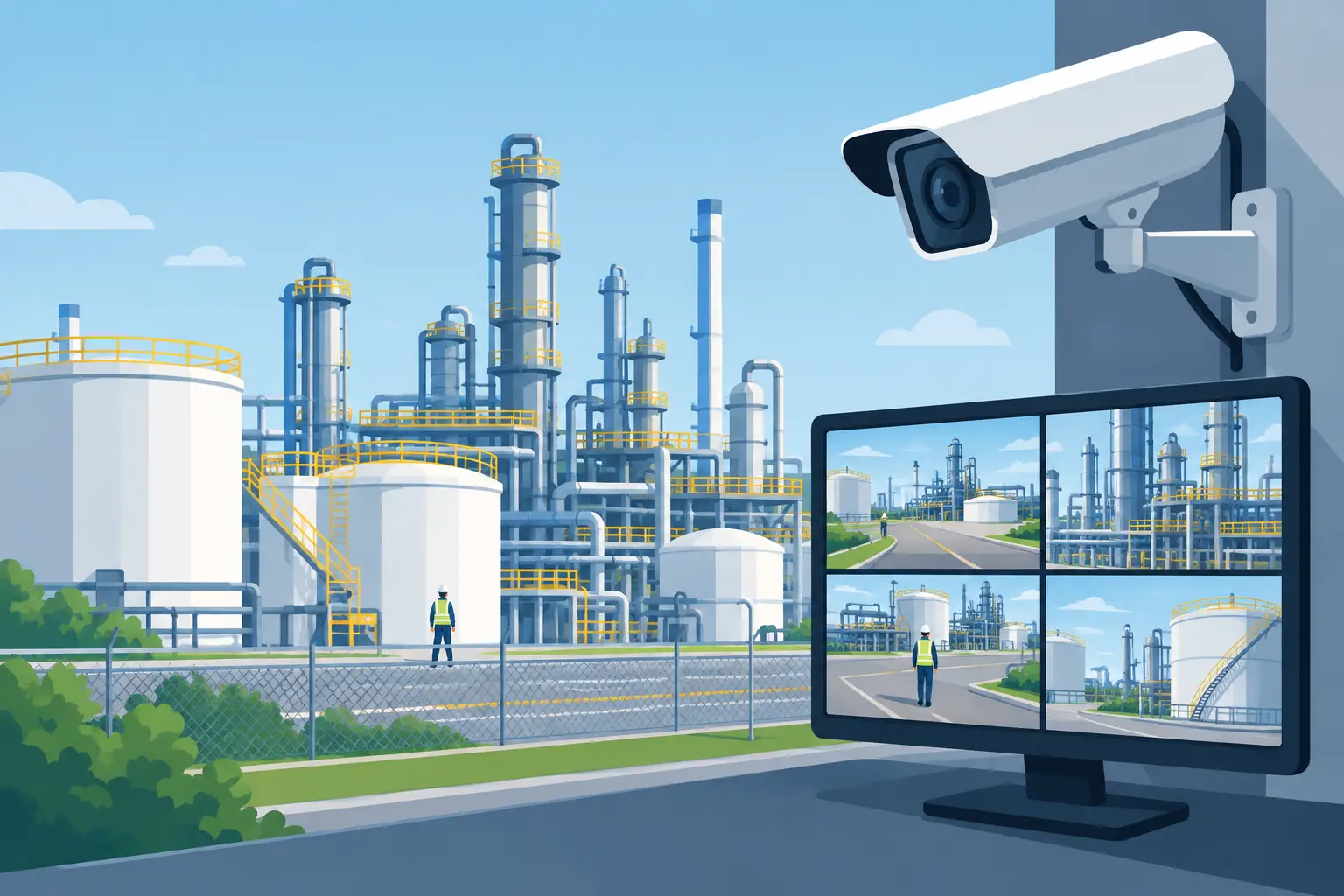
A chemical plant CCTV guide should begin where many standard security proposals fail: at the process risk, not at the camera count. A camera that produces clear images at a front gate may be completely unsuitable near a solvent transfer point, reactor area, tank farm, or classified loading zone. For plant operators, CCTV is a working layer of operational visibility. It must support safer decisions, faster incident review, controlled access, and dependable oversight when conditions become difficult.
The right system is not simply the one with the highest resolution. It is the one that remains available in heat, vapor, dust, corrosion, vibration, poor light, and potentially hazardous atmospheres while delivering usable evidence and live views to the people who need them.
Start With the Risk, Process, and Operating Environment
Before specifying a camera, map the locations where visibility has the greatest operational value. This usually includes perimeter entry points, truck scales, loading racks, control room approaches, utility areas, chemical storage, pipe corridors, flare systems, pump stations, and critical process equipment. Each area has different surveillance requirements.
A gate camera needs reliable identification of vehicles, drivers, and credentials. A camera overlooking a loading rack must show hose connections, vehicle position, containment conditions, and worker activity. A process-area unit may be selected primarily to help operators verify valve position, observe abnormal emissions, or assess an area before sending personnel closer.
Environmental conditions drive the equipment specification. Chemical facilities commonly expose surveillance hardware to corrosive gases, salt air, washdown, high ambient temperatures, particulate buildup, and constant vibration. Outdoor housings, mounting hardware, cable glands, connectors, and power supplies all need the same level of attention as the camera itself. A high-quality imaging unit can still fail early if its enclosure or installation materials are not suited to the site.
Hazardous-area classification is equally decisive. Where flammable gases, vapors, or combustible dust may be present, plant teams must select equipment certified for the applicable area classification and installation method. Certification requirements depend on jurisdiction, zone or division, gas group, temperature class, and site policy. Do not treat an ordinary weatherproof camera as a substitute for hazardous-area equipment. The lower purchase price quickly becomes irrelevant when compliance, uptime, and personnel safety are at stake.
Chemical Plant CCTV Guide: Select Cameras by Job
A strong design uses different camera types for different tasks rather than forcing one model across the entire site. Fixed cameras are effective for stable views of entrances, corridors, access points, and equipment faces. Pan-tilt-zoom cameras give control rooms the ability to investigate a developing event across wide tank farms, jetties, and open process areas. Thermal cameras can provide a clear view in darkness, smoke, haze, and low-contrast conditions where conventional imaging loses detail.
Optical gas imaging systems deserve separate consideration. These systems are built to visualize specific hydrocarbon or methane gas emissions under appropriate conditions. They are not a replacement for fixed gas detection, alarm systems, or mandated process safety controls. Their value is in supporting inspection, leak investigation, emissions monitoring programs, and visual confirmation by trained teams. Procurement should assess detectable gas types, viewing distance, environmental limitations, operator training, reporting needs, and how footage will be retained.
Resolution matters, but it should be specified against a defined objective. A wide overview of a tank farm may not need the same pixel density as a camera intended to identify a contractor badge or read a vehicle plate. Excessive resolution across every channel increases storage, bandwidth, and network loading without always improving the outcome. The better question is simple: what must an operator be able to see, recognize, or verify from this exact viewpoint?
Low-light performance is another frequent source of disappointment. Infrared illumination can work well in contained areas, but it has limits across long open distances and may be affected by fog, steam, reflective surfaces, or airborne particles. White-light illumination can improve color detail and deter intrusion, yet it may be unsuitable near sensitive operations or where light pollution is a concern. A site survey should test real nighttime conditions rather than relying solely on product specifications.
Design the Network and Recording System for Continuity
CCTV delivers little value if live video freezes during a network event or recordings cannot be found after an incident. Industrial surveillance should be designed as part of the facility network architecture, with clear ownership between operations, security, IT, and engineering teams.
Network segmentation helps isolate video traffic from business and control systems. Managed industrial switches, fiber links, protected field cabinets, and appropriate surge protection can improve reliability across large sites. Fiber is often the preferred choice for long runs, high-interference areas, and locations with electrical isolation concerns. Copper can remain suitable for shorter protected routes, but its distance limits and exposure profile must be understood.
Recorders and video management platforms should be sized for the actual operating requirement, not a generic retention figure. Storage planning depends on camera count, frame rate, resolution, compression settings, scene activity, recording schedule, and retention policy. A 24/7 recording policy delivers the fullest history but requires more capacity. Event-based recording reduces storage demand, although motion detection can be unreliable in steam, rain, moving vegetation, or continuously active process zones.
For high-priority cameras, edge recording can add resilience by storing footage locally during a temporary network interruption. Central recording still remains essential for management, search, user permissions, audit trails, and long-term evidence handling. The best approach often combines both, especially on large or remote facilities.
Remote access must be controlled, not merely convenient. Operations directors and authorized managers may need secure live views from a control center or off-site location, but open internet exposure creates unnecessary risk. Use role-based permissions, multi-factor authentication, encrypted access, logging, and a clear process for removing credentials when staff or contractors leave. Remote viewing should strengthen accountability without creating a weak point in the security architecture.
Place Cameras for Evidence, Not Just Coverage
A site can have full apparent coverage and still miss the moment that matters. Poor camera placement often results from viewing a layout drawing without walking the process area. Field verification exposes obstructions, glare, vapor plumes, maintenance access limits, vehicle movement patterns, and changing sightlines that plans do not show.
Mount cameras where they can answer an operational question. At a loading bay, that may mean one overview camera and a second view focused on the connection point. At a perimeter, it may mean one camera for approach detection and another for identification at the controlled entry point. Around critical equipment, avoid placing every unit too high. An elevated overview is useful, but a lower protected angle may be needed to show gauges, access panels, or work activity.
Camera views should not introduce unsafe maintenance practices. Specify mounting arrangements that allow inspection and cleaning without exposing technicians to unnecessary height, traffic, or process hazards. In corrosive or dirty areas, a maintenance plan is part of the CCTV design. Lens windows, housings, wipers, heaters, and protective shields must be selected with real service intervals in mind.
Use Video as an Operational Tool
The highest-performing chemical plant CCTV systems are used daily, not only after a security incident. Control room teams can verify conditions before dispatching personnel. Supervisors can review traffic flow at loading areas. Safety teams can investigate near misses with more context. Maintenance leaders can confirm access conditions and equipment status before entering an area.
This does not mean video should replace field checks, permit controls, gas testing, or established safety procedures. It gives teams another dependable source of information. Procedures should define who watches key views, when operators escalate an observation, how footage is retained after an event, and who can export recordings. Without these rules, even top-of-the-line equipment becomes passive infrastructure.
Commissioning is the point where the system proves its value. Test every view in daytime and nighttime conditions. Verify PTZ presets, recording retrieval, alarm integrations, user permissions, network recovery, and image quality at the control room display. Document camera names, locations, fields of view, certifications, network addresses, and maintenance requirements. This record will save time every time the plant expands, an incident occurs, or a unit needs replacement.
For procurement teams, the strongest CCTV investment is not the cheapest quote or the longest feature sheet. It is a site-matched system that provides clear visibility when operations are under pressure. Specify for the hazard, validate the image, protect the network, and demand equipment that is built to keep working where ordinary surveillance cannot.
🛡️ Secure Your Home or Business Today
Protect your home, office, shop, or business with reliable CCTV security cameras. Explore our range of CCTV cameras and find the right security solution for your needs.
Explore CCTV Cameras ✉️ Email Us



 Singapore :
+65-6708-9302
Singapore :
+65-6708-9302