
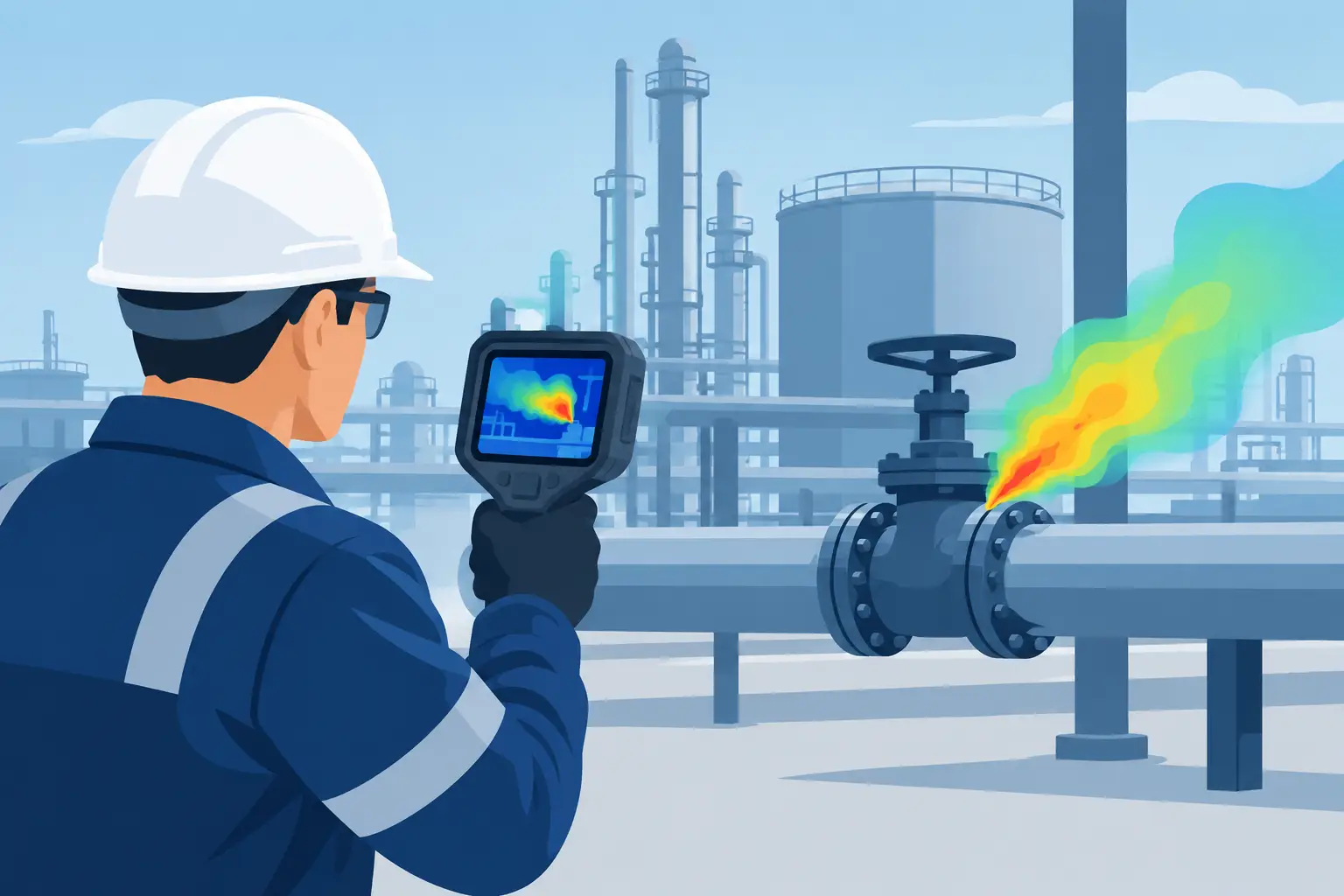
A refinery leak is rarely just a maintenance issue. It can become a production loss, an emissions event, a safety exposure, and a costly source of unplanned downtime. Gas imaging gives operating teams a faster way to see what conventional inspections can miss: the movement of leaking gas against real operating equipment.
For oil and gas facilities, chemical plants, power stations, marine assets, and offshore installations, the value is practical. A properly selected optical gas imaging system helps crews locate suspected leaks, verify repair priorities, document findings, and improve response decisions without shutting down every process line for investigation.
What Gas Imaging Does at an Industrial Site
Gas imaging uses specialized thermal sensing technology to reveal gas plumes that are otherwise invisible to the human eye. Rather than measuring a point in space alone, the system creates a visual image of the plume as it escapes from valves, flanges, compressors, seals, tanks, piping, and other process equipment.
This distinction matters. A conventional gas detector may tell a team that gas is present at a location. Optical gas imaging can help show where the release is originating, how the plume is moving, and whether wind or equipment geometry is affecting the observation. That visual context can shorten the time between identifying a concern and assigning the right corrective action.
The technology is particularly useful for hydrocarbon compounds, methane, and other gases with absorption characteristics within the system’s operating spectral range. Detection performance depends on the target gas, concentration, plume size, background temperature, distance, weather conditions, and the selected sensor configuration. There is no one-size-fits-all specification, which is why procurement decisions should begin with the actual gases and inspection scenarios at the facility.
Why Visual Leak Detection Changes Maintenance Decisions
Maintenance teams are often required to work through large volumes of equipment during scheduled inspections. When every component appears normal to the eye, finding a small gas release can demand significant time and labor. Gas imaging concentrates attention where it is needed.
A visible plume allows an inspector to distinguish a suspected source from surrounding equipment. This is valuable around dense pipe racks, elevated valves, compressor skids, loading areas, tank farms, and offshore process modules where access may be restricted. Instead of treating every audible indication, odor report, or detector alarm as an equally urgent event, the operations team can build a clearer repair queue based on observed conditions.
That does not mean gas imaging replaces all fixed detection, personal monitoring, or process safety systems. Fixed detectors provide continuous coverage in designated risk areas. Personal monitors protect personnel entering hazardous environments. Gas imaging adds another high-value inspection layer by providing visual confirmation and broader area assessment. The strongest programs use these systems together, with clear procedures for escalation and repair verification.
Where Gas Imaging Delivers the Strongest Return
The commercial case is not limited to compliance reporting. Lost product has a direct cost, and small leaks can become larger reliability issues when they remain undetected. Facilities that use optical gas imaging effectively can improve inspection productivity while reducing the uncertainty that slows maintenance decisions.
At refineries and gas processing sites, the highest-value applications commonly include fugitive emissions surveys, compressor seal checks, pressure relief device inspections, valve and flange monitoring, and turnaround verification. In petrochemical operations, the system can support inspection of reactors, transfer systems, storage areas, and process piping where volatile compounds require closer control.
Marine and offshore operators face a different operating environment but the same need for rapid evidence. Salt air, vibration, limited access, changing weather, and confined equipment layouts place greater demands on surveillance hardware. For these installations, a fixed or integrated solution may provide more consistent coverage than an inspection-only deployment, particularly where teams need remote viewing from a control room or shore-based operations center.
Power generation and industrial utilities can also benefit where natural gas supply systems, turbine enclosures, boiler areas, and fuel handling equipment must be monitored. The right installation approach depends on the site risk assessment, process layout, and operating procedures. A system that performs well in a protected indoor space may not be the correct choice for an exposed offshore deck or high-temperature processing area.
Selecting a Gas Imaging System That Fits the Job
The product specification must match the operating environment, not simply the procurement checklist. Buyers should first identify the gases of concern and confirm that the optical system is designed to detect them. Methane-focused performance does not automatically mean equivalent results for every volatile organic compound, refrigerant, or industrial gas.
Range is another factor that deserves careful evaluation. A longer stated detection range can be useful for elevated equipment, hazardous zones, and perimeter observations, but it is not a guarantee of equal performance under all field conditions. Humidity, wind speed, background contrast, temperature differential, and gas concentration all influence what an operator can see. Site demonstrations and representative test conditions are often more useful than comparing a single headline range figure.
For permanent installations, environmental durability should be a core requirement. Consider enclosure protection, corrosion resistance, hazardous-area suitability where required, operating temperature limits, vibration tolerance, and mounting options. Industrial buyers should also review power requirements, network compatibility, video output, recording integration, and remote access controls before deployment.
A gas imaging system becomes more valuable when its output can be reviewed and retained. Recording supports maintenance documentation, engineering review, contractor accountability, and before-and-after repair verification. Networked video can allow supervisors or reliability teams to assess a reported issue without waiting for a separate site visit. However, remote access must be designed with appropriate network segmentation, user permissions, and cybersecurity controls. A connected sensor should strengthen site visibility, not create an unmanaged entry point into operational infrastructure.
Operational Practices That Improve Results
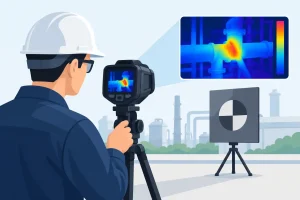
Effective use depends on operator technique as much as equipment capability. Inspectors need to understand how angle, movement, focus, distance, and background conditions affect visibility. A warm, uniform background may provide a different level of contrast than a cool sky, shaded steel structure, or active process unit.
Inspection routes should be structured around likely leak sources and process risk. Teams should establish repeatable observation positions where possible, especially for frequently monitored compressors, manifolds, loading connections, and isolation points. This makes trend comparisons more useful over time and reduces the risk that a change in viewing angle is mistaken for a change in leak severity.
Recorded footage should include enough context to be operationally useful: asset identification, date and time, inspection location, observed weather conditions where relevant, and the maintenance work order tied to the finding. A plume image without asset context may be compelling, but it is not enough to drive a disciplined repair process.
Teams should also avoid overstating what the image proves. Gas imaging can indicate the presence and apparent behavior of a plume, but it does not by itself provide a precise mass-flow rate or replace formal quantification methods. When emissions reporting, regulatory thresholds, or repair prioritization require measurements, pair visual findings with the appropriate measurement and engineering assessment process.
Fixed Coverage or Inspection Deployment?
The best format depends on how the facility intends to use the technology. Inspection deployments are well suited to scheduled surveys, broad asset checks, maintenance troubleshooting, and changing work areas. They offer flexibility and can support multiple sites when managed by trained personnel.
Fixed gas imaging installations are stronger where there is a recurring risk point, a hard-to-access area, or a need for continuous visual oversight. Examples include compressor zones, flare-related equipment, loading stations, process boundaries, and offshore modules. A fixed system can feed a security or operations center, record events, and support faster verification when alarms or process abnormalities occur.
Many operators benefit from a combined approach. Fixed coverage protects selected critical zones, while scheduled inspections cover the wider asset base. This balances capital expenditure with operational reach and provides better evidence for maintenance planning.
Revlight Security supplies industrial surveillance and detection solutions designed for demanding oil and gas, marine, energy, and process environments. The right system should deliver dependable image quality, appropriate environmental protection, practical network integration, and a clear route from detection to corrective action.
A gas plume does not wait for the next convenient shutdown window. When teams can see a suspected release clearly, document it accurately, and route it to the right decision-maker, leak response becomes a controlled operational process rather than a costly search.
🛡️ Secure Your Home or Business Today
Protect your home, office, shop, or business with reliable CCTV security cameras. Explore our range of CCTV cameras and find the right security solution for your needs.
Explore CCTV Cameras ✉️ Email Us


 Singapore :
+65-6708-9302
Singapore :
+65-6708-9302