
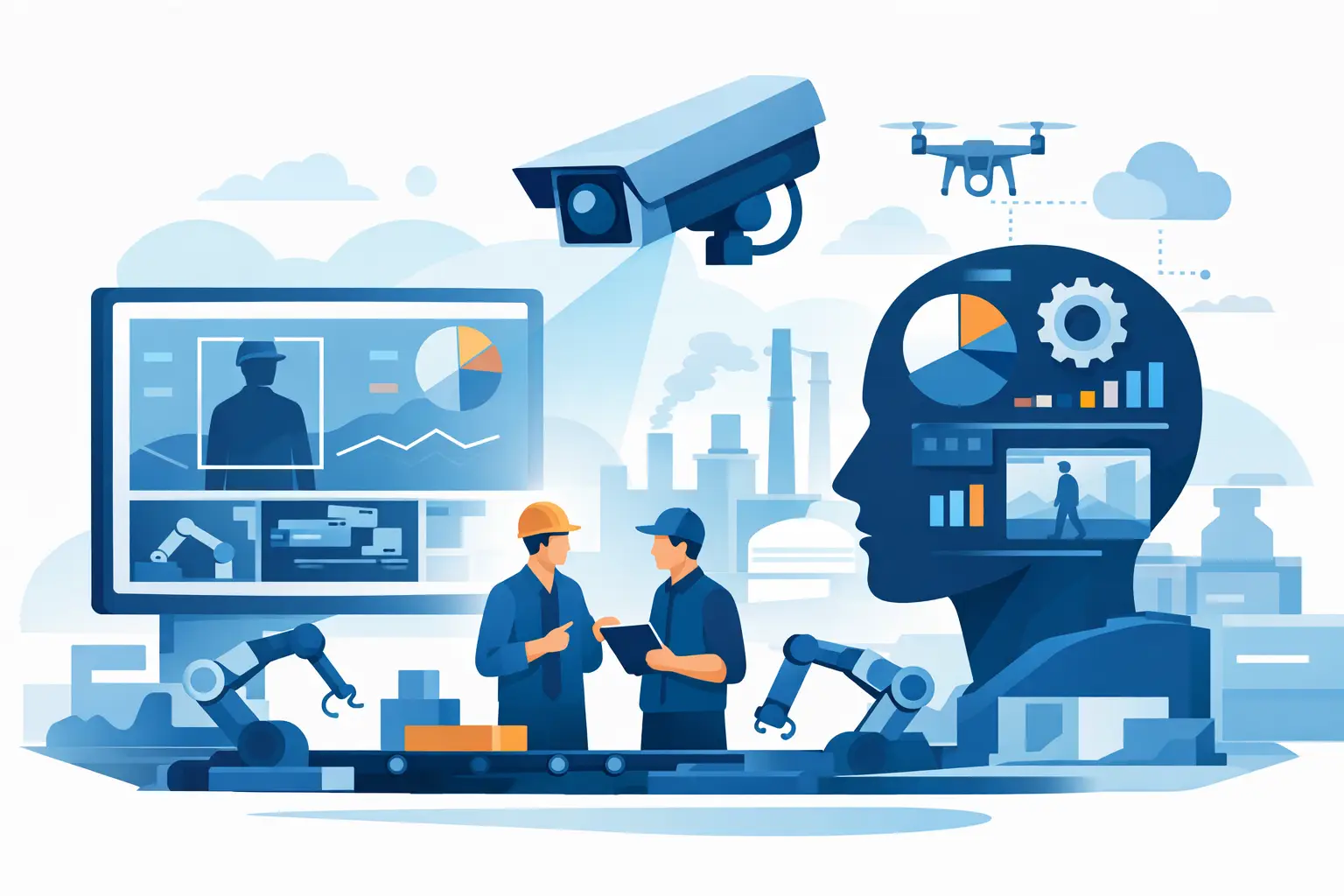
A refinery alarm that activates after a vapor cloud has already expanded is not enough. A vessel crew that learns about an unsecured perimeter from a delayed review is already behind. The industrial video analytics future is defined by a simple operational requirement: turn visual coverage into early, reliable intelligence while there is still time to act.
For oil and gas operators, marine fleets, power stations, and high-consequence industrial facilities, this is far more than a camera upgrade. It changes how sites detect hazards, verify alarms, protect restricted areas, investigate incidents, and direct limited personnel toward the highest-priority event. The strongest systems combine purpose-built imaging hardware, analytics suited to the environment, resilient networks, and a response process that operators can trust.
The Industrial Video Analytics Future Is About Decisions
Video surveillance once meant recording an event for later playback. That remains essential for compliance, claims, and investigations, but it is no longer the full value proposition. Industrial operators need systems that identify meaningful activity as it develops and place usable evidence in front of the right person.
Analytics can distinguish between routine movement and activity that requires intervention. A person entering an exclusion zone, a vehicle operating too close to a loading area, a missing safety barrier, a crowd forming at an access point, or an abnormal thermal pattern can each generate an alert. The objective is not to create more notifications. It is to reduce the time between an emerging risk and a verified operational decision.
This distinction matters because industrial sites already have no shortage of alarms. A poorly configured analytics platform simply adds noise to an overloaded control room. A well-engineered platform filters events by location, time, confidence level, asset criticality, and operating condition. It helps teams see what deserves attention first.
The future will favor video systems that support decision-making across security, safety, maintenance, and environmental monitoring. Procurement teams should therefore evaluate analytics as part of the wider surveillance infrastructure, not as a software feature added at the end of a project.
From Perimeter Coverage to Process Awareness
The next generation of industrial video analytics will extend beyond perimeter intrusion detection. Perimeter security remains a core requirement at refineries, terminals, substations, and marine facilities, particularly where sites cover large, exposed areas. But the higher commercial value often comes from visibility around the process itself.
At an oil and gas facility, visual analytics can support verification of methane and gas leak alerts, monitor access around critical equipment, and identify unsafe activity near hazardous zones. Optical gas imaging provides a direct visual layer that conventional security cameras cannot deliver. When paired with a defined escalation process, operators can confirm a potential release, assess direction and scale, and dispatch the correct response without relying on incomplete reports.
At sea, the same principle applies differently. Marine operators may need to monitor boarding areas, engine spaces, cargo operations, restricted decks, and offshore work zones where connectivity is inconsistent and weather conditions are severe. Analytics can prioritize activity around protected areas, while reliable onboard networking ensures that crews and shore-based teams can access live views, recorded evidence, and system health information when required.
For power generation and chemical operations, thermal analytics will become increasingly relevant where heat buildup, equipment degradation, or unauthorized presence can create serious consequences. Thermal monitoring is not a replacement for instrumentation or inspection programs. It is an additional detection layer that can reveal patterns traditional surveillance may miss, especially in low-light conditions or large outdoor areas.
Edge Processing Will Matter More at Remote Sites
The practical limit on advanced analytics is often not the camera. It is the network. Offshore installations, vessels, remote pump stations, and widely distributed energy assets may operate with constrained bandwidth, intermittent connections, or expensive satellite communications. Sending every high-resolution stream to a central server is not always commercially sensible.
That is why edge processing will become a central part of the industrial video analytics future. Edge-enabled devices can analyze video near the source, transmit an event and a short verification clip, and retain fuller footage locally according to the retention policy. This reduces network load while preserving the evidence needed for a detailed review.
However, edge analytics should not be selected solely because it is marketed as advanced. The right design depends on camera count, retention requirements, available power, ambient temperatures, network topology, control room staffing, and the cost of a missed event. A remote unmanned site may require a different architecture than a continuously staffed refinery control room.
Buyers should also ask what happens when connectivity fails. Can the system continue recording locally? Will alerts queue for transmission? Can an engineer remotely confirm camera health after the connection returns? These are operational questions, not minor technical details. They determine whether the system performs when conditions are least forgiving.
Accuracy Depends on the Scene, Not the Sales Sheet
Analytics vendors often quote detection rates that sound decisive. Real performance is more complex. A model trained in a controlled environment can struggle with glare on water, steam plumes, flare light, rain, fog, vibration, dust, low contrast, or workers wearing varied protective equipment.
Industrial buyers need to assess analytics against their actual scene conditions. A marine deck has different visual challenges than a fenced substation. A gas processing area has different hazards than a distribution warehouse. Camera position, lens selection, lighting, mounting stability, field of view, and environmental protection all affect the quality of the data reaching the analytics engine.
False alarms deserve as much attention as missed detections. If an analytic repeatedly triggers on waves, moving shadows, insects, exhaust, or routine personnel movement, operators will lose confidence and may begin ignoring alerts. That creates a dangerous gap between installed capability and real-world use.
The strongest approach is to establish measurable operating scenarios before purchase. Define the event to be detected, the area of interest, acceptable response time, expected traffic conditions, and escalation path. Then test the system under representative site conditions. This gives procurement and operations teams a performance benchmark that can be verified after commissioning.
Integration Will Separate Useful Systems From Isolated Ones
A surveillance platform delivers more value when it works with the systems operators already use. Video events may need to be presented alongside access control, intrusion detection, fire and gas alarms, vessel management tools, maintenance records, or command center workflows. The goal is not to force every system into one screen. It is to shorten verification and give teams the context to respond correctly.
For example, an access event at a restricted gate becomes more useful when the operator can immediately view the associated video, confirm the identity and direction of travel, and see whether the event occurred during an approved work window. A gas detection alarm becomes more useful when visual confirmation can be reviewed from the affected zone without exposing personnel to unnecessary risk.
Open integration capability should be assessed carefully. It is not enough for a supplier to state that a system is compatible. Buyers should confirm which events can be exchanged, whether integrations are maintained through software updates, how user permissions are controlled, and whether the network has sufficient capacity for the planned workflow.
Cybersecurity belongs in the same discussion. Connected cameras, recorders, wireless bridges, and remote viewing platforms are part of the operational technology attack surface. Secure credentials, network segmentation, firmware management, encrypted communications, user access controls, and audit logging are all necessary for dependable deployment. A system that improves visual awareness but creates a network exposure is not a sound investment.
Procurement Must Focus on Lifecycle Value
The lowest installed price rarely represents the lowest long-term cost. Industrial surveillance equipment operates in corrosive, wet, high-temperature, high-vibration, and electrically noisy environments. A camera or network component that fails repeatedly can cost far more in vessel time, contractor access, production disruption, and safety exposure than the initial savings justified.
A commercially sound specification considers environmental ratings, housing materials, mounting requirements, power availability, spare-part strategy, warranty coverage, storage capacity, remote diagnostics, and support responsiveness. For offshore and marine projects, corrosion resistance and serviceability can be decisive. For refineries and chemical plants, hazardous-area requirements and equipment certification may be non-negotiable.
It also pays to separate essential analytics from attractive but unused features. A focused system that reliably detects defined risks, records high-quality evidence, and supports remote verification will outperform an oversized platform that no one has time to configure or maintain. Revlight Security supports this practical approach with specialized surveillance and detection equipment built around demanding industrial and marine operating conditions.
The Human Response Still Determines the Outcome
Analytics can identify an event, rank its likely significance, and deliver visual evidence quickly. It cannot decide whether a crew should halt operations, deploy a response team, isolate equipment, or notify external authorities. Those decisions remain human and procedural.
Every deployment should therefore include clear ownership. Who receives the alert? Who verifies it? What response is expected at different confidence levels? How are incidents documented, and who reviews recurring alert patterns? Without these answers, even top-of-the-line surveillance systems can become expensive recording devices.
The most valuable future investment is not simply more cameras or more artificial intelligence. It is a surveillance design that gives operators credible, timely information in the conditions where uncertainty is most costly. Start with the hazards that demand faster verification, build the network and imaging system around them, and insist on performance that can be proven at the site.
🛡️ Secure Your Home or Business Today
Protect your home, office, shop, or business with reliable CCTV security cameras. Explore our range of CCTV cameras and find the right security solution for your needs.
Explore CCTV Cameras ✉️ Email Us

 Singapore :
+65-6708-9302
Singapore :
+65-6708-9302