
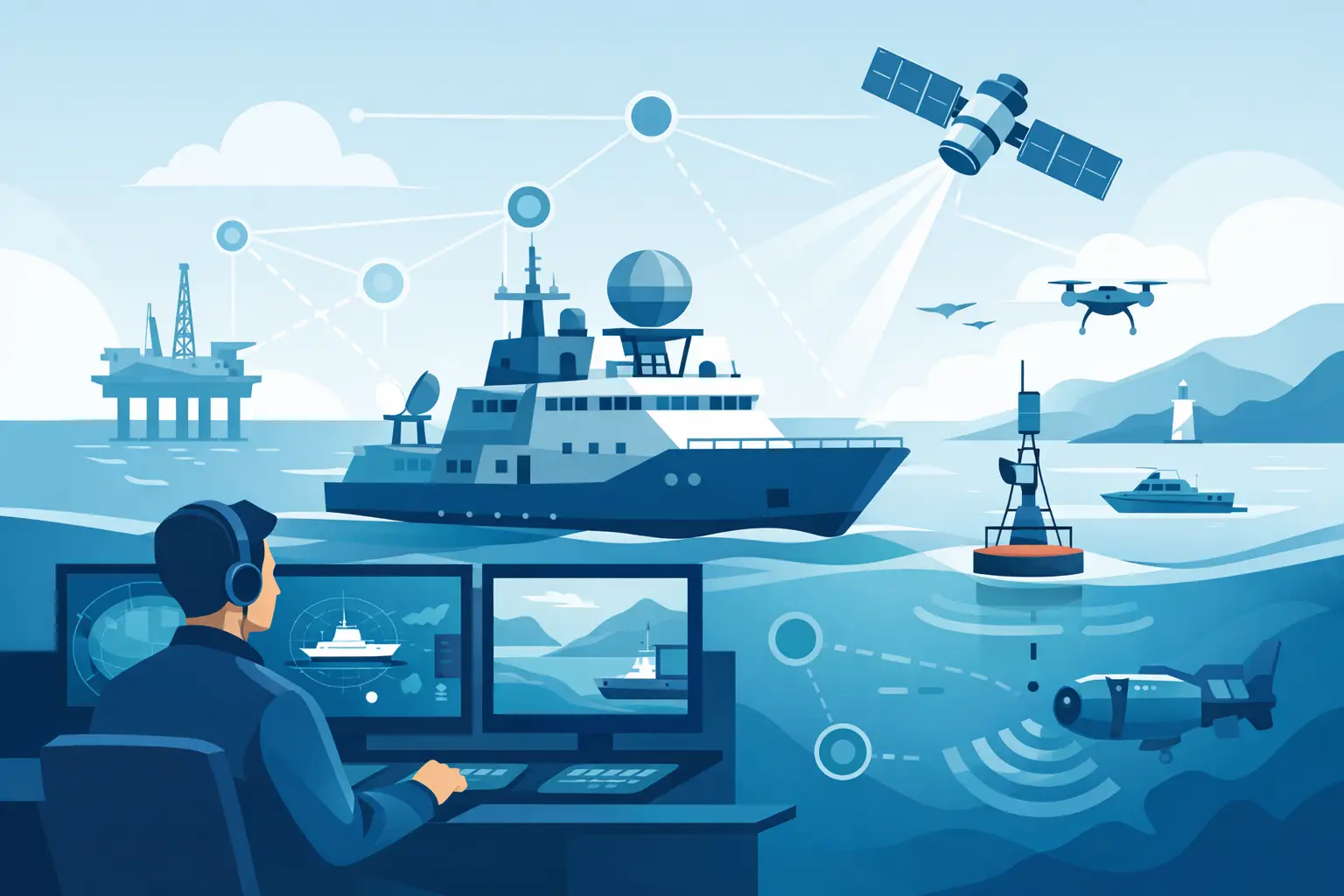
A marine surveillance network guide should begin where operational risk begins: at the points where a crew cannot maintain direct visual control. That may be a vessel gangway, engine room access door, cargo manifold, pump room, crane deck, perimeter buoy, or subsea structure. The right system does more than display video. It gives shore teams and onboard personnel usable evidence, faster incident awareness, and reliable oversight in conditions that defeat ordinary security equipment.
For marine operators, the buying decision is not simply about choosing cameras. It is about designing a connected surveillance environment that continues to record, transmit, and support investigation despite salt exposure, vibration, limited bandwidth, power constraints, and long distances from technical support.
Start With the Operational Risk, Not the Camera Count
A camera schedule built only around visible coverage gaps often underperforms. Start by defining the event each coverage zone must help detect, verify, or investigate. A deck camera may need to monitor unauthorized boarding and personnel safety. A camera near loading equipment may need enough detail to review procedural compliance and identify leaks, obstructions, or improper connections. An underwater unit may be specified for hull inspection, berth infrastructure, subsea assets, or restricted-water monitoring.
This distinction determines the required field of view, mounting position, illumination, resolution, frame rate, and recording policy. Wide coverage is useful for situational awareness, but it will not necessarily provide identification-quality evidence. Conversely, a narrow high-detail view can miss the activity leading up to an incident. Critical areas frequently require both.
Procurement teams should work with operations, marine engineering, HSE, and IT personnel before issuing a specification. A practical site survey should account for blind spots created by containers, pipework, cranes, railings, weather covers, and vessel movement. It should also identify where access for maintenance is restricted, because an inaccessible camera is not a dependable camera.
Marine Surveillance Network Guide: Build for the Environment
Marine environments impose a different failure profile than land-based facilities. Salt spray attacks connectors and enclosures. Continuous vibration affects mounts and cable terminations. Condensation can impair optics and electronics. Direct sun, storm conditions, and rapid temperature changes can reduce image quality or cause premature component failure.
Specify equipment based on the exact exposure level rather than assuming every device needs the same protection. Exterior deck locations, jetty installations, and offshore platforms generally require weather-resistant housings, corrosion-resistant materials, and hardware designed for marine service. Hazardous areas may require certified equipment appropriate to the zone classification. Engine spaces and enclosed industrial areas can introduce heat, fumes, and low-light challenges that need different housing, lens, and illumination decisions.
The mounting system deserves the same scrutiny as the camera itself. A high-performance imager will not compensate for a poorly secured bracket that shifts under vibration or wind. Mounts should protect cable entry points, preserve the intended angle of view, and allow technicians to service the unit without compromising safety procedures.
Lighting is another common source of weak performance. Bright reflections from water, deck lighting, and polished metal can obscure critical detail. Low-light operation may be essential at a gangway or perimeter, but infrared illumination can behave differently around mist, spray, and reflective surfaces. Test the proposed configuration under real operating conditions whenever the zone is high consequence.
Design the Network Around Bandwidth and Resilience
A surveillance network is only as effective as its ability to move and retain video when an incident occurs. On a vessel or offshore facility, available bandwidth is often shared with navigation, operational technology, crew welfare, business communications, and remote support. Sending every stream at maximum quality to shore is usually expensive and unnecessary.
A better approach is to prioritize traffic. Record high-quality video locally, use lower-bandwidth live streams for routine remote viewing, and configure event-based alerts or higher-quality transmission for selected incidents. Motion analytics, line-crossing rules, intrusion detection, or operator-triggered bookmarks can reduce the need to search through hours of footage after the fact. These functions must be tuned carefully. Excessive false alarms quickly cause crews to ignore the system.
Network architecture should separate surveillance traffic from safety-critical and operational control networks. Segmentation reduces cyber risk and helps prevent video demand from affecting essential vessel or facility functions. Managed switches, protected network cabinets, power conditioning, and documented port configurations make the system easier to troubleshoot and expand.
For offshore locations, consider the expected loss of a communications path. If satellite, microwave, cellular, or marine Wi-Fi connectivity is interrupted, local recording should continue without operator intervention. When the link returns, authorized users should be able to review the retained footage through a controlled process. The correct retention period depends on risk, policy, regulatory obligations, storage cost, and the time normally required to report an event.
Select Recording That Supports Investigation
The recorder is not merely storage. It is the evidence management center for the surveillance network. Capacity must be calculated from the number of streams, resolution, compression settings, frame rate, recording schedule, and retention target. A system that is specified only by the number of channels can leave operators with substantially less recording time than expected.
Use continuous recording where the full sequence of activity matters, such as cargo transfer zones, security perimeters, access points, and areas with repeated personnel movement. Event-based recording can reduce storage requirements in lower-risk locations, but it should include pre-event and post-event footage. Without that context, investigators may see the outcome without understanding how it developed.
Redundancy should match the consequence of losing footage. For high-value operations, use storage designed to tolerate individual drive failures and consider backup recording paths for selected critical views. Recorders should be installed in protected spaces with stable power, appropriate cooling, and controlled physical access. A recorder placed in an exposed or poorly ventilated cabinet can become the system’s single point of failure.
Make Remote Access Controlled and Useful
Remote access is valuable when it allows a superintendent, operations center, security manager, or technical team to verify a developing situation without waiting for a report to travel through several layers of communication. It becomes a liability when credentials are shared, permissions are excessive, or remote connections are left unmanaged.
Set access roles according to operational need. A vessel master may need live views and playback for incident review. A shore-based security team may need access to specific perimeter and gangway cameras. Maintenance personnel may need device health information but not unrestricted video access. Strong authentication, account management, encrypted communications, audit logs, and timely removal of former users are baseline requirements.
Cybersecurity also includes operational discipline. Default passwords, unpatched firmware, undocumented remote connections, and consumer-grade network equipment can expose the system and the wider marine environment. Establish responsibility for updates and configuration control before deployment. If the operator cannot maintain a feature over the system life cycle, it should not be treated as a critical security control.
Plan the Installation as a Marine Project
Installation quality determines whether a surveillance design performs as specified. Cable routes must avoid damage points, protect against moisture ingress, and remain accessible for inspection. Power requirements should be verified against startup load, voltage drop, backup power expectations, and any need for power over Ethernet. On larger sites, fiber may be the better choice for long distances and electrical isolation, while copper remains practical for shorter protected runs.
Commissioning should include more than confirming that every view appears on a monitor. Test recording playback, timestamp accuracy, user permissions, remote connectivity, alert behavior, low-light performance, failover behavior, and network recovery after a controlled outage. Capture final camera views, network settings, equipment serial numbers, storage calculations, and maintenance procedures in handover documentation.
Revlight Security supports marine operators with surveillance and network solutions selected for demanding offshore, vessel, and industrial conditions. The best service provider is one that can connect equipment selection to the real operating environment, rather than supplying a generic package that leaves critical gaps after installation.
Measure Performance After Deployment
A marine surveillance network should be reviewed after crews have used it in real conditions. Ask whether operators can find footage quickly, whether remote users receive the information they need, and whether any views are consistently blocked by operational changes. Review storage consumption, device health alerts, false alarm rates, and recurring maintenance issues.
Expansion is often justified after the first deployment reveals operational blind spots. Leave room in the network, recording platform, power design, and mounting plan for additional coverage. A system that can scale without major rework protects the original investment and gives operations teams a clear path to stronger security coverage.
The right marine surveillance network is not defined by the largest camera count or the highest advertised resolution. It is defined by whether it delivers dependable visual evidence at the moment your vessel, platform, terminal, or industrial site needs it most.
🛡️ Secure Your Home or Business Today
Protect your home, office, shop, or business with reliable CCTV security cameras. Explore our range of CCTV cameras and find the right security solution for your needs.
Explore CCTV Cameras ✉️ Email Us


 Singapore :
+65-6708-9302
Singapore :
+65-6708-9302