
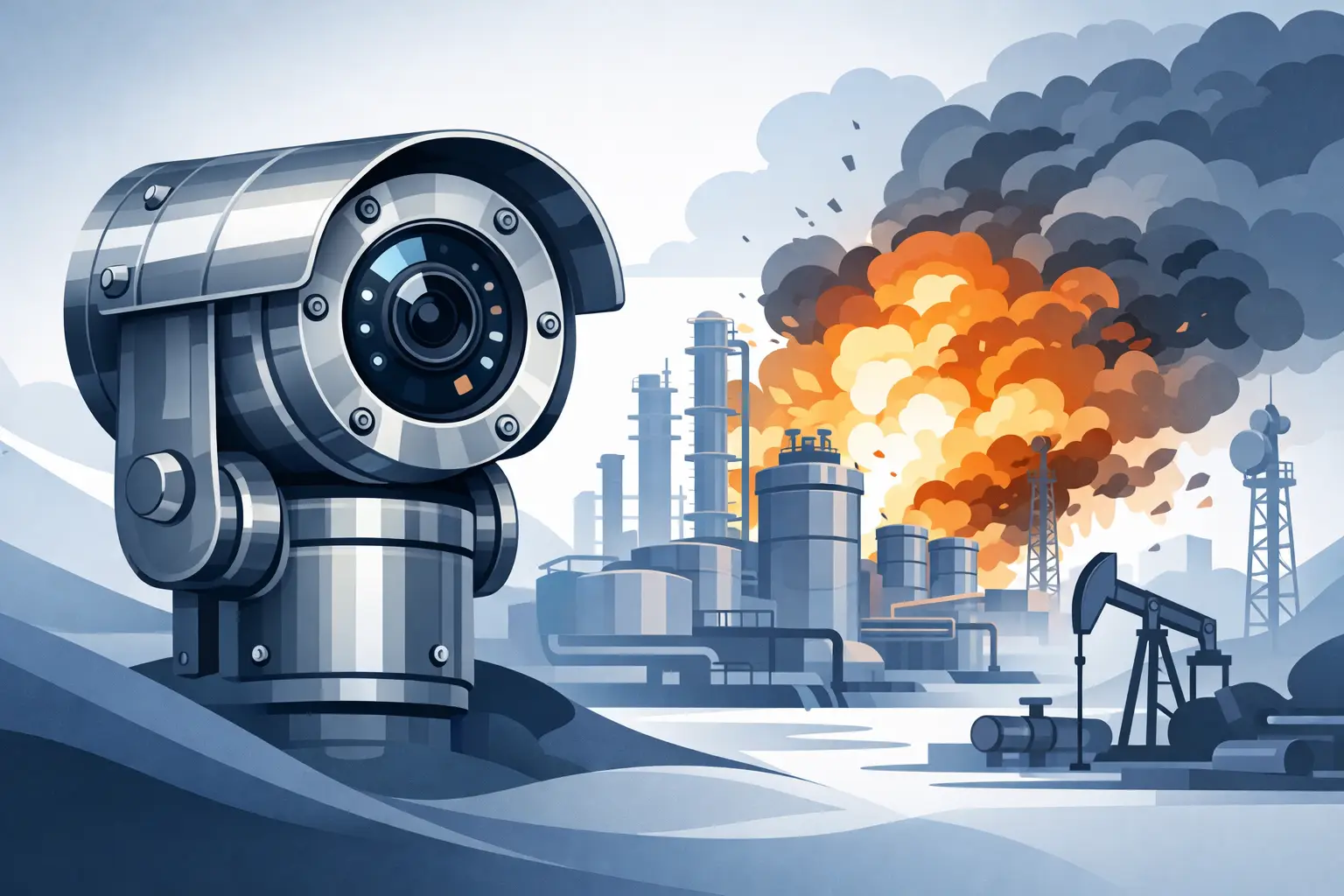
A camera mounted above a refinery loading rack, offshore deck, or chemical process area has one job: provide usable evidence and live situational awareness without becoming a source of ignition. That is the standard behind this explosion proof PTZ camera review. For industrial buyers, the decision is not about choosing the longest zoom figure on a specification sheet. It is about matching certified hazardous-area protection, optical performance, network reliability, and service life to a real operating risk.
A PTZ system can cover a wide area with fewer installed units than fixed cameras, but only when its movement, presets, image quality, and control system are engineered for the site. A poor selection creates blind spots, costly maintenance visits, and compliance questions. A properly specified unit becomes a high-value layer in an industrial surveillance program.
What an Explosion Proof PTZ Camera Must Deliver
The term “explosion proof” is often used loosely in the market. Procurement teams should look past the label and confirm the certification is valid for the intended location, gas group, dust risk, temperature class, and regional compliance requirement. A camera suitable for one classified area may not be suitable for another, even if both products use similar-looking housings.
For oil and gas, chemical processing, marine fuel handling, power generation, and storage terminals, the starting point is the area classification study. Buyers may need ATEX, IECEx, UL, CSA, or another applicable approval depending on project location and governing standard. The certificate, equipment marking, ambient-temperature range, cable-entry specification, and installation instructions should all be reviewed before purchase. Certification paperwork is part of the product, not an administrative extra.
A serious explosion-proof PTZ should also be built around a corrosion-resistant enclosure. Marine operators need protection against salt spray, humidity, vibration, and changing temperatures. Refinery and chemical-facility buyers must consider corrosive airborne contaminants, washdown exposure, and particulate buildup. Stainless steel construction, correctly specified coatings, IP or NEMA protection, and quality cable glands can matter as much as the camera sensor itself.
Explosion Proof PTZ Camera Review: Core Performance Factors
The most useful review criteria are operational. Can the unit identify a person or vehicle at the distance required? Can it retain image detail when a process area is brightly lit, backlit, foggy, or operating at night? Can control-room personnel move to a preset location immediately when an alarm occurs?
Optical zoom and image detail
Optical zoom remains one of the strongest reasons to select a PTZ camera. It allows an operator to inspect a valve manifold, berth approach, flare stack perimeter, or tank-farm access point without placing personnel closer to the hazard. However, extreme zoom is not automatically better. At long focal lengths, vibration, heat haze, low light, and poor mounting stability can reduce useful detail.
Buyers should evaluate the relationship between sensor size, resolution, optical zoom, frame rate, and scene distance. A high-resolution sensor can support better digital cropping, but it does not replace proper lens selection. For a large open process area, the right solution may be a PTZ paired with fixed overview cameras. The fixed units maintain continuous coverage while the PTZ provides investigation and close inspection.
Low-light capability and illumination
Night surveillance is where many systems reveal their limits. Industrial sites often have mixed lighting, bright localized fixtures, reflective surfaces, and deep shadows. Wide dynamic range helps maintain detail where a lit access road meets a dark perimeter. Low-light sensitivity improves color imaging in marginal conditions, while infrared illumination can support observation where visible light is limited.
There is a trade-off. Infrared can reflect from rain, fog, steam, dust, and nearby structures, producing glare that limits the value of the image. For marine and offshore installations, external illuminators or carefully designed white-light coverage may provide better results in certain zones. The correct approach depends on weather, mounting height, viewing distance, and whether the site needs identification, recognition, or general detection.
PTZ mechanics, presets, and tracking
The pan, tilt, and zoom assembly should move accurately and hold position under vibration and wind. This is especially relevant on vessels, offshore assets, elevated poles, and structures near rotating equipment. A PTZ that drifts after an operator releases control may look acceptable during commissioning but becomes a daily frustration in a live control room.
Preset accuracy is more valuable than a long feature list. Operators need to call up designated views for gates, unloading points, muster areas, process skids, and restricted zones with confidence. A practical configuration includes named presets, patrol patterns, restricted privacy areas where required, and priority control rules that prevent conflicting commands from multiple workstations.
Automatic tracking can add value in defined perimeter or access-control applications, but it should not be treated as a replacement for a well-designed surveillance plan. Steam plumes, moving shadows, vessel motion, and industrial traffic can all produce false or inconsistent tracking behavior. Use analytics as an operational aid, then validate it in the actual site conditions.
Network and Control-Room Integration
An explosion-proof camera is only useful when its video reaches the people and systems that need it. The network design must account for bandwidth, cybersecurity, fiber or copper distance, power availability, redundancy, and recording retention. For critical infrastructure, a camera should integrate cleanly with the existing video management system, network video recorder, and alarm platform.
ONVIF compatibility can simplify multi-vendor integration, but buyers should verify the exact functions supported, including PTZ control, events, audio where permitted, metadata, and video profiles. Generic compatibility claims do not guarantee that every feature will work correctly with every VMS.
Cybersecurity deserves direct attention. Change default credentials before commissioning, use role-based access, segment surveillance networks, apply supported firmware, and define who can access PTZ controls remotely. Remote visibility is a major advantage for site managers and corporate security teams, but uncontrolled remote access creates operational risk. The best service provider will support both camera supply and the network decisions that protect the complete system.
Installation Costs Are Part of the Review
The unit price does not tell the full commercial story. Hazardous-area installation requires approved mounting hardware, compliant cable routes, certified glands or conduit arrangements, grounding, surge protection, and qualified personnel. Offshore work may also involve vessel access, lifting plans, weather windows, and shutdown restrictions.
A lower-cost camera can become the more expensive option if it has a shorter service interval, lacks available spare parts, requires proprietary integration, or needs frequent site visits for adjustment. Procurement managers should compare total cost of ownership across the expected operating life. Ask suppliers about warranty coverage, repair turnaround, spare assemblies, firmware support, and availability of technical documents.
Four questions should be answered before issuing a purchase order:
- Is the certification correct for the exact hazardous-area classification and ambient temperature?
- Does the optical design provide usable identification at the required distance, day and night?
- Will the camera integrate with the existing VMS, recording platform, and network security policy?
- Can the unit be installed, serviced, and supported without excessive offshore or shutdown costs?
Where PTZ Cameras Create the Most Value
PTZ surveillance is particularly effective where operators need broad-area oversight plus the ability to inspect an incident in detail. Tank farms, jetty operations, refinery perimeters, offshore decks, loading bays, chemical transfer areas, and power-station yards are common examples. A single certified PTZ can monitor changing activity across a large zone, direct attention toward an alarm, and provide recorded evidence for incident review.
It is not the right answer for every location. Fixed cameras are often better for constant coverage of critical doors, control panels, narrow passages, and transaction points. Thermal imaging may be the better choice for some long-range perimeter applications or low-visibility scenarios. Gas detection and flame detection systems address a different objective entirely: early hazard detection rather than visual confirmation. The strongest industrial designs combine these technologies into a coordinated response workflow.
Revlight Security approaches hazardous-area surveillance as infrastructure, not a catalog transaction. The right system is specified around the site’s approval requirements, environmental exposure, viewing objectives, and operational response plan.
Before selecting a unit, walk the scene with the people who will use the video at 2:00 a.m. during bad weather or an alarm event. Their required view, response time, and confidence in the image should define the purchase. That is where a PTZ investment earns its value.
🛡️ Secure Your Home or Business Today
Protect your home, office, shop, or business with reliable CCTV security cameras. Explore our range of CCTV cameras and find the right security solution for your needs.
Explore CCTV Cameras ✉️ Email Us



 Singapore :
+65-6708-9302
Singapore :
+65-6708-9302