

A perimeter alarm at a refinery, berth, or remote power station creates one immediate question: what is happening at the point of intrusion? The PTZ camera vs bullet camera decision determines whether operators can actively investigate that event from the control room, or whether they already have a fixed, court-ready view of the area. Both formats belong in serious industrial surveillance systems, but they solve different problems.
Choosing on price alone usually creates blind spots, unnecessary maintenance, or an operator workflow that fails under pressure. The right specification starts with the asset, the threat, the required evidence, and the operating environment.
PTZ Camera vs Bullet Camera: Start With Risk
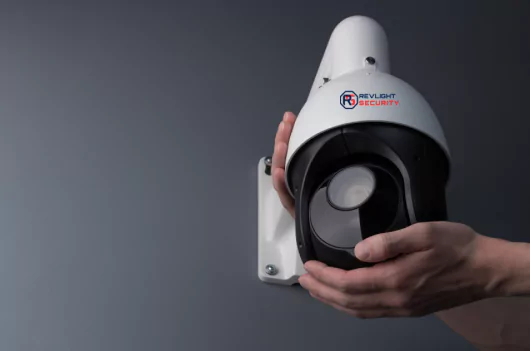
A PTZ camera pans, tilts, and zooms under operator control or through programmed presets. It is designed to follow activity across a wide area, inspect distant equipment, and give security teams a closer view without dispatching personnel. On a marine terminal, for example, one properly positioned PTZ can scan a vessel approach, track movement along a jetty, and zoom toward a restricted-access gate.
A bullet camera is fixed in one direction. Its value is consistency. Once aimed at a valve bank, loading lane, access door, tank stairwell, or gangway, it records the same scene continuously. That fixed viewpoint is a major advantage when teams need dependable playback showing who entered an area, when a vehicle passed, or whether personnel followed a designated route.
The key trade-off is simple. PTZ cameras provide flexible observation, but their active field of view can be looking elsewhere when an incident occurs. Bullet cameras provide permanent evidence for one defined scene, but cannot investigate beyond their installed angle. Industrial sites should not treat this as an either-or purchase unless the protected area is very limited.
Where PTZ Cameras Deliver More Value
PTZ units are the stronger option when the protected area is broad, distant, or constantly changing. They are particularly effective at fence lines, tank farms, ports, offshore platform decks, large substations, rail spurs, and approach roads. High optical zoom lets an operator verify an alarm location from a safe distance, reducing unnecessary patrols and avoiding exposure to hazardous or restricted zones.
For operations teams, presets are a major commercial advantage. A camera can automatically move between programmed positions to inspect a gate, pump skid, flare area, and perimeter section on a defined schedule. Guard tours can also be initiated remotely, allowing a centralized control room to supervise multiple facilities more efficiently.
Auto-tracking can add value where people, vehicles, or vessels need to be followed after an alarm. However, it should be specified carefully. Tracking performance depends on scene complexity, lighting, weather, distance, analytics configuration, and available network bandwidth. At a busy port or refinery, a PTZ may follow the wrong subject if rules are poorly configured. Operators still need fixed cameras to maintain a continuous record of critical lanes and access points.
PTZ deployment also requires sound mechanical planning. Wind loading, vibration, mounting height, cable routing, and service access matter more on marine structures and exposed industrial sites than in ordinary commercial installations. For hazardous locations, buyers must confirm that the complete camera and housing assembly holds the required certification for the classified area. A standard unit inside an unsuitable enclosure is not an acceptable workaround.
Where Bullet Cameras Are the Better Choice
Bullet cameras are built for persistent observation. They are the workhorse format for entrances, corridors, personnel gates, equipment enclosures, loading racks, warehouse lanes, and defined sections of a perimeter. Because the camera remains fixed, the video team always knows what it will capture.
This makes bullet cameras ideal for incident reconstruction. If a fuel transfer connection is accessed, a restricted door is opened, or a vehicle enters a controlled zone, a fixed camera provides stable footage before, during, and after the event. There is no risk that the camera had moved to another preset at the decisive moment.
Bullet cameras can also be easier to deploy in large quantities. Their compact form factor suits walls, poles, eaves, and equipment structures, while their fixed lens simplifies daily operation. For sites that need coverage across dozens of doors, gates, lanes, and process areas, fixed cameras normally deliver a lower cost per continuously monitored scene than PTZ units.
Lens selection remains critical. A wide-angle bullet camera may cover an entire loading area but provide insufficient detail for identification at the far end. A narrower lens can capture faces, vehicle markings, or instrument readings at greater distance, but covers less area. The best system design maps each camera to a required task: detection, observation, recognition, or identification. A camera that merely shows movement is not necessarily capable of proving who or what caused it.
PTZ Camera vs Bullet Camera in Harsh Environments
Environmental suitability can outweigh camera type. Salt spray, high humidity, vibration, blowing dust, corrosive gases, extreme temperatures, and poor lighting can shorten equipment life and degrade image quality. Marine and energy operators should specify housing materials, ingress protection, operating temperature, corrosion resistance, heater and blower requirements, wiper systems where needed, and power options before approving a camera format.
For offshore and coastal installations, a PTZ’s moving parts need especially careful consideration. High-quality units are engineered for continuous movement and adverse weather, but they require planned inspection and cleaning. A fixed bullet camera has fewer moving elements, which can reduce mechanical service exposure, yet its lens still needs protection from salt buildup, dust, and rain spotting.
Night performance should be assessed against the actual site, not a brochure specification. Infrared illumination can be effective for gates and short perimeter runs, while thermal imaging is often more suitable for long-range detection in darkness, haze, smoke, or low-contrast conditions. Where methane or gas leak detection cameras are part of the wider security strategy, visual surveillance should be positioned to support safe verification and response without placing personnel in harm’s way.
Build Coverage in Layers, Not in Isolation
The strongest industrial systems use bullet and PTZ cameras together. Fixed cameras establish continuous coverage of critical zones. PTZ cameras provide active verification, wide-area patrols, and close inspection after an alarm. This layered approach protects evidence while giving operators the flexibility to respond quickly.
A typical high-value deployment may use bullet cameras at all entry and exit points, along vehicle lanes, at key process assets, and at restricted doors. PTZ cameras can then be installed on elevated structures to oversee the perimeter, berth, tank farm, or wider facility. When a fixed camera, access control event, fence sensor, radar alert, or gas detection alarm activates, the PTZ can move to the associated preset for immediate assessment.
Integration is where purchasing decisions become operational savings. Confirm compatibility with the video management system, recording capacity, network switches, fiber infrastructure, power budget, cybersecurity standards, and remote-access policy. PTZ control latency, camera stream settings, and retention requirements should be tested before the system is accepted. A premium camera cannot compensate for an undersized network or inadequate storage design.
Questions Procurement Teams Should Ask
Before selecting either format, procurement teams should require a site-specific answer to four questions: What exact area must remain on record at all times? What alarm events require an operator to investigate remotely? What level of image detail is required at the target distance? And what environmental or hazardous-area approvals apply at the installation point?
The answers expose whether a low-cost fixed installation is enough, whether a PTZ adds measurable operational value, or whether both are required. They also prevent common specification errors, such as using a PTZ as the only camera covering a gate, choosing inadequate zoom for a long perimeter, or installing equipment that cannot withstand the local atmosphere.
Revlight Security supports industrial buyers with surveillance equipment selected around real operating conditions, not generic camera categories. The goal is clear coverage, dependable evidence, and faster verification when the site needs it most.
A bullet camera should be the first choice when a scene can never be missed. A PTZ should be added when that scene connects to a larger operational area that must be investigated, tracked, and managed from a safe distance. Specify each camera around the risk it must control, and the system will deliver value long after installation day.
🛡️ Secure Your Home or Business Today
Protect your home, office, shop, or business with reliable CCTV security cameras. Explore our range of CCTV cameras and find the right security solution for your needs.
Explore CCTV Cameras ✉️ Email Us



 Singapore :
+65-6708-9302
Singapore :
+65-6708-9302