
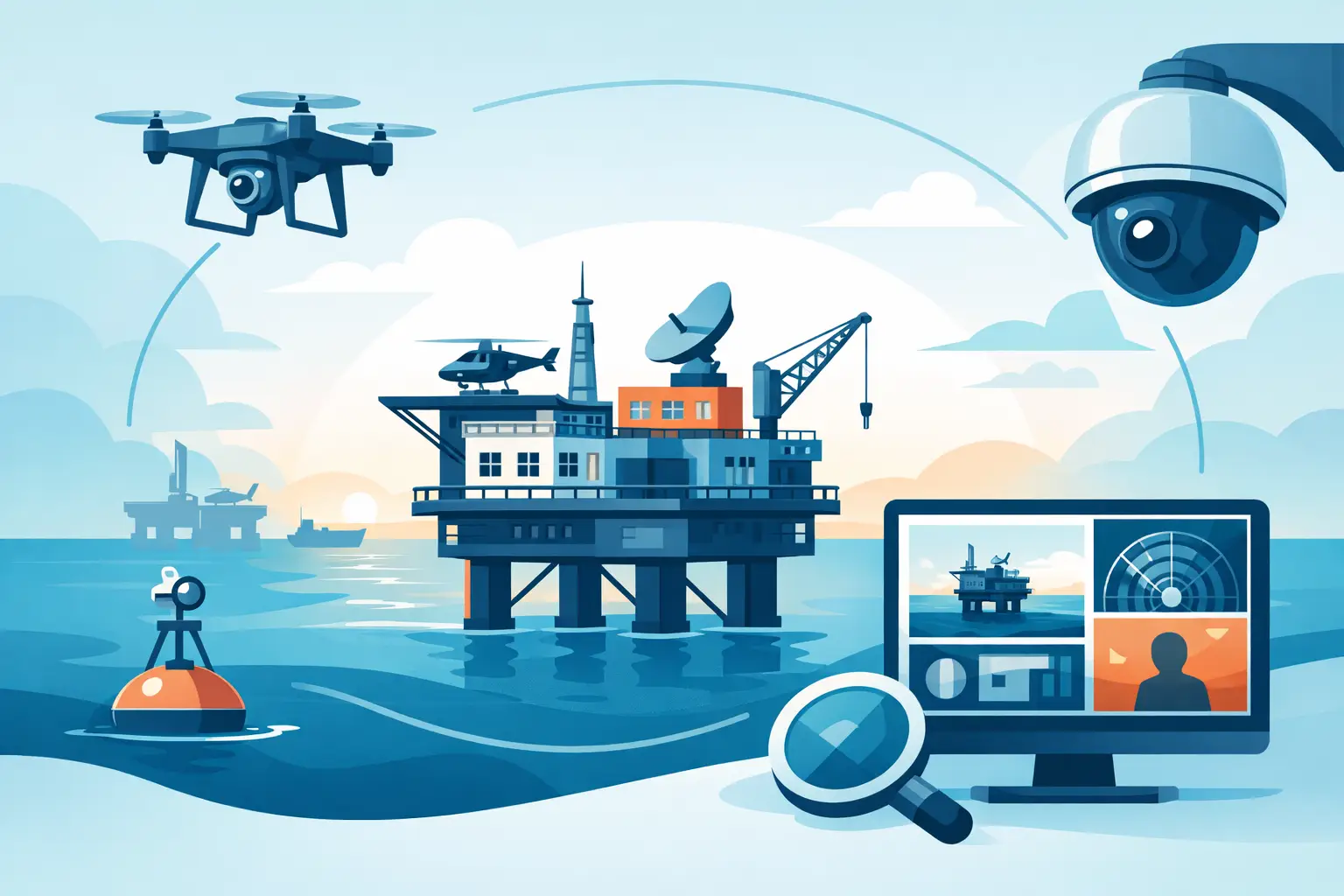
A false alarm offshore is expensive. A missed alarm is worse. That is why buyers looking for the best offshore platform surveillance solutions are not shopping for cameras alone. They are building a detection and response layer that has to work in salt spray, high wind, vibration, darkness, explosive atmospheres, and long maintenance cycles.
For offshore operators, the right solution is the one that reduces exposure, protects uptime, and gives control rooms usable visual intelligence the moment something changes. That usually means combining fixed thermal imaging, corrosion-resistant visual cameras, gas leak detection, underwater inspection coverage, recording infrastructure, and reliable offshore network transport into one system that can be monitored locally and remotely. The buying decision is less about a single product and more about whether the whole package performs under offshore conditions without becoming a maintenance burden.
What the best offshore platform surveillance solutions need to do
Offshore surveillance has a different job than standard industrial security. On a platform, the system has to support safety, asset integrity, perimeter awareness, and incident verification at the same time. If a flare changes behavior, if a gas plume forms, if a transfer area becomes unsafe, or if activity appears near the jacket or risers, operators need clear data immediately.
That is why the best offshore platform surveillance solutions are usually multi-layered. Visible cameras help with operations, access control, and evidential recording. Thermal cameras extend coverage in low visibility and at night, while also improving early awareness around process areas and helidecks. Specialized gas detection imaging adds another critical layer in hydrocarbon environments where invisible leaks can create serious risk before conventional visual systems show anything useful.
The trade-off is cost and complexity. A basic visual-only deployment may look attractive on paper, but it can leave major blind spots in fog, darkness, glare, or process conditions where thermal contrast or gas imaging is the only practical option. On the other hand, over-specifying every zone with premium sensors can waste budget. Strong system design starts with zoning the platform by risk, operational priority, and inspection difficulty.
Camera performance matters, but offshore survivability matters more
Many systems look strong in a catalog. Offshore service exposes weak engineering quickly. Housings need to resist corrosion, ingress, vibration, and temperature swings. Mounting hardware must stay stable in wind and salt-heavy conditions. Washers, wipers, heaters, and marine-grade enclosures are not nice extras offshore. In many installations, they are the difference between a useful image and a lens that becomes unreliable after a short period in service.
This is where procurement teams should push past headline resolution figures. High image quality is valuable, but offshore reliability is what protects lifecycle value. A 4K unit that requires repeated intervention is a poorer investment than a lower-resolution system that remains stable and readable for years. The best service provider will be clear about enclosure ratings, materials, certification requirements, maintenance intervals, and offshore installation constraints.
For hazardous zones, equipment certification is also central to the buying decision. Oil and gas operators already understand this, but surveillance packages are sometimes evaluated too narrowly on imaging performance alone. If the camera, housing, junction box, and associated network components are not appropriate for the classified area, deployment becomes more difficult and long-term compliance becomes a problem.
Thermal and gas imaging are no longer optional on high-risk assets
Onshore facilities can sometimes compensate for gaps with frequent physical inspection. Offshore, that is harder, slower, and more expensive. Thermal imaging gives operations teams dependable awareness during darkness, rain, haze, and smoke. It is especially effective for perimeter monitoring, marine approach visibility, helideck oversight, and high-value equipment areas where conventional cameras struggle.
Gas leak detection imaging goes a step further. For hydrocarbon processing zones, it helps teams visualize escaping gases that standard visible cameras cannot detect. That can shorten response time, support maintenance planning, and reduce the chance of escalation. For procurement managers comparing options, the practical question is not whether this technology is advanced. It is whether the risk profile and downtime exposure justify the investment. On many offshore assets, the answer is yes.
Still, not every area needs the same level of sensor sophistication. Living quarters, general access routes, and lower-risk logistics spaces may be well served by durable visual cameras with recording and remote access. Process modules, loading points, flare areas, and enclosed hazard-prone sections often justify a more advanced sensor stack.
Underwater surveillance fills one of the biggest offshore blind spots
A platform is not only what happens above deck. Subsea and splash-zone visibility can be just as important, especially where structural inspection, marine growth monitoring, diver support, and asset condition checks are involved. Underwater camera systems designed for offshore platforms help operators inspect difficult areas without sending personnel into high-risk situations unnecessarily.
This is one of the most overlooked parts of the best offshore platform surveillance solutions. Buyers often focus on topside security and process monitoring first, then treat underwater visibility as a separate project. In practice, integrating underwater coverage with the wider surveillance network gives operations a better picture of structural conditions, vessel interactions, and maintenance needs.
The right underwater system depends heavily on depth, clarity, lighting conditions, and whether the requirement is continuous monitoring or scheduled inspection support. Some operators need live subsea feeds into the control room. Others need rugged camera stations for targeted condition review. Either way, offshore-rated underwater imaging can deliver savings by improving inspection efficiency and reducing unnecessary intervention.
Networks and recording decide whether surveillance is usable
A platform can have excellent cameras and still fail operationally if the network is weak. Offshore surveillance depends on bandwidth planning, recording architecture, remote access reliability, and cyber-aware system design. If footage drops, if latency is too high, or if storage is undersized, the system becomes harder to trust when an incident occurs.
That is why top-of-the-line offers in this category should include more than endpoint devices. Marine WiFi, offshore network links, managed switching, edge recording, and properly sized NVR or VMS infrastructure are part of the surveillance result. The footage has to be available for live decision-making, for playback during incident review, and for longer retention where policy or regulation demands it.
There is also a practical offshore issue that many buyers know well: connectivity can be inconsistent. In those cases, edge recording at the camera or local node level becomes extremely valuable. It protects evidence continuity and allows the wider system to recover without losing critical footage. Remote access should also be designed around operational reality. Control rooms need fast, reliable views. Managers ashore may need secure access for support and oversight, but not at the expense of core platform performance.
How buyers should compare offshore surveillance suppliers
The strongest suppliers do not just offer a camera list. They ask how the platform operates, where incidents are most likely, what classifications apply, how maintenance is performed, and how footage will be used. That consultative approach matters because offshore surveillance is a systems problem, not a single-product sale.
Buyers should evaluate whether the supplier understands harsh-environment deployment, hazardous-area requirements, and integration across visible, thermal, gas detection, underwater, and network layers. They should also look at service support. Offshore systems are expected to run for years in punishing conditions, so spare strategy, technical guidance, and replacement planning affect total value.
Price still matters, of course. But the cheapest package often shifts cost into vessel time, technician callouts, image failures, or incomplete coverage. A better benchmark is lifecycle performance. If a system improves detection, reduces manual inspection exposure, and supports faster decision-making, it can justify a higher upfront cost very quickly.
Choosing the best offshore platform surveillance solutions for your asset
The best offshore platform surveillance solutions are the ones matched to the platform’s actual risk map. A small unmanned installation, a major production platform, and a marine transfer asset do not need the same architecture. Some need heavy thermal coverage and gas imaging. Others benefit most from marine-grade PTZ units, underwater inspection cameras, and resilient wireless transport.
For serious operators, the target should be clear: dependable surveillance that delivers recording, playback, remote visibility, and environment-specific durability without creating service headaches. That is the standard the market should expect from the ultimate in security surveillance systems for offshore use.
If you are reviewing an upgrade or specifying a new deployment, start with the operational risks that cost the most when missed. The right surveillance system earns its place when it helps your team see sooner, verify faster, and keep the platform working safely.
🛡️ Secure Your Home or Business Today
Protect your home, office, shop, or business with reliable CCTV security cameras. Explore our range of CCTV cameras and find the right security solution for your needs.
Explore CCTV Cameras ✉️ Email Us

 Singapore :
+65-6708-9302
Singapore :
+65-6708-9302