
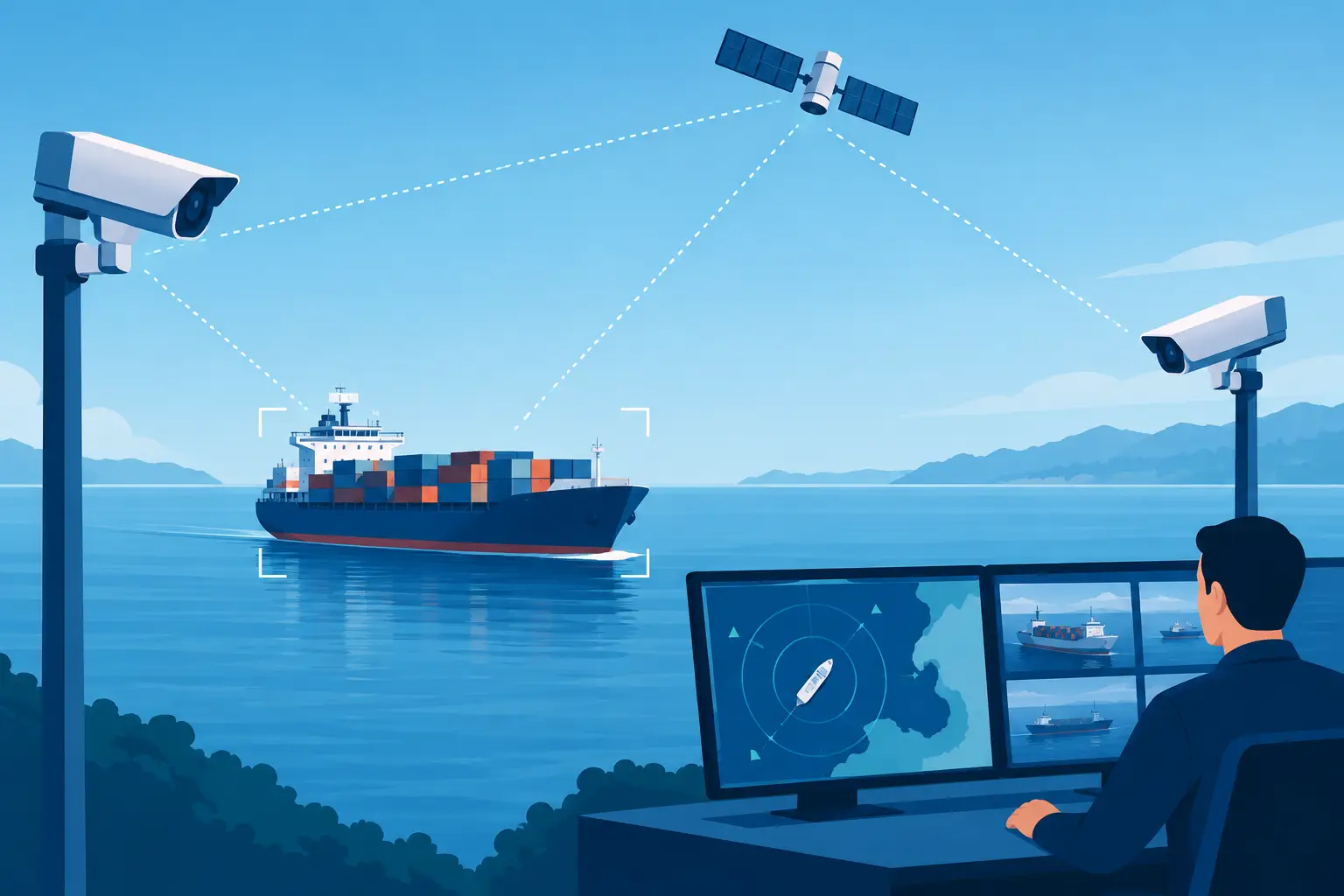
A vessel can lose operational visibility long before it loses propulsion. A blind stern deck, an unrecorded engine-room entry, or a camera feed that drops during a satellite handoff can leave the master and shore team without the evidence they need. Secure vessel surveillance networks are built to prevent those gaps by connecting purpose-selected cameras, recording equipment, onboard communications, and protected remote access into one controlled system.
For ship operators, offshore support fleets, tankers, workboats, and marine facilities, surveillance is not a box-ticking exercise. It supports crew safety, cargo protection, incident investigation, perimeter awareness, and operational discipline. The right network gives authorized personnel usable footage when it matters, not merely a collection of camera views that work in ideal conditions.
What Makes Vessel Surveillance Networks Secure
Security begins with architecture. A marine surveillance installation must protect video data from unauthorized access while continuing to record through poor connectivity, vibration, salt exposure, temperature changes, and power events. These are separate requirements, and a system that addresses only one of them is incomplete.
At the network level, surveillance traffic should be separated from business systems, crew internet access, and vessel control networks. Segmented network design limits the impact of an unauthorized device or compromised account. Managed switches, dedicated VLANs, role-based credentials, firewall rules, and encrypted remote connections give operators control over who can view, export, or administer video.
Physical protection matters just as much. Cameras, housings, connectors, cable runs, switches, and recording units need to suit their installation area. Exposed decks may require corrosion-resistant enclosures, marine-grade cable protection, and appropriate ingress ratings. Machinery areas may demand equipment selected for heat, vibration, low light, or hazardous-area requirements. A well-specified system matches each component to the real operating environment instead of applying one camera type across the entire vessel.
Design Secure Vessel Surveillance Networks Around Risk
The strongest surveillance design starts with a risk map, not a camera count. Procurement teams should identify the locations where visibility delivers a measurable safety, security, or claims-management benefit. On a cargo vessel, that may include gangways, access points, deck working areas, cargo manifolds, stern approaches, engine-room doors, and external perimeters. On offshore vessels, crane zones, ROV operations, moon pools, subsea work areas, and transfer points may carry higher priority.
Coverage requirements also depend on what the operator needs to prove. General situational awareness calls for broad-angle views. Identification at a gangway requires a more deliberate camera position, suitable image detail, controlled lighting, and a realistic expectation of the subject distance. Reading container markings, monitoring a valve position, or reviewing a crew transfer requires a different field of view again.
This is where generic packages fall short. More cameras do not automatically create better security. Poorly placed cameras can increase storage demand and monitoring workload while still leaving critical blind spots. A planned survey should define each scene, the expected activity, lighting conditions, mounting constraints, cable path, and recording objective before equipment is selected.
Record Locally, Review Remotely
Vessels do not have the dependable bandwidth of a shore-based facility. Satellite links can be costly, congested, or interrupted, especially when the vessel is operating offshore. Continuous high-resolution video transmission to shore is rarely the most economical or practical design.
Local network video recording is therefore central to marine surveillance. The onboard recorder should retain footage for the agreed period, support event search and playback, and protect recorded data with user permissions. Shore teams can access live views at reduced bandwidth when required, receive event-driven alerts, and retrieve selected clips rather than trying to stream every camera at full quality.
Edge recording at the camera can add resilience where network paths are exposed or where a temporary interruption must not create a recording gap. It is not a substitute for a properly designed recorder, but it can provide a valuable second layer of evidence. The right balance depends on the number of cameras, retention policy, resolution, frame rate, vessel connectivity, and the operational value of remote monitoring.
Build for Power and Network Failures
Power interruptions and equipment restarts are predictable marine events. Surveillance equipment should recover automatically after a power cycle, and critical recording hardware should be supported by suitable power protection. Where practical, network switches and recorders should be arranged so that one local failure does not disable all coverage in a high-risk area.
PoE network design can simplify camera deployment by carrying power and data over one cable, but it still requires accurate power-budget planning. A switch that supports the camera count on paper may not have enough available wattage for heaters, infrared illumination, PTZ movement, or peak startup demand. Engineering the network for real load avoids unstable feeds and unexplained camera outages.
Selecting Cameras for Marine and Offshore Conditions
A camera specification should follow the scene, not a brochure headline. High resolution can be useful for investigation, but it also raises storage use and bandwidth demand. Low-light capability, wide dynamic range, optical zoom, illumination, lens selection, and frame rate can be more valuable than maximum resolution in difficult vessel environments.
For exterior coverage, consider salt spray, glare from water, night operations, vibration, and changing weather. Fixed cameras are effective for entrances, corridors, deck zones, and defined work areas. PTZ cameras can support active monitoring of a wider area, but they should not be the only protection for a critical fixed location because they can be facing the wrong direction when an incident occurs.
Below the waterline, specialist underwater camera systems can provide valuable visibility for hull inspections, berth activity, subsea infrastructure, and offshore operations. These systems require careful attention to pressure rating, cabling, lighting, mounting, and integration with the vessel network. They should be treated as an operational tool with defined inspection objectives, not simply as an extension of deck surveillance.
Remote Access Without Opening a Security Gap
Remote video access helps fleet managers, security teams, and technical superintendents respond faster. It can support incident review, contractor verification, port-call oversight, and maintenance troubleshooting without waiting for the vessel to return to base. But remote access must be controlled with the same discipline applied to any critical operational system.
Avoid shared credentials and unrestricted internet exposure. Authorized users should have individual accounts, permissions based on their role, strong password requirements, and multi-factor authentication where supported. Access logs should show who viewed or exported footage. Remote connections should pass through a protected VPN or equivalent secure gateway rather than exposing recording equipment directly to the public internet.
There is a commercial benefit here as well. Controlled remote access can reduce unnecessary travel, accelerate review of operational events, and help management make faster decisions with reliable visual evidence. The savings are real only when the connection is stable, the footage is searchable, and user access is managed correctly.
Procurement Questions That Prevent Expensive Rework
Before purchasing a system, ask suppliers to demonstrate how the design will perform under vessel conditions. Request clear answers on expected recording retention, storage calculations, network segmentation, remote-access method, environmental ratings, warranty coverage, and support for replacement parts. Confirm whether the proposed hardware integrates with existing onboard networks and whether installation can be completed without disrupting critical operations.
Also define ownership of the system after commissioning. Crews need straightforward procedures for viewing footage, reporting faults, and preserving evidence. Shore teams need a clear escalation process for remote access and incident requests. A technically capable system becomes far more valuable when responsibilities are established before the first voyage.
Revlight Security helps operators specify surveillance and marine network solutions around real onboard requirements, from protected video recording and remote visibility to equipment selected for demanding marine environments. The goal is not to oversell complexity. It is to supply dependable security infrastructure that protects people, assets, and operational evidence.
A vessel’s surveillance network should earn its place every day: by keeping critical areas visible, recording without interruption, and delivering clear evidence when operations are under pressure.
🛡️ Secure Your Home or Business Today
Protect your home, office, shop, or business with reliable CCTV security cameras. Explore our range of CCTV cameras and find the right security solution for your needs.
Explore CCTV Cameras ✉️ Email Us

 Singapore :
+65-6708-9302