
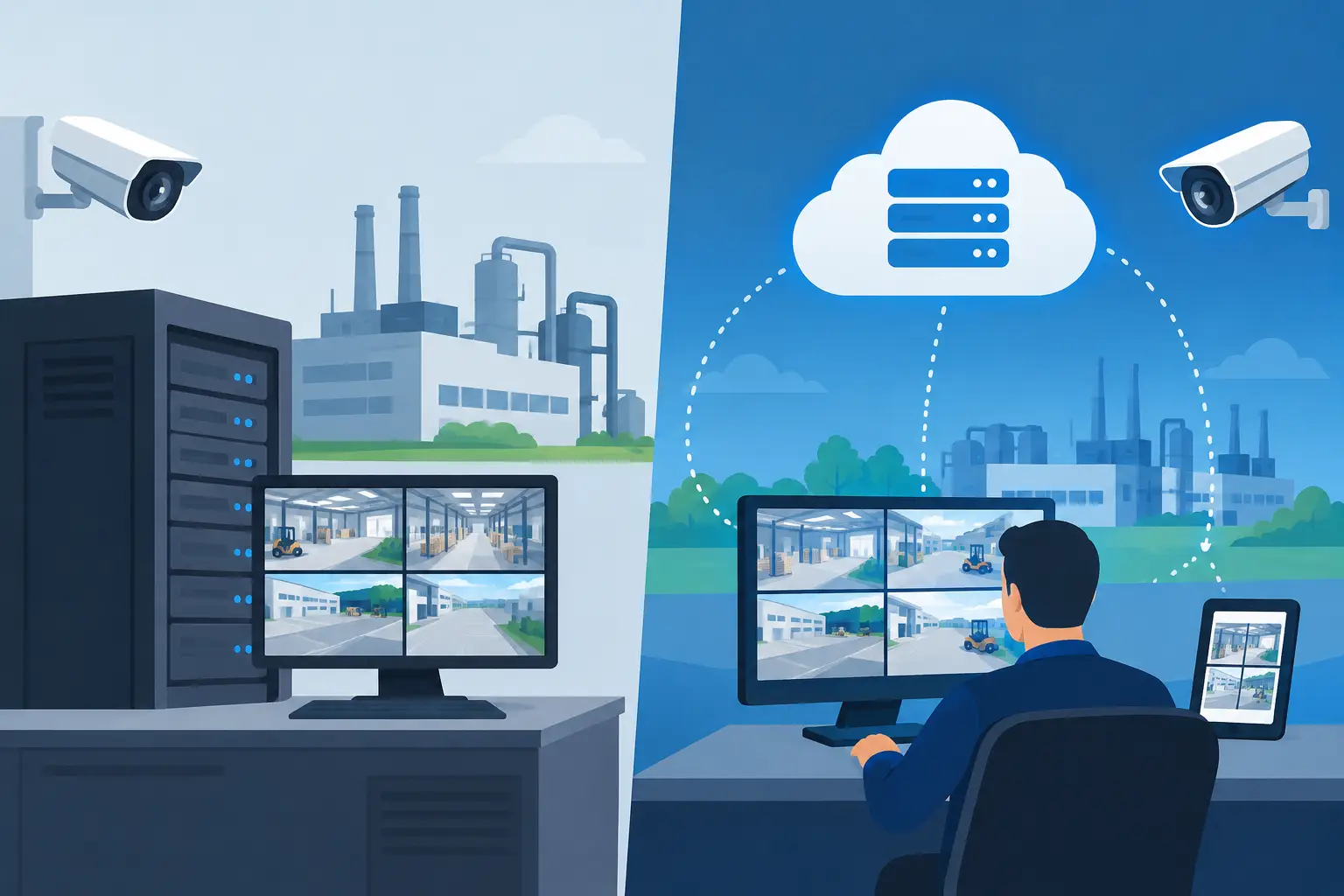
A surveillance system at a refinery, offshore platform, or commercial vessel cannot be selected on convenience alone. It must keep recording when bandwidth drops, provide usable evidence after an incident, and protect operational data from unauthorized access. The decision around on premise versus cloud surveillance is therefore a question of engineering, risk ownership, and lifecycle cost – not simply where video is stored.
For industrial operators, both models can deliver strong results when specified correctly. The wrong model can create recurring bandwidth charges, difficult incident retrieval, weak coverage in remote areas, or an unnecessary burden on site teams. The most effective decision starts with the operating environment, not a preference for a particular technology.
On-Premises Surveillance: Local Control Where It Counts
An on-premises surveillance system records footage to local network video recorders, servers, or edge storage installed at the facility, platform, vessel, or control room. Cameras, recording infrastructure, monitors, and network equipment are under the operator’s physical control.
This remains the preferred architecture for many critical sites because it continues to function even when external connectivity is limited or unavailable. A vessel at sea, an offshore installation using a constrained satellite connection, or a remote pumping station can retain full local recording and playback without depending on a public internet path.
The main strength is control. Security teams can define retention periods, access rights, recording quality, and archive procedures without sending continuous video to a third-party data center. This can simplify compliance where operational imagery, personnel records, process equipment, or restricted areas must remain within a controlled environment.
Local recording also supports high-bitrate applications. Thermal imaging, low-light coverage, multi-sensor units, and specialized gas detection cameras can generate significant data. Keeping that footage on site avoids forcing every stream through an expensive or unreliable uplink.
The trade-off is responsibility. The owner must provide suitable equipment rooms, protected power, cooling where required, physical security, software updates, replacement drives, and qualified support. A poorly maintained recorder is not a dependable security asset simply because it sits inside the facility.
Cloud Surveillance: Centralized Access and Faster Oversight
Cloud surveillance sends video, events, or selected recordings to remote infrastructure managed through an online platform. Authorized users can review live views, receive alerts, search incidents, and manage multiple locations from a browser or application.
For organizations operating several terminals, ships, substations, warehouses, or remote sites, this centralized visibility is valuable. A security manager can investigate an alarm across locations without traveling to the site or relying on local teams to export footage. Software updates, user administration, and expansion can also be easier to coordinate across a large estate.
Cloud platforms are especially effective when the requirement is event-led monitoring rather than continuous high-resolution archival. For example, a remote perimeter camera may send alarms, snapshots, and short event clips to a central team while retaining its full local recording separately. This reduces data transfer while preserving rapid situational awareness.
However, the cloud does not remove infrastructure requirements. Cameras still need power, network capacity, cybersecurity controls, and a reliable path to the internet. Remote industrial locations often have variable connectivity, restrictive firewall policies, or costly maritime communications. Continuous cloud recording may be impractical if it competes with operational traffic or if uplink availability is inconsistent.
Cloud service fees also require close scrutiny. A low entry cost can become a substantial operating expense when multiplied by camera count, retention duration, resolution, analytics, and years of service. Procurement teams should assess the full contract term rather than comparing only the initial hardware price.
On Premise Versus Cloud Surveillance: The Operational Test
The most useful comparison is not feature against feature. It is whether the system will still deliver evidence and visibility under real operating conditions.
For on-premises systems, ask what happens during a network outage, power event, recorder failure, or access control issue. The answer should include protected power, RAID or redundant storage, health monitoring, secure remote access, and a clear maintenance plan. Local systems are highly capable, but they must be designed as critical infrastructure rather than treated as a collection of cameras.
For cloud systems, ask how much video must leave the site, what happens if the uplink fails, where the data is stored, and how quickly footage can be retrieved after an incident. Confirm whether local edge recording continues independently, whether users can export evidence efficiently, and whether the service provider’s retention and access controls meet internal policy.
Cybersecurity deserves equal attention in both models. Default passwords, uncontrolled remote access, outdated firmware, and unmanaged switches create exposure regardless of where footage is stored. Industrial surveillance should use segmented networks, role-based permissions, encrypted communications, strong credential management, and documented patch procedures. A cloud dashboard is not a substitute for a secure network design.
Bandwidth Is Often the Deciding Factor
Bandwidth is where many cloud-first plans become expensive or unreliable. High-resolution video consumes far more capacity than a specification sheet may suggest, particularly when several cameras are active around the clock. Uploading multiple streams from a marine vessel or isolated industrial facility can strain the available connection and reduce performance for other business-critical systems.
Local recording keeps high-volume video traffic inside the site network. Remote operators can then access lower-bandwidth substreams, event clips, or selected playback when needed. This approach provides practical oversight without treating every camera feed as a permanent internet upload.
A carefully configured cloud deployment can manage bandwidth through motion-based recording, scheduled uploads, adaptive streaming, and event rules. Those measures are effective when the operational requirement allows them. They are less suitable when every second of process-area footage must be retained at full quality for investigation, safety review, or regulatory reasons.
Cost Must Include the Entire Service Life
On-premises surveillance usually requires higher initial investment in recorders, storage, network hardware, backup power, and installation. Over time, the recurring cost may be more predictable, especially for sites with many cameras and long retention periods. The organization owns the equipment, but it also owns the maintenance obligation and eventual refresh cycle.
Cloud surveillance can reduce local hardware requirements and speed deployment at smaller or widely distributed sites. Its cost structure shifts toward subscriptions, data usage, and managed service fees. That may be commercially attractive for a modest camera count, temporary operational requirement, or organization that wants centralized management without maintaining local servers.
Neither model is automatically cheaper. Compare five-year or seven-year total cost of ownership, including hardware, licenses, storage expansion, connectivity, cybersecurity support, replacement equipment, labor, and incident response. A system that appears inexpensive at purchase can become costly if it demands premium bandwidth or cannot support the retention period the site actually needs.
Where Each Model Fits Best
On-premises surveillance is often the stronger choice for refineries, chemical plants, power stations, offshore assets, and vessels where continuous recording, local resilience, and control over sensitive footage are priorities. It is also well suited to specialized applications such as monitoring hazardous process areas, subsea infrastructure, loading zones, and restricted perimeters.
Cloud surveillance can be a strong fit for dispersed, lower-bandwidth monitoring needs where central teams need rapid access across multiple locations. It can simplify oversight of entry points, yards, remote support facilities, and selected perimeter zones, provided connectivity and data policies are properly assessed.
In many industrial environments, the best answer is a hybrid design. Cameras record locally to protected on-site storage, while selected live views, alarms, health status, and incident clips are securely available to authorized remote users. This model maintains evidence capture during connectivity interruptions while giving operations leaders the visibility they need across assets.
Specify the System Around the Risk
Before selecting an architecture, define the events that matter most. A gas leak alarm, unauthorized approach to a berth, equipment failure, man-overboard investigation, perimeter breach, and safety incident do not all require the same camera placement, retention period, image quality, or remote access method.
Then assess the site conditions: available bandwidth, power quality, environmental exposure, hazardous-area requirements, required retention, existing network capacity, and who will operate the system after commissioning. A top-of-the-line surveillance platform only performs as intended when its cameras, storage, network, and support model are matched to those realities.
Revlight Security approaches industrial surveillance as a complete operating system, not a box-count exercise. The right design protects critical areas, supports fast playback and remote review, and avoids forcing your operation into a storage model that does not fit its risk profile.
Choose the architecture that preserves evidence when conditions are at their worst, not the one that looks simplest during a product demonstration. That standard will lead to better coverage, stronger accountability, and a surveillance investment that continues to earn its place long after installation.
🛡️ Secure Your Home or Business Today
Protect your home, office, shop, or business with reliable CCTV security cameras. Explore our range of CCTV cameras and find the right security solution for your needs.
Explore CCTV Cameras ✉️ Email Us


 Singapore :
+65-6708-9302