
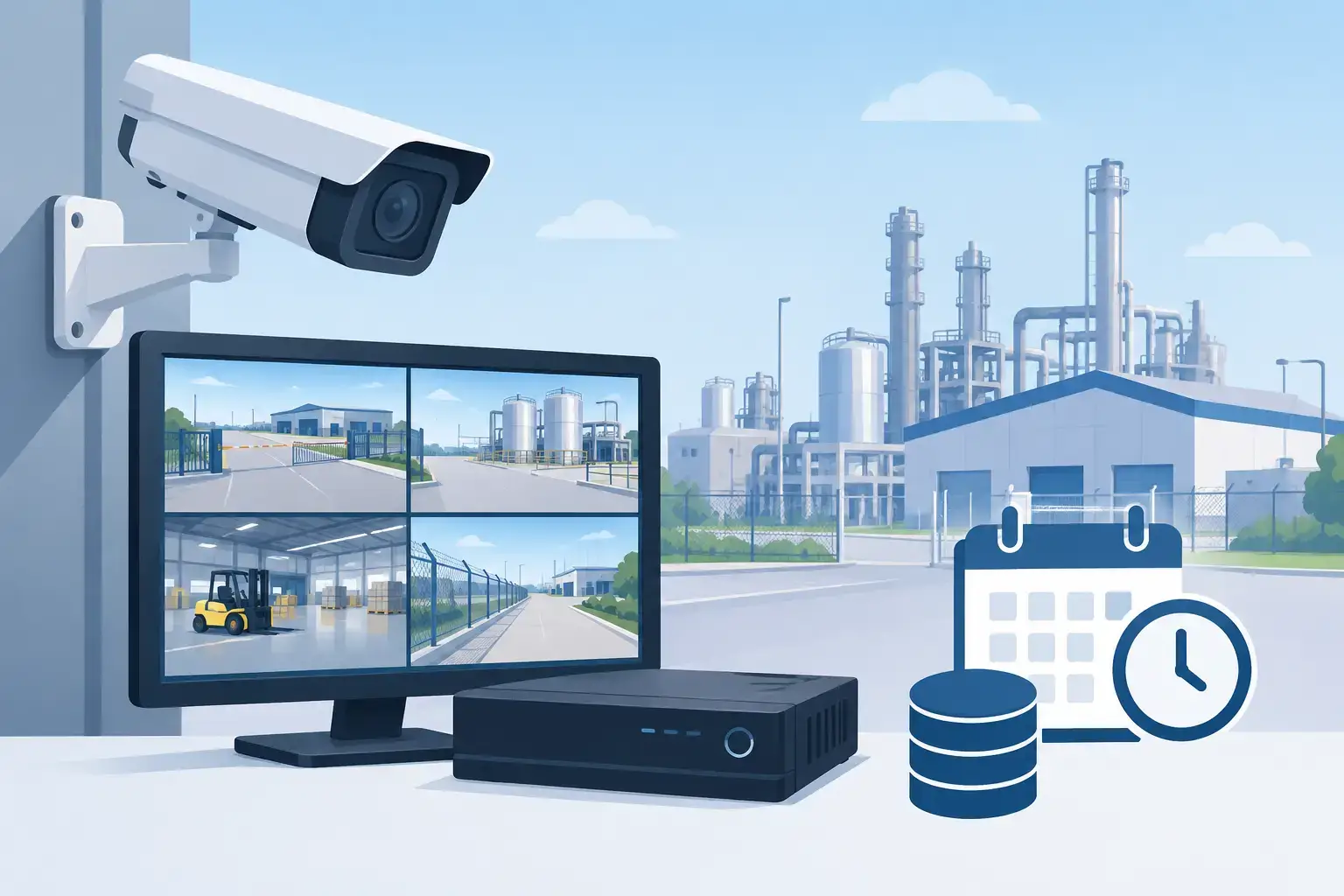
A refinery incident may not be reported until a contractor has left site, a vessel is already underway, or a process upset has been reviewed by several teams. That is why CCTV retention periods cannot be treated as a default recorder setting. For industrial operators, retention determines whether critical visual evidence is available when safety, security, environmental, insurance, or operational questions arise.
Keeping every video stream indefinitely is rarely practical or commercially sensible. Deleting footage too quickly is equally risky. The right policy balances the site’s risk profile, legal and contractual duties, incident reporting timelines, camera coverage, and the real cost of storage infrastructure.
What CCTV Retention Periods Mean
A CCTV retention period is the defined length of time recorded video remains available before the system automatically overwrites or deletes it. It applies to footage held on network video recorders, server-based video management systems, edge storage within cameras, and any approved secondary archive.
For a standard low-risk area, a short rolling retention window may be sufficient. For a tank farm, berth, control-room entrance, offshore platform access point, or hazardous-material loading zone, the same period may be inadequate. The difference is not the camera alone. It is the consequence of losing the evidence.
A retention period should also distinguish between routine footage and protected footage. Routine footage follows the rolling deletion schedule. Footage connected to an incident, complaint, alarm, near miss, claim, or investigation must be exported or placed under a legal hold before the automatic deletion cycle removes it.
How Long Should Industrial CCTV Footage Be Kept?
There is no universal number that fits every industrial facility. Many operations set a baseline of 30 days, then extend it to 60, 90, or more days for higher-risk locations and critical operational areas. The correct decision depends on how quickly an event is likely to be identified and escalated.
A marine operator may need longer retention because incidents can be reported after a vessel changes port or crew. An oil and gas facility may need extended coverage around perimeter security, flare systems, loading racks, production areas, and access control points because investigations can involve multiple contractors and delayed reviews. Power generation and chemical facilities may need additional retention where site access, regulated processes, or safety investigations demand stronger evidentiary support.
The strongest approach is a tiered schedule rather than one blanket setting across every camera. For example, general office corridors may have a shorter period than perimeter gates, custody-transfer points, dockside operations, or hazardous process areas. This controls storage costs without weakening surveillance where it matters most.
Start With Incident Discovery Time
Ask a practical question: how long does it normally take before your operation knows an event happened? If fuel theft, unauthorized access, equipment interference, or a safety violation may remain undiscovered for several weeks, a 14-day retention policy is not defensible from an operational standpoint.
Also account for reporting delays. Contractors may report concerns after demobilization. Vessel operators may need to retrieve footage after a voyage. A leak alarm, equipment fault, or environmental concern can trigger review only after engineers correlate data from several systems. Your retention period must leave enough time for that review to begin.
Consider Regulatory, Contractual, and Insurance Requirements
Site rules, privacy requirements, customer contracts, flag-state obligations, port rules, insurance conditions, and local laws can all affect video retention. These obligations vary by jurisdiction and facility type, so the retention policy should be verified with legal, compliance, and security stakeholders.
Avoid copying a retention number from another site without checking the operating context. A policy that works for a warehouse may fail at an offshore installation or refinery. Document the business reason for each retention tier, the systems it covers, and who can approve exceptions.
Calculate Storage Before You Set the Policy
Retention is ultimately a storage design decision. A system can only retain footage for the period it has been sized to hold. High-resolution cameras, low-light imaging, thermal streams, analytics metadata, audio where permitted, continuous recording, and high frame rates all increase capacity requirements.
A useful planning calculation is:
Number of cameras × average bitrate × recording hours per day × retention days = required raw storage
The real requirement is higher than the raw estimate. Allow capacity for RAID or other redundancy, system overhead, database indexing, export space, future camera additions, and a safety margin. If a recorder is designed at maximum capacity from day one, it will not maintain the promised retention period when bitrates rise or additional cameras are added.
Bitrate deserves close attention. A 4K stream recording continuously at a high bitrate consumes dramatically more storage than a 1080p stream operating on event recording. However, reducing bitrate too far can make footage unusable for identification, process review, or forensic analysis. The cheapest storage plan is not a saving if it produces images that cannot answer the question asked during an investigation.
Continuous Recording Versus Event Recording
Continuous recording is often the correct choice for critical industrial areas. It captures context before and after an alarm, supports incident reconstruction, and avoids missed events caused by poor motion detection settings. It is particularly valuable in dynamic environments with weather, steam, vibration, changing light, marine movement, or busy work zones.
Event recording can reduce storage demand in lower-risk areas, but it must be tested in the actual environment. Motion detection may trigger continuously in rain, waves, shadows, moving vegetation, or process activity. Conversely, it may fail to capture a slow-moving person, a partially obscured vehicle, or an event outside the configured detection zone.
A practical design may use continuous recording for critical cameras and event-based recording for selected secondary views. The result is stronger evidence where the consequences are highest and more efficient use of available storage elsewhere.
Build a Retention Policy That Works During an Incident
A retention policy is only useful if staff can act on it under pressure. Security teams, control-room personnel, vessel officers, supervisors, and authorized managers need a clear process for preserving footage before it is overwritten.
The policy should define who can request footage, who can export it, how the export is logged, where it is stored, and how access is controlled. It should also state when routine video becomes protected evidence. A clear trigger could include a security alarm, safety event, environmental concern, personnel complaint, property damage, equipment tampering, or formal request from management, insurers, or authorities.
For significant incidents, retain the relevant footage plus a meaningful time window before and after the event. A clip showing only the moment of impact may not reveal what led to it. Camera time synchronization is also essential. If recorder clocks, access-control logs, alarms, and process data do not align, the investigation becomes slower and less reliable.
Test Your Actual Retention, Not the Configuration Screen
A recorder may display a 30-day target while delivering less retention in practice. Changes in scene complexity, camera settings, firmware, recording profiles, or added devices can shorten the real archive window without being immediately obvious.
Review actual oldest footage on a scheduled basis. Check that each critical camera records at the intended resolution, frame rate, and time stamp. Confirm that failed disks, camera dropouts, network interruptions, and overwritten alarm clips are reported promptly. For remote installations, verify that local recording continues when the backhaul connection is unavailable.
This is especially relevant for offshore and marine operations, where bandwidth may be constrained and onshore access may be intermittent. Local storage should protect essential evidence, while network architecture should support secure retrieval when connectivity is restored. The system must perform at the edge, not only in ideal office-network conditions.
Common Retention Mistakes That Increase Risk
The most expensive errors are usually planning errors. One is applying the same retention period to every camera, regardless of risk. Another is buying storage based on camera count alone while ignoring bitrate, recording mode, redundancy, and future expansion.
A third mistake is retaining video but making it difficult to find. Without logical camera naming, synchronized time, operator permissions, health monitoring, and reliable playback tools, stored footage becomes operationally weak. Finally, organizations often forget to test preservation procedures until after an event, when the footage may already be gone.
Revlight Security helps industrial and marine buyers specify surveillance infrastructure around real operating requirements, including recording performance, remote access, environmental durability, and scalable network design. The objective is not simply more storage. It is dependable footage available when the operation needs answers.
Set CCTV retention periods around the time it takes your organization to detect, report, investigate, and resolve an event. When the policy, recorder capacity, camera settings, and preservation process all support that timeline, video becomes a working asset rather than a record that disappeared too soon.
🛡️ Secure Your Home or Business Today
Protect your home, office, shop, or business with reliable CCTV security cameras. Explore our range of CCTV cameras and find the right security solution for your needs.
Explore CCTV Cameras ✉️ Email Us



 Singapore :
+65-6708-9302