
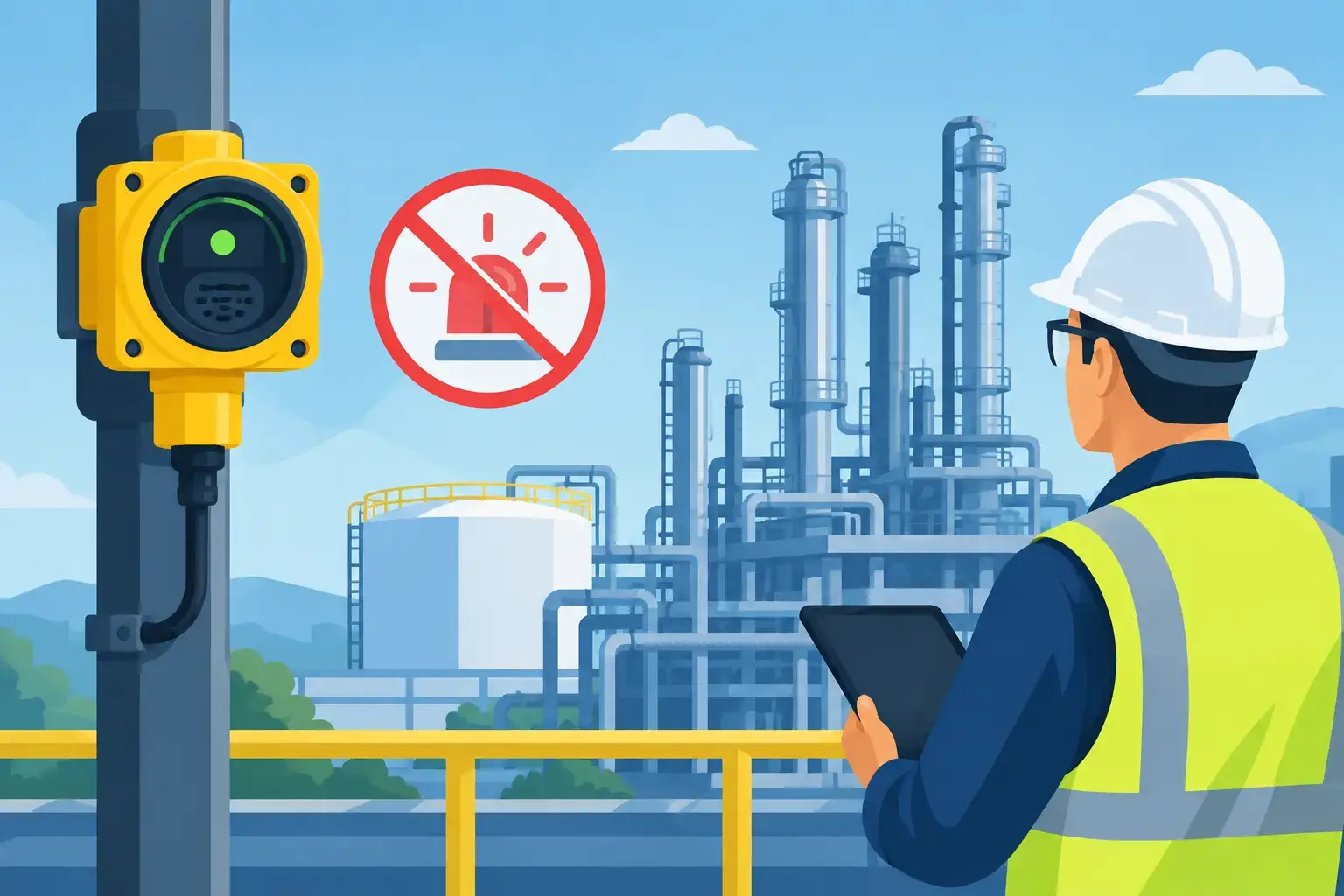
A gas alarm that repeatedly activates without a confirmed hazardous release does more than interrupt a shift. It pulls personnel from critical work, triggers unnecessary shutdown decisions, erodes confidence in the detection system, and can make a genuine warning easier to dismiss. To reduce false gas alarms, industrial operators need to treat nuisance activations as an engineering and operations issue, not simply a detector problem.
In refineries, offshore facilities, chemical plants, power stations, and marine environments, gas detection is exposed to changing temperatures, process emissions, weather, vibration, contamination, and complex airflow. A reliable strategy must account for the actual hazard, the actual environment, and the way people respond when an alarm occurs.
Why false gas alarms create operational risk
Every alarm should produce a clear and disciplined response. When alarms occur too frequently without a verified gas event, crews can become conditioned to view them as routine faults. This is alarm fatigue, and it is a serious safety exposure in facilities where combustible, toxic, or oxygen-displacing gases may be present.
There is also a commercial cost. False alarms can stop maintenance, delay cargo operations, require emergency callouts, and force supervisors to investigate events with limited evidence. In a high-output process area, repeated disruptions quickly become expensive. The objective is not to make detection less sensitive. It is to improve signal quality so the system identifies credible hazards while filtering out predictable non-hazard conditions.
That distinction matters. Raising alarm thresholds may reduce alerts, but it can also reduce the safety margin needed to identify a small leak before it escalates. Better results come from improving detector selection, positioning, maintenance, and alarm verification.
Start with the cause, not the alarm history
Alarm logs are useful, but they only show the symptom. A proper review should compare alarm times with process conditions, weather, maintenance activity, ventilation status, cleaning routines, vessel movements, and nearby equipment operation. Patterns usually emerge quickly.
For example, an open-path detector may alarm during heavy fog, steam discharge, or airborne particulates. A point detector installed near a vent or drain may respond to normal process releases. An electrochemical sensor can drift when exposed to temperature swings or chemical contaminants. Offshore, salt spray and vibration can affect equipment condition and the stability of supporting infrastructure.
Classify events before changing any configuration. Was the alarm caused by a confirmed release, a normal process condition, environmental interference, sensor contamination, communication failure, or an unknown condition? Unknown events deserve the most attention. They may be false alarms, but they may also indicate a small intermittent leak that conventional investigation methods have missed.
Review the alarm sequence
A single detector alarm is different from multiple devices responding in a credible plume path. Review timestamps, concentrations, wind direction, nearby process data, and video records where available. If alarms occur at the same time each day, during washdowns, or after a specific pump starts, the issue is likely tied to a repeatable operating condition.
This evidence-based approach prevents a common mistake: replacing a detector that is correctly reporting an unsuitable installation location.
Match detector technology to the hazard
No gas detection technology is ideal for every application. Selecting equipment based only on gas type or initial purchase price often creates avoidable nuisance alarms later. The detection method must suit the target gas, expected concentration range, response-time requirement, ambient conditions, and maintenance capability of the site.
Catalytic bead sensors are widely used for combustible gases, but they require oxygen to function and can be affected by poisons or inhibitors in the environment. Infrared detectors can be highly effective for hydrocarbon detection and do not depend on oxygen, yet their optical paths must remain clean and appropriate for the gas being monitored. Electrochemical sensors provide targeted toxic-gas measurement but have defined service lives and may be cross-sensitive to other gases.
Open-path systems are valuable for monitoring broad areas, fence lines, loading zones, and potential leak paths. However, they require a stable optical path and careful assessment of fog, dust, steam, vibration, and alignment. In the wrong environment, a point detector or alternative monitoring method may deliver more dependable results.
The right answer depends on the consequence of a missed leak and the operating conditions. A layered design frequently performs best: fixed point detection near likely sources, area coverage for plume migration, and camera-based gas visualization to support rapid confirmation.
Improve placement before adjusting thresholds
Detector placement is one of the strongest controls available to reduce false gas alarms without weakening protection. Devices should be located according to gas behavior, release scenarios, ventilation patterns, obstructions, and access for inspection. They should not be positioned simply where mounting is easiest.
Hydrogen and methane tend to rise, while many heavier hydrocarbon vapors can settle or travel along low points. Yet gas behavior is never determined by density alone. Mechanical ventilation, wind, heat sources, enclosed structures, and process equipment can redirect a plume in ways that defeat generic placement rules.
Pay particular attention to detectors installed near relief valves, vents, exhaust outlets, doors, washdown areas, and routine transfer points. If a location experiences short-duration, non-hazardous releases as part of normal operation, it may require a different alarm philosophy, physical relocation, or a separate monitored zone. Do not use a blanket delay to hide an installation problem.
Protect the measurement environment
A detector must be exposed to the gas hazard, not to unnecessary interference. Weather guards, splash protection, appropriate enclosures, sunshades, and properly selected sample systems can help, provided they do not obstruct gas access or conflict with the manufacturer’s requirements.
For outdoor and offshore installations, inspect mounting rigidity and cable protection. Vibration, movement, corrosion, and water ingress can create intermittent faults that look like gas alarms at the control room level. Reliable mechanical installation is part of reliable detection.
Build calibration and maintenance around actual conditions
A detector can pass a basic functional check and still produce unreliable readings if its calibration, response characteristics, or physical condition are not managed correctly. Maintenance intervals should reflect environmental severity and device performance history, not only the minimum calendar schedule.
Dirty optics, blocked flame arrestors, degraded filters, damaged seals, sensor poisoning, and aging components can all affect readings. Sites with salt air, airborne oil, chemical vapor, dust, or frequent washdowns generally need a more demanding inspection plan than clean indoor facilities.
Use traceable calibration gas where applicable, document as-found readings before adjustment, and investigate recurring drift. A repeated need for correction may point to contamination, unsuitable sensor technology, incorrect gas concentration, or environmental exposure outside the intended operating range.
Remote diagnostics can improve this process by identifying communication losses, fault states, signal degradation, and abnormal alarm frequency before the issue becomes operationally disruptive. But remote status does not replace field inspection. A clean signal on a screen cannot prove that an optical window, sensor inlet, or mounting assembly is in acceptable physical condition.
Use visual verification to improve response quality
Gas detection tells operators that a threshold has been reached. It may not show where the gas originated, whether a plume is moving, or whether a visible process condition explains the event. This is where gas leak detection cameras add significant value.
A properly specified optical gas imaging system can help teams verify hydrocarbon releases from a safe standoff distance, inspect valves and flanges, assess suspect equipment, and direct maintenance resources toward the source. In fixed surveillance applications, a gas-capable camera can provide an additional verification layer in high-risk areas such as compressor stations, tank farms, manifolds, loading zones, and offshore process modules.
Visual verification should support the alarm response plan, not override it. Operators must still follow emergency procedures when detection indicates a potentially dangerous concentration. The practical advantage is faster situational awareness: teams can distinguish between a developing leak, a routine venting event, an environmental interference issue, or a detector fault with better evidence.
Configure alarm logic with discipline
Alarm logic should be designed around risk, not convenience. A brief time delay, voting logic across appropriately placed detectors, or separate advisory and high-high alarm levels can reduce unnecessary escalations when supported by a documented hazard analysis. These measures are not universal fixes.
Voting logic may be unsuitable where a single detector is the only practical means of identifying a fast, localized release. Time delays can be dangerous if a gas cloud can reach an ignition source rapidly. Any configuration change should be reviewed by competent process safety, instrumentation, and operations personnel, then tested under controlled conditions.
Clear alarm messages also matter. An operator should be able to see the detector identity, area, gas type, concentration, status, and related camera view or process condition without searching across multiple screens. Faster interpretation reduces both unnecessary dispatches and delayed emergency action.
Reduce false gas alarms through accountable improvement
The best-performing sites treat every nuisance alarm as data. They track frequency by location, device type, environmental condition, and probable cause. They assign ownership for corrective actions and confirm whether changes actually reduce events without compromising detection coverage.
For procurement and operations leaders, the purchasing decision should extend beyond the sensor. Select detection and surveillance infrastructure that fits the facility’s hazard profile, supports maintenance access, integrates with control-room workflows, and delivers evidence when an alarm occurs. Lower alarm noise is valuable, but higher confidence in every safety decision is the real return.
A credible gas detection system should make the next alarm easier to trust, faster to investigate, and safer to act on.
🛡️ Secure Your Home or Business Today
Protect your home, office, shop, or business with reliable CCTV security cameras. Explore our range of CCTV cameras and find the right security solution for your needs.
Explore CCTV Cameras ✉️ Email Us



 Singapore :
+65-6708-9302