
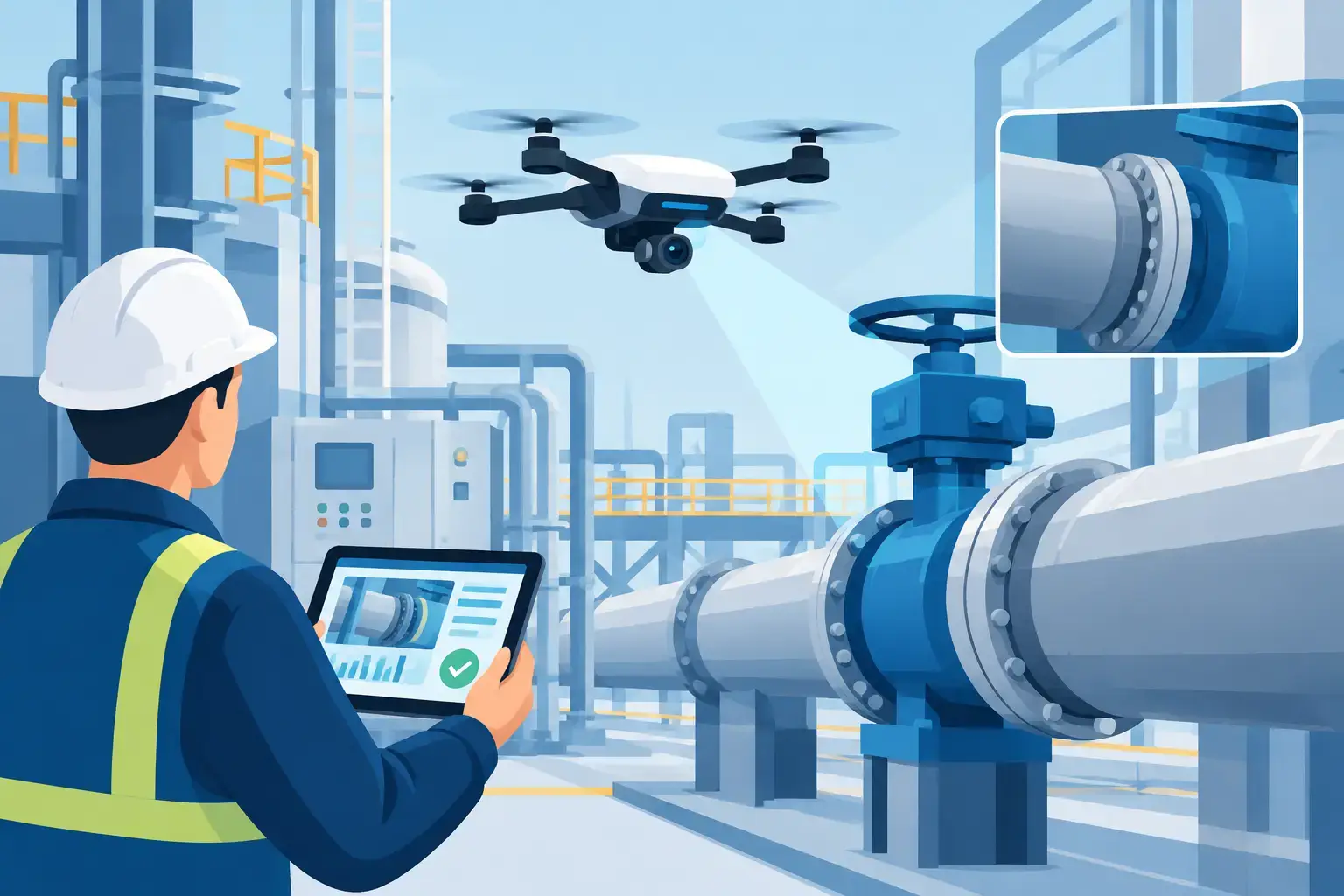
A flare stack, ballast tank, offshore jacket, or refinery pipe rack does not become safer because an inspection is scheduled. It becomes safer when usable evidence reaches the people who can act on it before a small defect becomes an outage, release, or personnel incident. Autonomous inspections give industrial operators a practical way to collect that evidence more often, in harder-to-reach locations, and with less time spent placing people near hazardous assets.
For oil and gas, marine, energy, and process facilities, the value is not automation for its own sake. The value is earlier detection, more consistent inspection coverage, recorded proof of asset condition, and fewer unnecessary site visits. When the system is specified correctly, autonomous monitoring supports the inspection team rather than attempting to replace the engineering judgment that protects the operation.
What Autonomous Inspections Mean in Industrial Sites
Autonomous inspections use fixed, remotely operated, or scheduled sensing systems to gather visual, thermal, gas, acoustic, or environmental data without requiring a technician to be physically present at every observation point. The system can capture footage or readings on a defined schedule, trigger an alert when a condition changes, and send data to a control room, vessel bridge, or remote operations center for review.
This is a materially different approach from occasional manual rounds. Manual inspections remain essential for hands-on verification, maintenance, testing, and repair. But they can be limited by weather, confined-space access, work permits, personnel availability, vessel movements, and the simple cost of repeatedly reaching the same remote location. Autonomous coverage fills the gap between those rounds.
At an offshore platform, that may mean fixed underwater imaging around subsea structures, risers, intake points, or hull-adjacent areas. At a refinery, it may mean gas detection imaging focused on valves, compressors, flanges, and process equipment where fugitive emissions create operational and regulatory exposure. On a vessel, it can include monitored machinery spaces, deck zones, access points, and networked surveillance that remains available to authorized crew and shore teams.
Why Inspection Programs Are Moving to Continuous Evidence
The traditional inspection model is often driven by calendar intervals. That model is understandable, but it can leave long periods between observations. A developing leak, coating failure, obstruction, unauthorized access event, or marine growth issue does not wait for the next planned route.
Autonomous systems provide a more active inspection posture. They create repeatable views from the same angle, at the same location, under defined operating conditions. That consistency matters. A superintendent comparing footage from month to month can identify a gradual change that may be missed when different personnel inspect from different positions.
The commercial impact is equally clear. Sending personnel to inspect difficult areas can require permits, standby support, vessel time, access equipment, isolation procedures, and production coordination. Reducing unnecessary exposure and repeat mobilization can lower operating cost while allowing the team to focus labor on confirmed issues. For procurement managers, the strongest business case is usually not a single dramatic event. It is the accumulated saving from faster verification, fewer wasted callouts, and better maintenance planning.
There is also an accountability benefit. Recorded inspection data creates a traceable history of what was observed, when it was observed, and how the condition changed. That is valuable during incident review, contractor management, insurance discussions, and asset handover.
Selecting the Right Autonomous Inspection System
A successful deployment starts with the inspection question, not the device specification. “We need more surveillance” is too broad. Define the failure mode or operational uncertainty first. Are you trying to identify hydrocarbon emissions, verify a subsea condition, monitor a restricted zone, confirm equipment status, or provide remote situational awareness during an operation?
The environment then determines the equipment standard. Marine and offshore installations need systems designed for salt exposure, vibration, humidity, washdown, low-light conditions, and constrained communications. Refinery and chemical applications may require equipment suitable for hazardous areas, high temperatures, corrosive atmospheres, and locations where gas detection performance must be dependable. Power generation sites may prioritize long cable runs, wide-area coverage, high-voltage separation, and integration with existing control infrastructure.
Image quality is only one part of the requirement. Buyers should consider field of view, illumination, housing material, ingress protection, operating temperature, mounting options, recording retention, and the ability to access live and archived data. A system that produces excellent footage but cannot maintain stable network connectivity at the asset is not a complete inspection solution.
For remote or offshore assets, communications design deserves early attention. Bandwidth may be limited, intermittent, or expensive. The right network architecture can prioritize alerts and critical streams while retaining local recording for later retrieval. Marine WiFi and industrial network solutions should be specified as part of the inspection system, not treated as an afterthought once equipment is installed.
Detection Must Match the Hazard
Visual monitoring is highly effective for many conditions, including access control, mechanical movement, fluid presence, structural changes, and process-area awareness. It is not the right tool for every hazard. A gas release, for example, may require purpose-built optical gas detection rather than standard visual coverage.
This distinction matters when evaluating supplier claims. The right system should help operators identify the condition they actually need to manage. A methane detection solution should be selected for its ability to reveal and document emissions in the relevant operating environment. Underwater inspection equipment should be selected for water clarity, depth, lighting, mounting position, and the specific structure being observed.
Where Automation Delivers the Strongest Return
The best applications are typically areas that are hazardous, remote, repetitive, difficult to access, or critical to production continuity. Offshore operators may use scheduled observation of subsea zones and marine interfaces to reduce unnecessary intervention. Ship managers can improve oversight of key onboard areas without relying solely on physical rounds, especially when crews are managing cargo, navigation, machinery, and security tasks at the same time.
Refineries and chemical plants can use continuous detection and recorded coverage to support leak investigation, perimeter control, and process-area monitoring. Power stations can apply the same principle to isolated structures, transmission-adjacent zones, cooling areas, and equipment rooms where rapid awareness supports safer maintenance decisions.
However, the highest return does not always come from monitoring the largest area. It often comes from covering the point where uncertainty is most expensive. One critical compressor train, loading connection, valve bank, intake structure, or restricted-access corridor can justify a focused system if it repeatedly causes callouts, delays, or safety concerns.
Integration Is What Turns Data Into Action
Autonomous inspections can create a large volume of data. Without clear alarm logic, review responsibilities, and retention rules, that volume becomes another burden for operations teams. The objective is actionable evidence, not an endless stream of footage.
Set practical thresholds for alerts. Define who receives them, who verifies them, and what response is expected at different levels of severity. For some applications, a control room operator may review an alert immediately. For others, the event may be logged for maintenance planning and compared with previous recordings during a daily or weekly review.
Integration with existing surveillance, access control, operational networks, and recording platforms can improve response speed, but it should be handled carefully. Cybersecurity, user permissions, segmentation, and remote-access controls are operational requirements. A remotely accessible inspection system should provide authorized visibility without creating an unnecessary pathway into critical infrastructure.
Revlight Security supports this approach with specialist surveillance, detection, and industrial network solutions built around the operating realities of marine, energy, and high-risk facilities. The right configuration combines dependable field equipment with recording, playback, remote access, and communications designed for the site rather than a generic installation.
The Limits of Autonomous Inspection
Automation has trade-offs. Poor positioning can create blind spots. Dirty lenses, marine fouling, inadequate lighting, network interruptions, and false alerts can reduce system value if maintenance is ignored. Detection equipment must also be tested and maintained according to its intended use, particularly where safety, emissions, or compliance decisions depend on performance.
Autonomous inspection does not remove the need for competent personnel. It helps those personnel make better decisions with better information. Engineers still need to assess severity. Maintenance teams still need to inspect, isolate, repair, and certify equipment. Operations leaders still need to decide when a developing condition requires shutdown, escalation, or continued monitoring.
The strongest programs use automation to direct human effort where it matters most. Instead of sending people out to look for an unknown problem, teams can respond to a recorded condition with a clearer understanding of location, timing, and likely priority.
When choosing an autonomous inspection system, start with the asset that creates the greatest exposure when it cannot be seen, verified, or reached quickly. The right surveillance and detection coverage turns that blind spot into an informed operational decision.
🛡️ Secure Your Home or Business Today
Protect your home, office, shop, or business with reliable CCTV security cameras. Explore our range of CCTV cameras and find the right security solution for your needs.
Explore CCTV Cameras ✉️ Email Us

 Singapore :
+65-6708-9302