
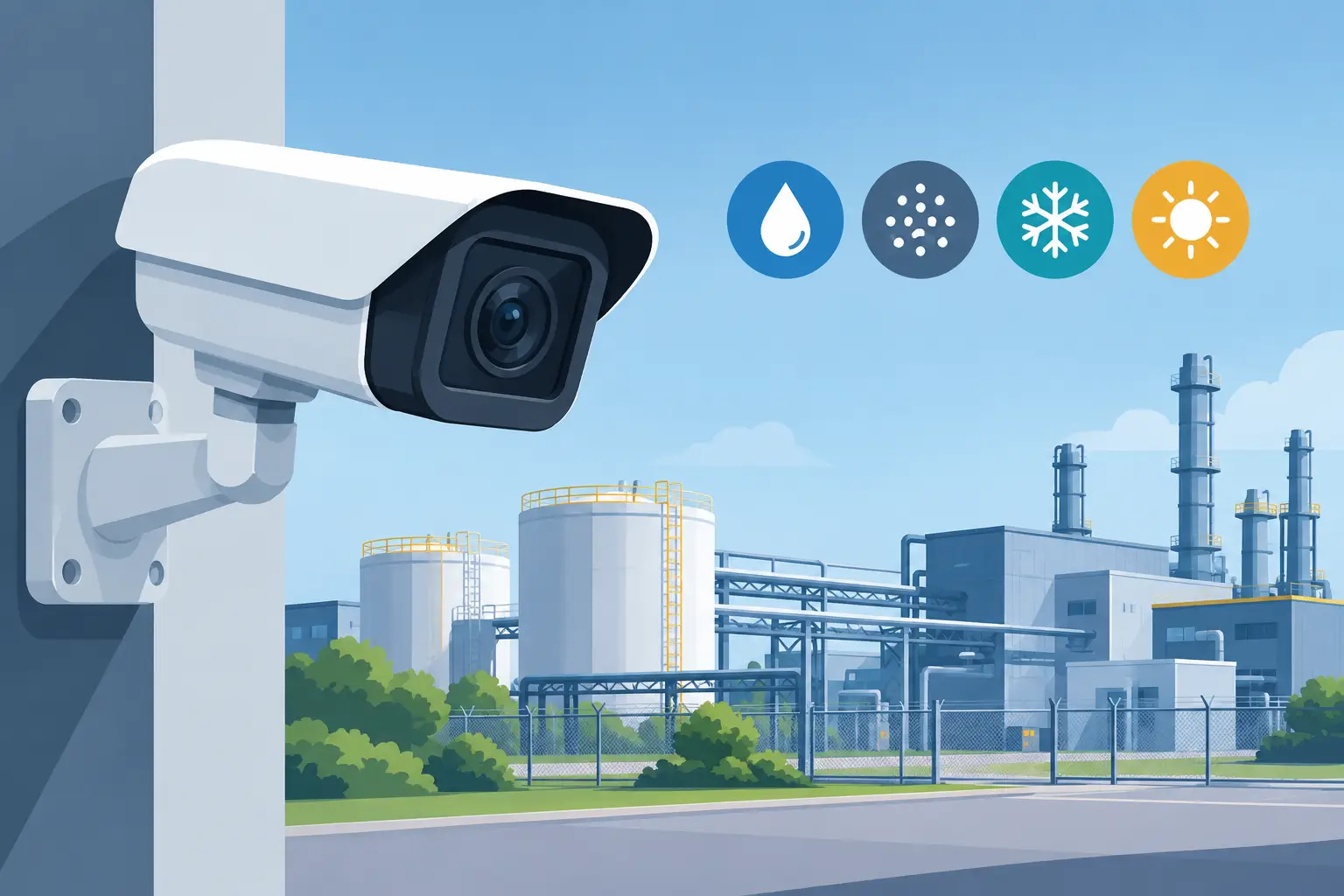
A refinery camera mounted above a loading rack can look fully operational on installation day, then fail months later after dust intrusion, salt-laden air, pressure washing, or water entering through an incorrectly sealed cable gland. Camera ingress ratings are the first screening tool for avoiding that outcome. They define how well an enclosure resists solid contaminants and water – but they are only useful when the rating matches the actual exposure at the site.
For procurement teams and operations managers, the goal is not to specify the highest IP rating on every line item. It is to buy surveillance equipment that will perform through the conditions it will face, without paying for protection the installation does not require. A camera monitoring a clean control room, a gas processing unit, a vessel deck, and a submerged structure each need very different levels of enclosure protection.
What Camera Ingress Ratings Actually Measure
Ingress protection, usually shown as an IP code, is defined under IEC 60529. The two digits after IP describe resistance to solid objects and dust, followed by resistance to water. For example, IP66 and IP68 may both suit harsh industrial work, but they address different exposure risks.
The first digit ranges from 0 to 6. In industrial surveillance, the relevant distinction is usually between IP5X, which is dust protected, and IP6X, which is dust tight. Dust protected equipment limits dust entry to a level that should not impair operation. Dust-tight equipment is designed to prevent dust ingress entirely under the standard test conditions.
The second digit ranges from 0 to 9. It covers water from dripping and spraying through powerful jets, temporary immersion, continuous immersion, and high-temperature, high-pressure washdown. This number often drives the purchasing decision because outdoor facilities, marine assets, and process areas face rain, spray, washdown, and standing water routinely.
A higher number is not automatically a better fit in every respect. IP68, for example, indicates suitability for continuous immersion, but the test depth, duration, and other conditions must be stated by the manufacturer. It does not mean that any IP68 unit can be installed at any subsea depth indefinitely.
Reading the IP Code for Real Operating Conditions
For most fixed surveillance deployments, a practical interpretation looks like this:
| Rating | What it generally protects against | Typical use case | |—|—|—| | IP54 | Limited dust ingress and water splashes | Protected industrial interiors and sheltered equipment rooms | | IP65 | Dust-tight enclosure and water jets | Outdoor cameras with normal weather exposure | | IP66 | Dust-tight enclosure and powerful water jets | Vessel decks, refineries, exposed yards, and washdown-prone areas | | IP67 | Dust-tight enclosure and temporary immersion | Low-mounted assets with a credible flood or temporary submersion risk | | IP68 | Dust-tight enclosure and continuous immersion to stated conditions | Underwater inspection and permanently submerged installations | | IP69K | Dust-tight enclosure and high-pressure, high-temperature washdown | Specialized hygiene or aggressive washdown environments |
IP65 can be adequate for a camera under an eave in a moderate climate. It may be a poor choice on an offshore platform where wind-driven rain, salt spray, vibration, and maintenance washdowns all occur. In that setting, IP66 is often the stronger baseline, provided the housing, connectors, and installation hardware are equally suited to the environment.
For an underwater camera system, ask for more than the IP68 label. Confirm the approved operating depth, pressure rating, cable type, connector design, lens window material, and the expected duration of submersion. Hydrostatic pressure rises rapidly with depth, and a housing that passes a shallow immersion test may not be engineered for a deepwater inspection task.
The Rating Is Only as Good as the Installed System
A properly rated camera can lose its protection through a poor installation. This is one of the most expensive and preventable failures in industrial surveillance. Water seldom needs a dramatic opening to enter an enclosure. A loose gland, wrong gland insert, damaged O-ring, unused conduit entry, or cable that wicks moisture into the housing can defeat the stated rating.
Specify compatible cable glands and junction boxes with at least the same environmental protection level as the camera. Where a camera connects through a field junction box, the assembly should be reviewed as one protection system. An IP66 camera connected to an IP54 box does not create an IP66 installation.
Cable routing also matters. Install drip loops where appropriate, avoid upward-facing cable entries, and protect cable runs from abrasion and repeated flexing. On vessels and offshore structures, vibration can gradually loosen fittings that appeared secure at commissioning. Planned inspection of seals and mounting points is considerably cheaper than replacing failed equipment during an unplanned outage.
Thermal cycling deserves the same attention. A sealed enclosure installed in a hot process area may heat during the day and cool overnight, creating pressure changes that stress seals over time. This does not make the IP rating invalid, but it reinforces why proven housings, correctly rated glands, and disciplined maintenance are essential.
IP Ratings Do Not Replace Other Industrial Approvals
Camera ingress ratings are a valuable environmental specification, not a complete suitability statement. An IP66 unit may withstand powerful water jets and still be unacceptable in a hazardous area. If the location has flammable gas, vapor, dust, or combustible particulate risk, the equipment must also carry the required hazardous-location approval for the applicable area classification.
Likewise, IP performance does not measure corrosion resistance. Offshore and coastal applications require careful attention to housing material, coatings, stainless steel grade, fasteners, sunshields, and mounting brackets. Salt spray can damage inferior finishes and galvanically incompatible hardware long before water enters the enclosure.
Impact resistance is another separate issue. IK ratings indicate a housing’s resistance to mechanical impact. A camera mounted within reach at a loading terminal or along a busy industrial access route may need both a high ingress rating and a suitable impact rating. The right specification depends on the threat model, mounting height, traffic patterns, and likelihood of accidental contact.
Network reliability must also be addressed. Moisture-resistant housings do not compensate for unsuitable outdoor Ethernet components, exposed power connections, inadequate surge protection, or network cabinets that overheat. A dependable surveillance system is engineered from the camera lens to the recording and remote-access infrastructure.
How to Specify the Right Protection Level
Start with the exact location, not a generic product category. Ask whether the camera will be indoors or outdoors, exposed to dust, subject to direct rain or salt spray, washed down, temporarily flooded, or permanently submerged. Then identify the cleaning procedure. A hose-down, a high-pressure wash, and a high-temperature wash are materially different conditions.
Next, assess installation geometry. A camera facing upward, mounted low near deck level, or located below a pipe flange may receive far more water than another unit only a few feet away. Process areas can create localized vapor, condensate, dust, and chemical exposure that are not obvious on a site plan.
For procurement documents, require the manufacturer to state the full IP rating, the applicable test standard, and any limitations. For IP68 equipment, the approved depth and duration should be written into the specification. For IP69K, verify that the equipment is genuinely tested for the washdown environment rather than simply described as washdown capable.
Avoid over-specification when it offers no operational value. A fully submerged-rated unit may add cost, size, and service complexity to a dry indoor application. Conversely, saving modestly on an under-rated outdoor camera can create replacement costs, coverage gaps, labor exposure, and lost evidentiary footage that far exceed the initial purchase price.
Selecting Cameras for Marine, Energy, and Process Sites
High-risk facilities benefit from a site-specific camera schedule. Each position should identify the viewing objective, mounting location, ambient conditions, expected contaminants, cleaning method, required approvals, and network or power connection method. This gives engineering, operations, and procurement teams a common basis for comparing products.
For exposed marine and offshore positions, IP66 is frequently a sensible minimum starting point, with corrosion-resistant construction and marine-ready connections evaluated alongside it. For submerged work, use equipment specifically engineered for the operating depth and pressure, not a general-purpose enclosure with a broad IP68 claim. For dusty processing areas, prioritize IP6X protection and inspect every gland, conduit interface, and access cover as part of commissioning.
Revlight Security supports industrial buyers with surveillance and detection equipment selected for demanding operational environments. The best result comes from matching the camera, housing, network components, and installation method to the real conditions on site.
Before issuing a purchase order, walk the proposed camera location with the maintenance team. They can often identify the washdown path, spray zone, flood risk, or corrosion issue that is missing from a drawing – and that single observation can determine the ingress rating your system actually needs.
🛡️ Secure Your Home or Business Today
Protect your home, office, shop, or business with reliable CCTV security cameras. Explore our range of CCTV cameras and find the right security solution for your needs.
Explore CCTV Cameras ✉️ Email Us


 Singapore :
+65-6708-9302