
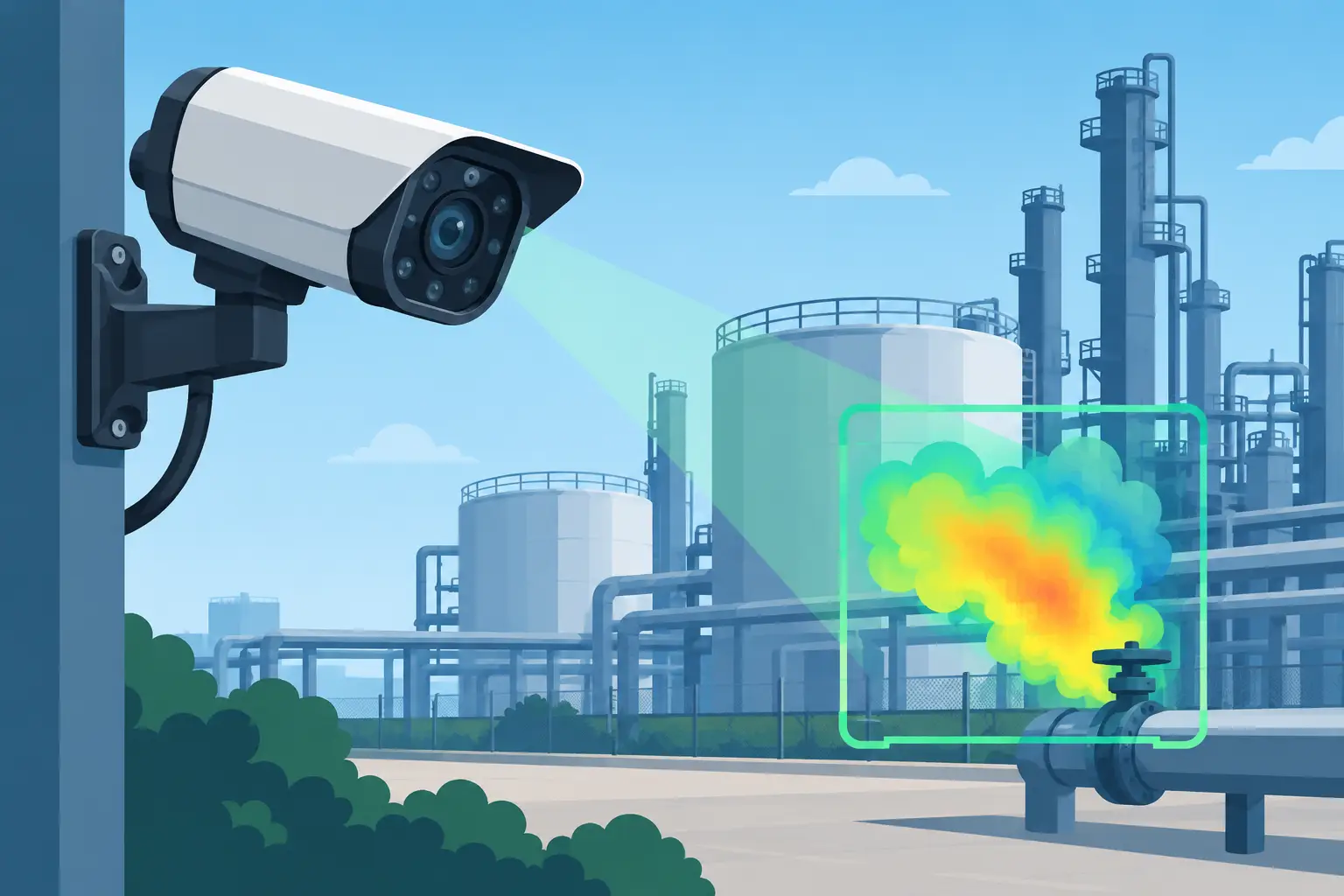
A hydrocarbon leak is rarely visible to the naked eye, but it can quickly become a safety, production, compliance, and reputational problem. Gas detection cameras give operations teams a way to see qualifying gas emissions as they occur, helping personnel investigate faster without sending people unnecessarily close to a suspected release. For refineries, offshore assets, chemical plants, power facilities, and marine operators, that visibility can materially improve how a leak event is managed.
These systems are not a replacement for fixed gas detectors, personal monitors, process alarms, or disciplined inspection programs. They add a different capability: visual confirmation of a gas plume and a recorded view of where it is moving. When specified correctly, the result is a stronger surveillance layer around the assets where a small release can turn into a costly shutdown.
Why Gas Detection Cameras Change Leak Response
Conventional gas detection instruments are essential, but they generally report concentration at a point or along a defined path. A camera designed for optical gas imaging can show the location, direction, and apparent behavior of a plume within its field of view. That changes the first operational question from “Which alarm activated?” to “Where is the release coming from, and what is it affecting?”
This is particularly valuable around valve trains, compressors, tank farms, loading areas, pipe racks, flare systems, manifolds, and processing skids. A control room team can use the live image to support a field response, assess whether an emission is dispersing toward occupied areas, and direct maintenance personnel toward the most likely source. If conditions require isolation or escalation, recorded footage gives supervisors a defensible record of the event and the response.
The commercial case extends beyond incident response. Fugitive emissions waste product, increase maintenance exposure, and can create reporting obligations. Finding a leak earlier may prevent lost inventory and unplanned downtime. It can also reduce the time spent on broad manual searches across complex equipment. A camera does not eliminate the need for inspection crews, but it can make their work more targeted.
Performance always depends on the gas being assessed, the selected spectral technology, distance to the target, thermal contrast, wind, humidity, background conditions, and line of sight. A camera that performs well for one target gas or application may be unsuitable for another. That is why a generic camera specification is not enough for a hazardous industrial site.
Selecting Gas Detection Cameras for Actual Duty
The right system begins with the hazard study and operating environment, not a catalog comparison. Procurement teams should define the likely gases, expected release points, required coverage zones, normal viewing distances, ambient conditions, and the operational decision the image must support. A system intended to monitor a refinery process unit has different requirements from one monitoring a marine loading connection or an offshore utility area.
Match the imaging technology to the target gas
Optical gas imaging systems are designed around specific absorption characteristics. The first technical check is whether the proposed camera is suitable for the gases that matter at the site. Methane and other hydrocarbons, sulfur hexafluoride, carbon dioxide, refrigerants, and toxic industrial gases do not all require the same sensing approach.
Buyers should ask for clear performance information rather than relying on broad claims. What gases can the system visualize? At what approximate distances and under what environmental conditions? What minimum plume size or concentration difference is needed for useful detection? Is the proposed configuration suitable for continuous monitoring, periodic inspection, or both?
Sensitivity figures are useful, but they should be interpreted in context. A highly sensitive imaging core cannot compensate for a blocked view, poor camera placement, unsuitable optics, or a plume that is rapidly dispersed by wind. The best design combines appropriate technology with a coverage plan based on the real geometry of the site.
Specify the enclosure and certification level
Industrial gas monitoring is frequently installed where ordinary surveillance hardware will not survive or cannot be approved. Offshore salt exposure, vibration, high ambient temperatures, washdown, dust, corrosive atmospheres, and extreme weather all affect equipment life and image quality.
For hazardous areas, certification must match the site classification and jurisdiction. Explosion-proof or intrinsically safe requirements, temperature class, ingress protection, marine-grade construction, corrosion resistance, and cable entry arrangements should be confirmed before purchase. Retrofitting an unsuitable device after a site review wastes time and can delay a critical project.
A serious specification also considers heating, cooling, sunshields, wipers, window cleaning access, and mounting rigidity. Gas detection performance is only useful when the lens remains clear and the camera stays pointed at the required area. On offshore platforms and vessels, vibration-resistant mounting and corrosion-resistant materials are especially important.
Design for operators, not just installers
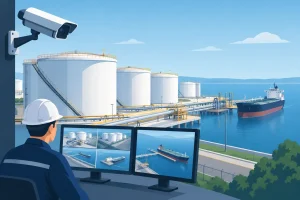
A gas imaging feed should arrive where decisions are made. That may be a local control room, a security operations center, an engine control room, or a remote operations hub. Integration with video management software allows operators to view live streams, review playback, apply user permissions, and retain event footage under the site’s retention policy.
Alarm integration should be considered carefully. In some applications, the camera is used as visual verification following an alarm from fixed detectors. In others, analytics or operator observation may trigger an investigation. The correct approach depends on the risk assessment and the reliability needed for the specific safety function. Do not assume a visual system alone meets requirements intended for certified fixed detection equipment.
Network capacity also matters. High-resolution thermal or optical imaging streams can place meaningful demands on bandwidth, storage, switching, and remote connectivity. Sites with limited offshore communications or segmented industrial networks need an architecture that protects operational technology while still providing dependable access to authorized users.
Where Deployment Creates Operational Value
At refineries and gas processing facilities, fixed gas detection cameras can oversee high-consequence areas that are difficult to inspect continuously. Coverage around compressor seals, pressure relief points, storage transfer lines, and remote pipe racks gives operations teams an additional visual tool during abnormal conditions. Pan-tilt-zoom configurations can expand coverage, although fixed views often provide more consistent monitoring of a known risk point.
For offshore installations, the value is often linked to distance and exposure. Equipment may be located on open decks, elevated structures, or restricted areas where weather and operating conditions make immediate access difficult. A properly positioned system can support remote assessment before personnel are dispatched, helping the team determine whether the issue appears localized, persistent, or affected by wind direction.
Marine operators can apply the same thinking around cargo handling, bunkering connections, engine spaces, gas processing equipment, and other defined risk zones. The system must be selected for the vessel’s operating environment, power arrangements, network design, and class or flag-state requirements. Reliability at sea is not achieved by adding a camera to a standard network. It requires equipment and installation practices built for marine duty.
Chemical plants, power stations, and industrial manufacturing sites benefit when cameras are part of a wider risk-control plan. The technology is particularly effective where an emissions source may be difficult to identify quickly or where process equipment creates too many potential leak points for efficient manual investigation alone.
Procurement Questions That Prevent Costly Gaps
Before issuing a purchase order, buyers should require a site-specific response to four practical questions:
- Which gases and leak scenarios is the proposed camera proven to address?
- What coverage area, viewing distance, and lens selection are required for each installation point?
- Which hazardous-area, environmental, and marine certifications apply to the finished configuration?
- How will live video, recording, alarms, cybersecurity, power, and maintenance be handled after commissioning?
The answers should be documented in the proposal, not left as assumptions for the installer. A low initial equipment price can become expensive if the system needs additional housings, network upgrades, specialized mounts, storage expansion, or replacement after exposure to the actual operating environment.
Commissioning should include field verification from the intended monitoring position. Operators need to understand what a plume may look like on screen, how environmental conditions can affect visibility, and how the video should be used alongside existing emergency procedures. Periodic functional checks, lens inspection, firmware governance, and recording reviews keep the system ready for the moment it is needed.
Revlight Security supplies specialist surveillance and detection equipment for demanding oil and gas, marine, energy, and industrial environments, with system selection focused on real operating conditions rather than generic camera specifications. The right deployment protects more than an asset: it gives the people responsible for the site a clearer basis for acting early, acting safely, and keeping operations under control.
🛡️ Secure Your Home or Business Today
Protect your home, office, shop, or business with reliable CCTV security cameras. Explore our range of CCTV cameras and find the right security solution for your needs.
Explore CCTV Cameras ✉️ Email Us

 Singapore :
+65-6708-9302