
A gas alarm activates at a remote compressor station. The operations team needs live images immediately, while investigators may need recorded footage days later to confirm the sequence of events. That is where edge versus cloud video becomes a practical engineering and procurement decision, not an IT preference.
For refineries, offshore assets, power facilities, vessels, and chemical plants, video infrastructure must continue working through bandwidth constraints, network interruptions, harsh weather, and changing operating conditions. The best architecture protects evidence, gives authorized teams fast access, and controls long-term operating costs.
Edge Versus Cloud Video: The Core Difference
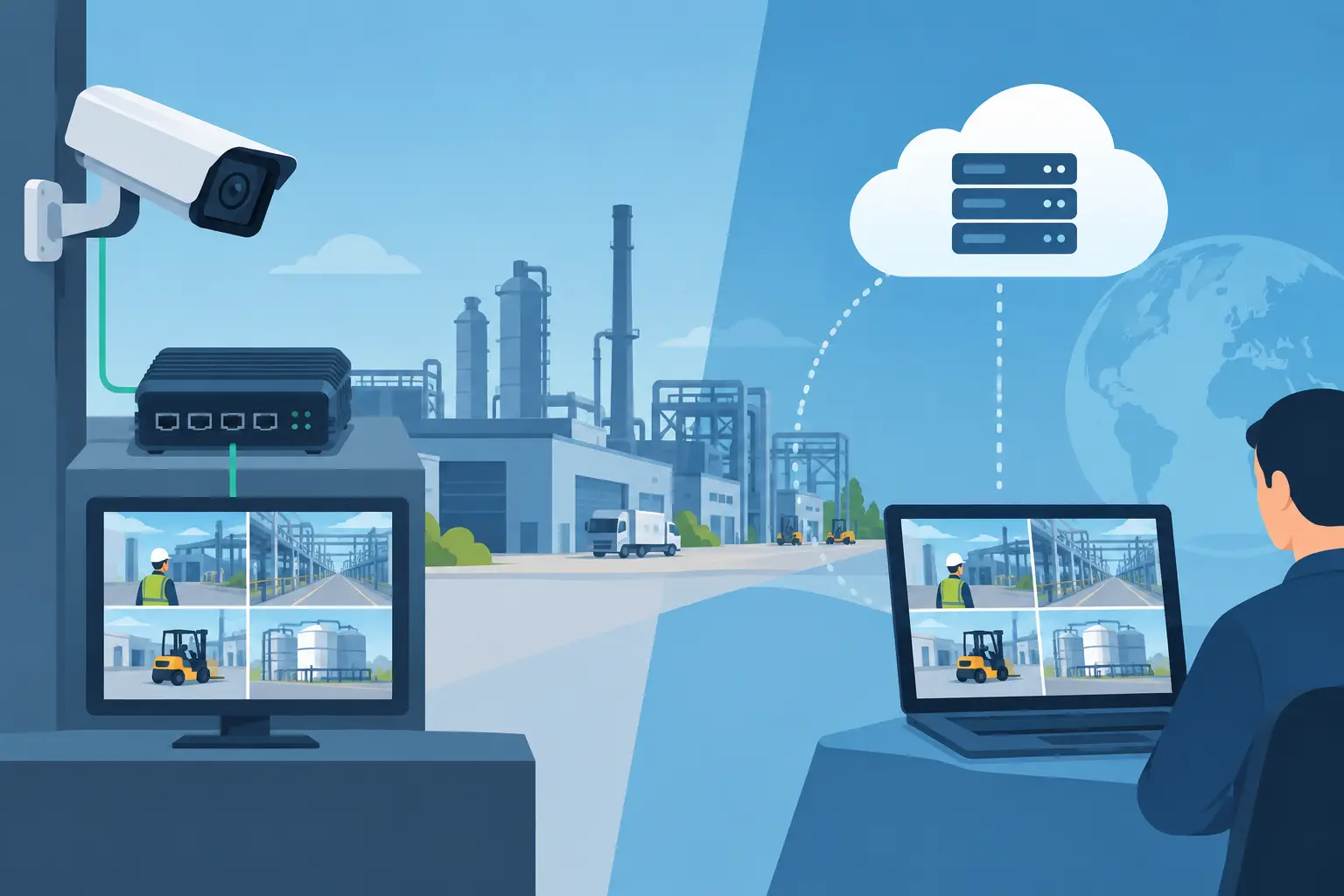
Edge video processes and stores footage at or near the camera location. A camera may record to onboard storage, while a local network video recorder or industrial server manages multiple streams on site. Analytics such as intrusion detection, line crossing, object classification, thermal alerts, or gas detection events can also be processed locally.
Cloud video sends footage, metadata, or both to remote data centers for storage and access through an internet connection. Depending on the platform and configuration, cameras may record directly to the cloud, use a gateway, or keep a local copy while synchronizing selected footage remotely.
The distinction matters because industrial sites do not operate like office buildings. An offshore platform may rely on a constrained satellite connection. A refinery may operate a segmented network with strict cybersecurity controls. A ship may lose its preferred communications path while at sea. In each case, local recording can preserve coverage even when remote access is temporarily unavailable.
Cloud video, however, can simplify centralized oversight. A security director responsible for several terminals, vessels, or generating stations can review events from one interface without maintaining separate storage systems at every location. The right choice depends on what footage must remain available locally, what can be transmitted, and how quickly remote teams need access.
When Edge Video Is the Better Industrial Choice
Edge architecture is often the stronger option where connectivity is expensive, limited, intermittent, or operationally sensitive. Instead of continuously sending multiple high-resolution video streams across a WAN, the site records locally and transmits health status, alarms, low-bandwidth previews, or event clips.
This approach is especially valuable for methane detection cameras, thermal perimeter monitoring, offshore underwater cameras, and surveillance coverage in hazardous or remote zones. These systems can generate valuable evidence, but continuous high-bitrate transmission may be impractical. Local storage prevents a communications outage from becoming a recording outage.
Edge video also supports faster local response. If a control room needs to verify an alarm, a locally hosted system can display the relevant camera feed without waiting for traffic to travel through an external cloud platform. In process environments where seconds affect safety, production, or environmental response, that reduction in delay can matter.
Data control is another major factor. Some operators require footage to remain inside a site network or within a defined geographic region. Local recording gives security and compliance teams clearer control over where video resides, who can access it, and how it is retained. This does not remove the need for encryption, access controls, patching, and network segmentation. It does give the organization more direct authority over the system design.
The trade-off is responsibility. Local storage servers, recorders, switches, and camera storage must be correctly sized, monitored, protected, and replaced before failure. A low-cost recorder without sufficient drive redundancy or retention capacity is not a serious industrial video strategy.
Where Cloud Video Delivers Value
Cloud video is compelling when central visibility is the priority. It can reduce the burden of supporting separate video management servers across a wide estate, particularly when sites have stable, high-capacity connections. Authorized users can review footage, manage permissions, receive alerts, and investigate incidents from a centralized platform.
For a ship management company, cloud access can help shore teams review security events across a fleet without waiting for footage to be manually exported. For a multi-site energy operator, it can standardize user access and retention policies across facilities. These operational gains are real when the communications design supports them.
Cloud storage also changes the cost model. Rather than making a larger upfront investment in local servers and storage arrays, the buyer typically pays recurring subscription and storage charges. That can be attractive for predictable budgeting, but procurement teams should calculate total cost over the expected life of the system. Monthly fees, camera licensing, storage duration, data egress, gateway hardware, and bandwidth upgrades can materially change the final number.
Cloud platforms do not automatically eliminate local equipment. Cameras still need power, network connectivity, physical protection, and maintenance. Remote industrial assets may still require local buffering or recording to prevent footage loss during WAN disruption. In many deployments, the cloud is an access and management layer rather than the only recording location.
Bandwidth Decides More Than Features
Video is one of the heaviest workloads on an industrial network. A single high-resolution stream may be manageable. Dozens of cameras recording continuously, including thermal or specialized detection devices, can quickly saturate a connection that was designed for operational telemetry and business traffic.
Before selecting an architecture, assess the actual connection at every site. Do not rely on advertised bandwidth alone. Measure available upload capacity, latency, packet loss, contention, service interruptions, and the priority assigned to operational systems. A vessel’s communications profile may vary considerably by route and weather. A remote pumping station may be dependent on cellular service that changes by location and carrier load.
Compression settings, frame rate, resolution, scene activity, and recording mode all affect bandwidth. Continuous streaming provides the fullest record, but event-driven transmission may be more efficient for remote assets. It is often better to record the full-quality stream at the edge and send alarm-related clips or lower-resolution live views to remote teams.
This is also why a hybrid design is frequently the commercial and operational winner. It protects local evidence while delivering remote visibility where it has real value.
The Hybrid Model for High-Consequence Sites
A hybrid system combines edge recording with cloud-based management, off-site backup, or event access. Cameras and local recorders retain primary footage on site. The system then sends selected alarms, health notifications, thumbnails, clips, or scheduled exports to remote users.
For an offshore platform, the local system can retain continuous footage from critical areas, underwater inspection points, access routes, and process zones. When an alarm occurs, supervisors onshore receive an event notification and can review the available clip without consuming the bandwidth required for every live stream around the clock.
For a refinery, a hybrid architecture can keep operational video inside the plant network while providing approved security personnel with controlled remote access. For marine operators, it can preserve onboard recording during transit and synchronize priority evidence when communications capacity allows.
The design must be intentional. Decide which cameras require continuous recording, which alarms trigger remote transmission, how many days of local retention are required, and what happens when storage reaches capacity. Establish who owns each responsibility: operations, security, IT, vessel engineering, or a managed service provider. Ambiguity becomes expensive when an incident occurs and footage cannot be found.
Questions Procurement Teams Should Ask
A purchase specification should go beyond camera count and image quality. Ask whether the system continues recording during internet loss, how long local footage is retained, and whether remote users can access video without exposing the operational network. Confirm the storage calculation using the intended resolution, frame rate, codec, and recording schedule.
Also examine cybersecurity in practical terms. Require encrypted communications, unique credentials, role-based permissions, audit logs, supported firmware, and a clear process for security updates. Cloud platforms should provide transparent information about data location, service availability, account recovery, and export options. Local systems should be protected against physical tampering, power disruption, and single-drive failure.
Finally, assess support against the asset environment. Offshore corrosion, vibration, hazardous-area requirements, salt exposure, heat, and unstable power all influence equipment selection. A video platform is only as dependable as the network, enclosure, power design, storage, and field hardware supporting it.
The strongest decision is rarely edge-only or cloud-only by default. Build the architecture around the consequence of losing footage, the quality of available communications, and the people who must act on an alarm. Revlight Security can help industrial buyers specify surveillance and detection infrastructure that keeps critical video available where it is needed most.
🛡️ Secure Your Home or Business Today
Protect your home, office, shop, or business with reliable CCTV security cameras. Explore our range of CCTV cameras and find the right security solution for your needs.
Explore CCTV Cameras ✉️ Email Us

 Singapore :
+65-6708-9302