
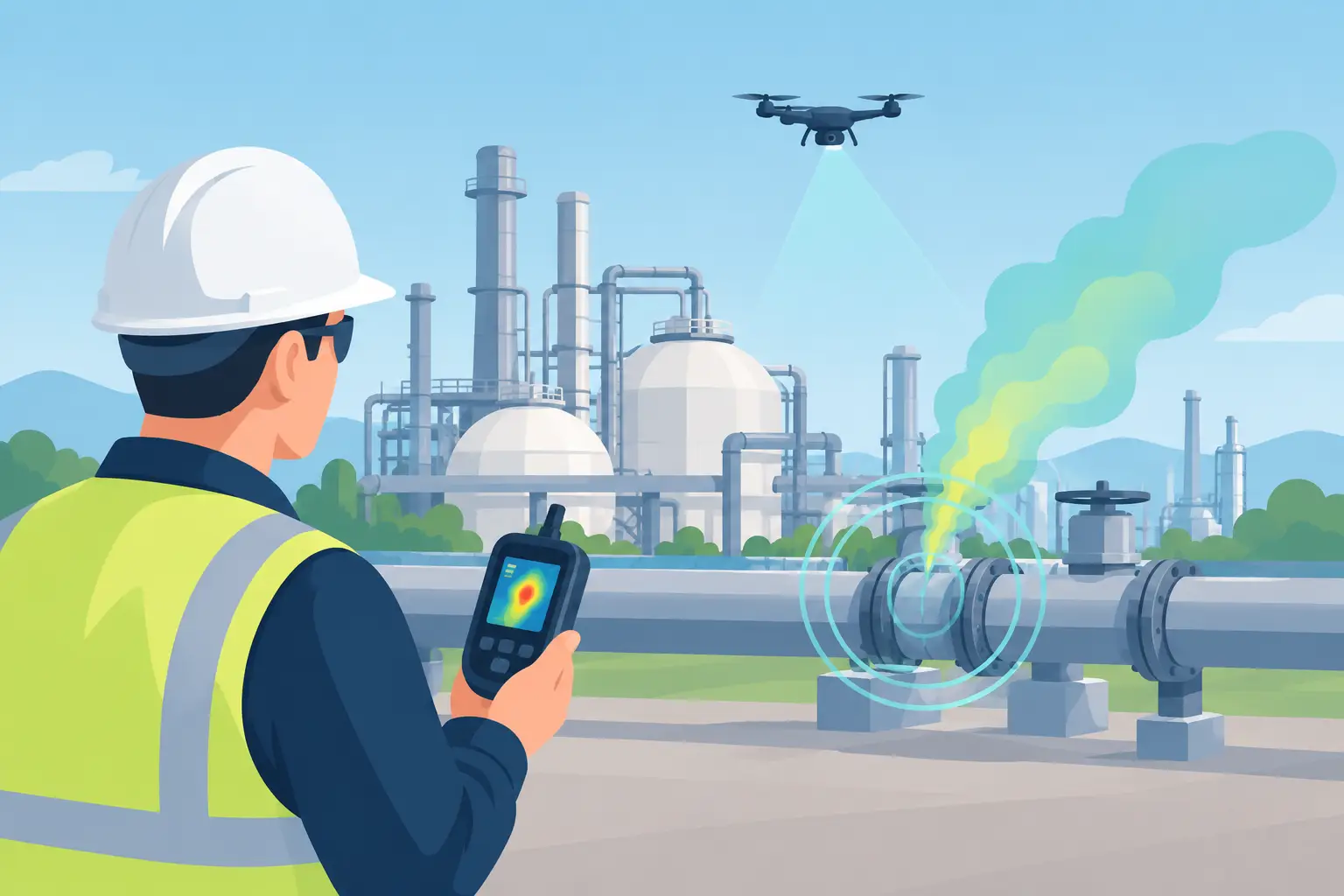
A methane release rarely announces itself with a visible plume or a dramatic alarm. At a refinery, compressor station, tank farm, offshore installation, or processing plant, the loss can begin at a valve packing, flange, seal, vent, or transfer connection while production continues normally. Effective methane monitoring gives operations teams the evidence to find that loss early, prioritize the response, and verify that the repair worked.
For industrial operators, this is not only an environmental reporting issue. Methane escaping from process equipment is lost product, a potential safety concern, a maintenance signal, and a source of operational uncertainty. The right detection strategy turns an invisible risk into actionable information.
Why methane monitoring belongs in operations
Methane is difficult to manage because leaks vary widely in size, duration, and location. A small persistent leak at a component that is hard to access may create greater cumulative loss than a short, obvious release. Offshore structures add wind, salt exposure, confined work areas, and equipment located at height. Onshore facilities may have hundreds or thousands of potential leak points spread across large operating areas.
Routine walk-throughs and operator awareness remain valuable, but they do not provide the consistent coverage needed for complex assets. Monitoring systems add a repeatable layer of surveillance. They support inspections, help maintenance teams focus labor where it matters, and create a record that can be reviewed by operations, environmental, safety, and management personnel.
The commercial case is straightforward. Faster identification can reduce gas loss, prevent minor defects from becoming major repair events, lower time spent searching for uncertain sources, and improve confidence in emissions data. The value depends on the asset, the cost of downtime, and the number of likely leak sources. A high-consequence compressor area needs a different level of coverage than a low-traffic utility zone.
Methane monitoring technologies and where they fit
No single technology is the answer for every facility. Strong programs combine detection methods based on the hazard profile, inspection frequency, access limitations, and response requirements.
Optical gas imaging for rapid surveys
Optical gas imaging cameras are a powerful option for scanning equipment groups and identifying potential gas plumes in real time. They are especially useful around valves, flanges, pressure-relief devices, compressor seals, storage infrastructure, and elevated pipework. Instead of checking components one by one without visual confirmation, inspectors can assess a wider area and direct close-range investigation to the most likely source.
Camera selection must match the gas of concern and the operating environment. Image quality, thermal sensitivity, lens selection, recording capability, remote viewing, and environmental protection all affect field performance. A system built for a controlled indoor location may not be suitable for an exposed marine deck or a refinery unit with high ambient temperatures and corrosive conditions.
Recorded inspection footage also has practical value. It provides maintenance teams with visual evidence, supports repair planning, and creates a before-and-after record when a leak is corrected. For remote assets, network-connected systems can help authorized personnel review live or recorded images without waiting for a site visit.
Fixed gas detection for continuous coverage
Fixed methane detectors are designed for areas where continuous monitoring is required. These may include enclosed process areas, compressor buildings, loading zones, battery limits, or locations where personnel could be exposed to accumulated gas. When correctly positioned and maintained, fixed devices can provide alarm functions that support immediate operational response.
Fixed detection is not a substitute for broader inspection. Its coverage is influenced by airflow, detector placement, gas behavior, obstructions, and calibration status. A detector placed too far from a likely release point, or in a poorly considered airflow path, can leave a critical gap. Engineering the layout is more important than simply increasing the device count.
Point measurement and verification
After a potential release is identified, point measurement equipment can support confirmation and quantification at the component level. This is where a monitoring program becomes a maintenance decision tool rather than a simple alerting exercise. Teams can document the source, assess its urgency, issue a work order, and confirm whether the repair reduced or eliminated the release.
The most effective setup often uses fixed coverage for critical zones, optical imaging for broad surveys, and close-range verification for maintenance follow-up. The right balance depends on whether the priority is safety alarm coverage, emissions management, equipment reliability, or all three.
Designing a methane monitoring program that works
Buying equipment without a deployment plan produces inconsistent results. Before selecting hardware, map the facility’s likely release points and the operational conditions around them. Include process units, compression equipment, storage, loading connections, vents, drains, sampling points, and equipment with a history of seal or packing issues.
Next, define what happens when a release is found. A useful program assigns responsibility from detection through closure: who reviews the alert or inspection footage, who classifies the severity, who creates the maintenance action, and who verifies completion. Without this workflow, even high-performance detection equipment can become another unreviewed source of data.
Environmental conditions deserve close attention. Offshore and marine applications may require salt-fog resistance, durable housings, stable network connectivity, and equipment that performs in rain, vibration, temperature swings, and low-light conditions. Refinery and chemical plant installations may require hazardous-area suitability, protected cabling, and integration with existing control room or video management infrastructure.
A well-designed program should also establish inspection intervals. Critical equipment with known failure patterns may need frequent checks, while lower-risk zones can be surveyed less often. Changes in production rates, maintenance shutdowns, new equipment installation, and incident history should trigger a review of those intervals.
From detection to verified repair
The operational benefit of methane monitoring is realized after detection, not at the moment an image is recorded or an alarm appears. Teams need a disciplined response process that separates urgent safety conditions from maintenance issues that can be planned safely.
First, preserve the evidence. Record the date, time, equipment tag, operating condition, weather or ventilation factors where relevant, and visual or sensor data. Then determine whether the source needs immediate isolation, temporary mitigation, or scheduled repair. A small leak in an accessible, noncritical location may be managed differently from a release near ignition sources, occupied areas, or high-pressure equipment.
After maintenance, repeat the inspection under comparable operating conditions. This verification step prevents a common failure: closing a work order because work was performed without confirming that the gas release stopped. It also creates useful performance data. If the same asset repeatedly develops leaks, the issue may be material selection, vibration, installation quality, operating pressure, or maintenance practice rather than a one-time component failure.
Procurement priorities for industrial buyers
Procurement teams should evaluate methane detection equipment as part of a complete operating system, not as a catalog line item. Initial price matters, but an inexpensive device that cannot withstand the site environment, integrate with existing networks, or provide useful recorded evidence can cost more over its service life.
Focus on detection capability for the target gas, suitability for the intended area classification, housing durability, serviceability, calibration requirements, image or data retention, and communications compatibility. For remote or offshore facilities, consider the practical realities of power availability, bandwidth, mounting locations, spare parts, and technician access.
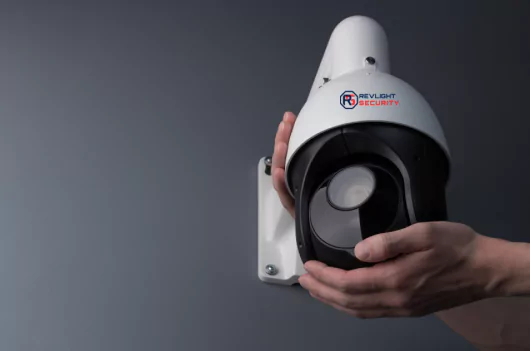
Supplier capability matters as much as the specification sheet. Industrial teams need clear guidance on system configuration, installation constraints, network design, and ongoing support. Revlight Security supplies specialist surveillance and detection equipment designed around demanding industrial, marine, and energy-sector applications, where reliability and usable visibility are commercial requirements.
Avoid over-specifying every location. Premium continuous monitoring is justified in high-risk or high-value areas, but periodic imaging surveys may be the better investment for dispersed equipment with lower consequence. Conversely, relying only on periodic inspections in a continuously occupied or enclosed gas-risk area can create an unacceptable gap. Good procurement decisions match technology to consequence, not just to budget.
Make methane visibility part of asset control
The strongest methane monitoring programs are built into routine operations, maintenance planning, and management review. They give teams a clear view of where gas is being lost, which repairs deliver measurable results, and where capital investment will have the greatest effect. Start with the areas that combine high leak probability, difficult access, and meaningful operational consequence, then expand coverage using evidence from the field.
🛡️ Secure Your Home or Business Today
Protect your home, office, shop, or business with reliable CCTV security cameras. Explore our range of CCTV cameras and find the right security solution for your needs.
Explore CCTV Cameras ✉️ Email Us



 Singapore :
+65-6708-9302
Singapore :
+65-6708-9302