
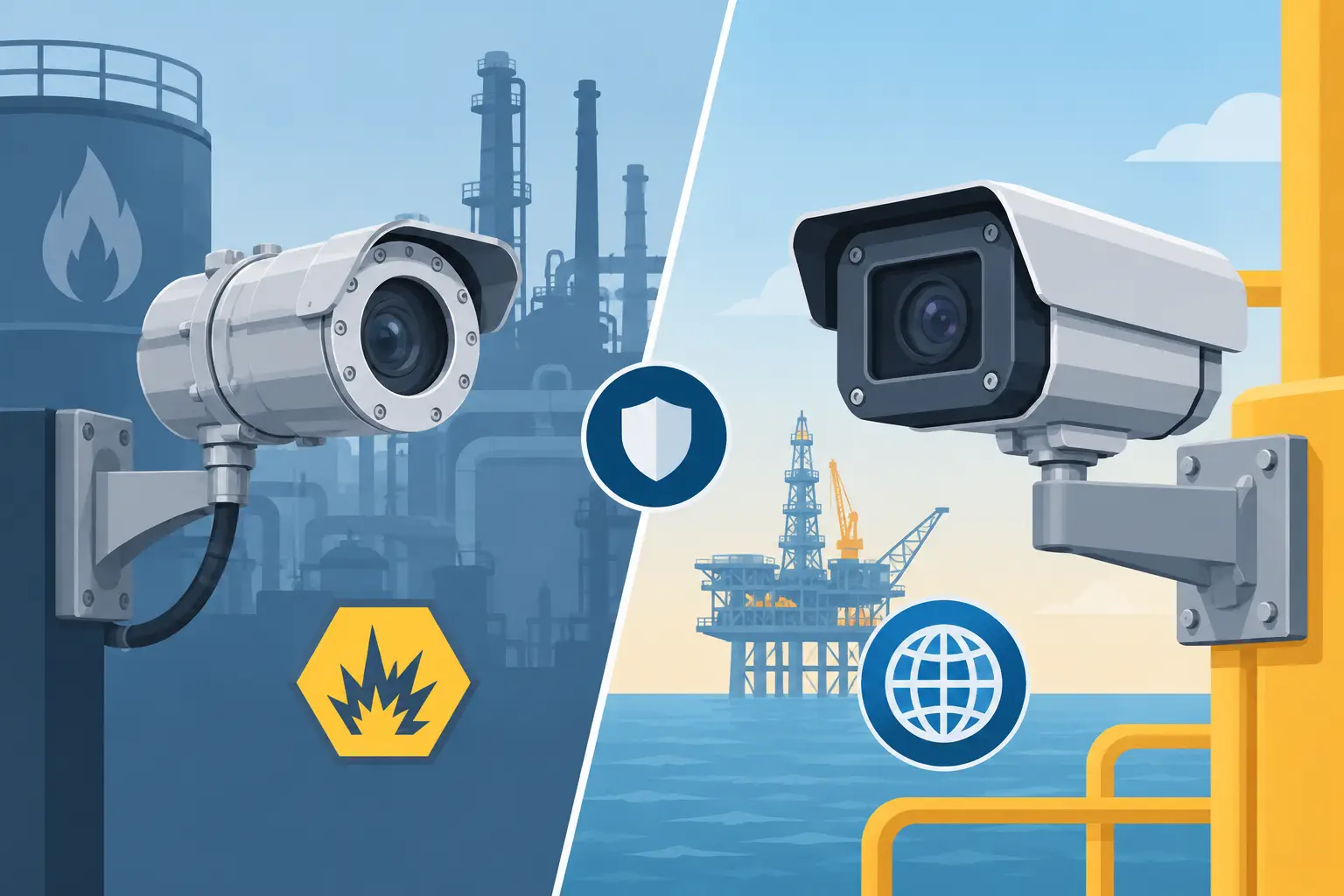
A refinery control room cannot treat hazardous-area surveillance as a standard CCTV purchase. A camera placed near a tank farm, process unit, loading rack, or offshore production area can become an ignition source if its enclosure, cable entry, power arrangement, or operating temperature is wrong. That is why the choice between ATEX versus IECEx cameras needs to begin with the site classification and project jurisdiction, not a product image or a headline specification.
Both certification paths support safe surveillance in potentially explosive atmospheres. Both can be relevant to oil and gas, marine, chemical processing, power generation, and industrial facilities. They are not, however, automatic substitutes. A technically capable camera with the wrong approval can delay commissioning, fail a client specification, or create an expensive replacement exercise after installation.
Why ATEX Versus IECEx Cameras Is a Procurement Decision
ATEX and IECEx address equipment intended for use where flammable gas, vapor, mist, or combustible dust may be present. In surveillance applications, the approval applies to more than the camera sensor. Buyers must evaluate the complete supplied assembly: housing, lens window, internal electronics, heater or blower if fitted, glands, cable entries, mounting arrangement, and any approved accessories.
The principal difference is regulatory reach. ATEX is the European Union framework governing equipment and protective systems for use in explosive atmospheres. IECEx is an international certification system based on IEC standards. It is widely recognized across global industrial markets, but acceptance is determined by the authority having jurisdiction, local regulations, owner standards, and contract requirements.
For procurement teams managing multiple sites, this distinction has commercial consequences. An ATEX-certified unit may meet a European project requirement while not satisfying an IECEx-only specification for an overseas facility. An IECEx certificate may be highly credible engineering evidence, yet still require a separate local approval before it can be installed in a particular country. The correct choice is the one that matches the installation location and classification dossier without qualification.
What ATEX Certification Means for Cameras
ATEX equipment is governed by European directives and is typically supplied with CE marking and the appropriate explosion-protection marking. For hazardous-area cameras, documentation should clearly identify the equipment group, category or equipment protection level, permitted zone, protection concept, gas or dust group, and temperature classification.
In practical terms, ATEX supports equipment selection for classified zones. Gas and vapor hazards are commonly categorized as Zone 0, Zone 1, and Zone 2, while combustible dust hazards use Zone 20, Zone 21, and Zone 22. The lower the zone number, the more frequently an explosive atmosphere is expected to be present and the more demanding the equipment selection becomes.
A camera intended for a Zone 1 gas area must be approved for that environment and installed exactly within the conditions of its certificate. It is not enough for a supplier to describe the product as “explosion proof” or “hazardous-area rated.” Those terms do not replace a valid marking, certificate, instructions, and declared ambient operating range.
ATEX is often the direct route for projects in the EU and for asset owners that have standardized their engineering practices around European requirements. It can also be specified elsewhere when a multinational operator uses ATEX as its internal benchmark. The approval still needs to align with the local legal framework.
How IECEx Certification Works
IECEx uses the IEC 60079 series of standards for explosive atmospheres and provides an internationally recognized certification route. It is especially common on global energy, marine, mining, and process-industry projects where equipment may be procured for deployment across several countries.
An IECEx-certified camera is assessed against defined protection standards and receives markings that communicate where it can be used. Those markings can include the applicable protection type, equipment protection level, gas group, temperature class, and ambient temperature limits. The certificate documentation is central to acceptance because it defines the equipment configuration that was actually evaluated.
IECEx can simplify technical comparison between international suppliers because the underlying standards are familiar to engineering teams worldwide. It does not eliminate country-specific obligations. Some jurisdictions recognize IECEx directly, some use it as a basis for national certification, and some require additional approvals or local registration. A procurement specification should never assume universal acceptance without confirmation from the project engineering authority.
For offshore operators and ship management companies, IECEx is frequently valuable where vessel routes, yards, and operating regions create a cross-border equipment requirement. However, marine class requirements, vessel rules, and installation constraints may sit alongside hazardous-area certification. A camera approval alone does not address every compliance obligation on a vessel or offshore installation.
Certification Is Not Interchangeable by Default
The most common purchasing error is treating ATEX and IECEx as labels with equal status in every market. They are closely related in technical purpose, and many professional hazardous-area camera ranges hold both approvals. Still, each certificate is its own controlled document.
A dual-certified camera can reduce sourcing complexity, especially for companies operating refineries, terminals, platforms, and support vessels in different regions. But dual approval does not mean every configuration is approved in every condition. A different lens, wiper, illuminator, cable gland, mounting accessory, or power variant can change what is permissible. The exact part number and configuration should be checked against the certificate schedule.
It also matters whether the equipment is intended for gas, dust, or both. A camera suitable for a gas Zone 1 location is not automatically suitable for a dust Zone 21 location. Likewise, a temperature class is not a general performance rating. It states the maximum surface temperature under specified conditions. That value must remain below the ignition temperature of the hazardous material present at the site.
Selecting the Right Hazardous-Area Camera
The strongest surveillance design starts with the hazardous-area data, then selects imaging performance and network functionality around it. This protects compliance while ensuring the system produces usable evidence and operational visibility.
Match the marking to the classified area
Obtain the area classification drawing and hazardous-substance information before requesting a quotation. Confirm whether the position is gas or dust classified, the zone, gas group or dust group, required temperature class, ambient temperature range, and any special process conditions. A camera mounted outside the classified boundary may have different requirements from one mounted directly over a process area, even if both view the same asset.
Do not overlook the cable route. A correctly certified camera can be compromised by unsuitable cable entries, incorrect glands, poor earthing, or unauthorized field modifications. The full installation must follow the manufacturer instructions and the approved configuration.
Specify the surveillance result, not just the approval
Once compliance is defined, focus on operational performance. A long-range fixed camera may be the right choice for perimeter monitoring around a flare area or loading terminal. Pan-tilt-zoom coverage can support active observation of large process zones where operators need to inspect valves, manifolds, or vessel activity remotely. Low-light performance, optical zoom, thermal imaging, video analytics, recording retention, and remote access should be selected according to the actual operating risk.
For gas detection applications, optical gas imaging capability must be considered separately from standard visible-light surveillance. A conventional hazardous-area camera can provide excellent situational awareness while being unable to visualize a methane or hydrocarbon leak. Where leak detection is a requirement, the system specification must state the gas type, detection objective, viewing distance, environmental conditions, and alarm workflow.
Network architecture deserves equal attention. Industrial sites need dependable bandwidth, secure remote viewing, compatible video management integration, and power arrangements that suit the approved equipment design. A low-cost camera can become a high-cost project when it requires unsuitable infrastructure changes or fails to integrate with the existing control-room workflow.
Questions to Put in Every RFQ
A clear request for quotation prevents comparisons based on incomplete claims. State the installation country, industry application, hazardous-area zone, gas or dust classification, required certification, temperature class, ambient range, power supply, preferred communications method, mounting position, and required viewing distance. Include whether fixed, PTZ, thermal, or gas-detection capability is required.
Ask suppliers to provide the certificate reference, full marking, data sheet, installation instructions, approved accessories, and confirmation that the quoted part number matches the supplied certification. Also request clarity on lead time, spare parts, technical support, and warranty terms. Hazardous-area surveillance is critical infrastructure, and documentation quality is a practical indicator of supplier capability.
Revlight Security helps industrial buyers specify surveillance equipment around real site conditions, from offshore and marine installations to refineries and high-risk process facilities. The goal is not simply to supply a certified enclosure. It is to provide a camera system that supports safer decisions, clearer incident review, and dependable remote visibility where conventional equipment cannot be used.
Before releasing a purchase order, have the final camera marking and installation configuration reviewed against the classified-area requirement by the responsible site engineering team. That disciplined step keeps certification, performance, and project delivery aligned from the first drawing to final commissioning.
🛡️ Secure Your Home or Business Today
Protect your home, office, shop, or business with reliable CCTV security cameras. Explore our range of CCTV cameras and find the right security solution for your needs.
Explore CCTV Cameras ✉️ Email Us


 Singapore :
+65-6708-9302
Singapore :
+65-6708-9302