
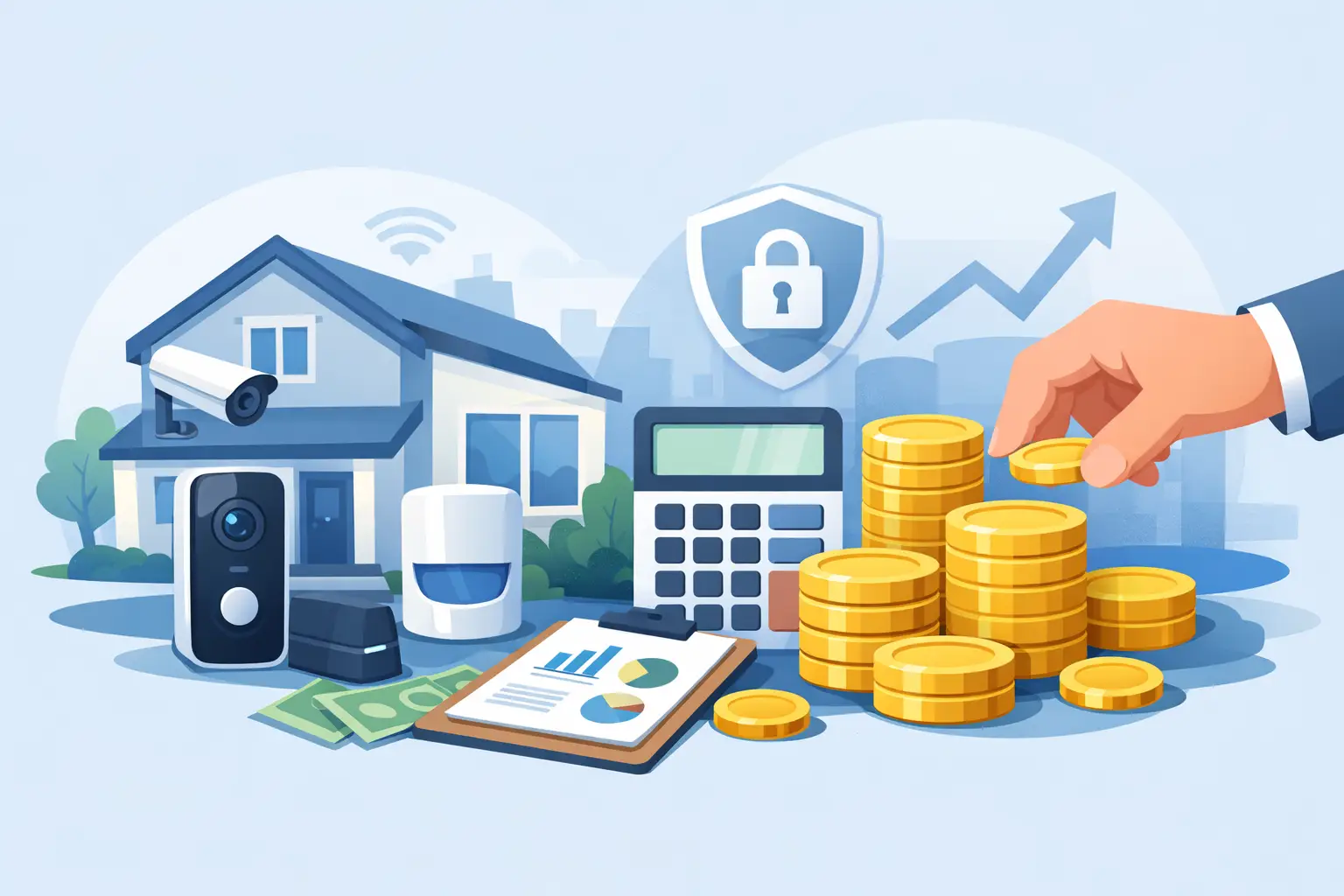
A monthly security bill can be as low as $0 for a self-monitored setup or exceed $60 for a professionally monitored package with equipment financing. So, how much do home security systems cost monthly? For most U.S. households, the realistic answer is $20 to $60 per month after installation. The right figure depends on who responds to alarms, how many devices are connected, and whether equipment is purchased upfront or spread across a contract.
For commercial and industrial decision-makers, that headline price needs context. A home package is designed to protect a single property with modest camera counts and limited integration. A refinery, vessel, offshore platform, or power facility requires a different class of surveillance infrastructure, including higher resilience, managed connectivity, environmental protection, retention capacity, and support. The monthly pricing logic, however, remains useful: separate equipment cost from monitoring, communications, maintenance, and service.
How Much Do Home Security Systems Cost Monthly?
A basic professionally monitored system commonly costs $20 to $35 monthly. This usually covers intrusion alarm monitoring, a mobile app, alerts, and access to a monitoring center. Equipment may be included at a promotional rate, but buyers should verify whether that offer requires a 24- to 36-month service agreement.
A more complete package with connected locks, video doorbells, interior and exterior cameras, cloud recording, and cellular backup often lands between $40 and $60 per month. Some providers charge extra for video storage, additional users, or advanced detection features. Equipment financing can push the monthly figure higher, particularly when several cameras or automation devices are included.
Self-monitored systems can cost $0 to $15 per month if the owner receives alerts and handles escalation. This is the lowest recurring-cost option, but it places the response burden on the property owner. A notification is not the same as an operator assessing an alarm and dispatching emergency services when appropriate.
| System format | Typical monthly cost | What the payment generally covers | |—|—:|—| | Self-monitored alarm | $0-$15 | App alerts, optional cloud features, limited support | | Professionally monitored alarm | $20-$35 | Monitoring-center response, alerts, cellular service | | Video and smart-home package | $40-$60+ | Monitoring, camera storage, automation, expanded access | | Equipment-financed package | $50-$80+ | Service plan plus monthly equipment repayment |
These figures exclude the initial installation when it is billed separately. Professional installation may add roughly $100 to $500 for a standard residence, while a larger property with wiring requirements, multiple entry points, or difficult camera locations can cost more.
The Costs That Change the Monthly Price
Monitoring is the primary recurring cost. A monitored provider maintains alarm-receiving infrastructure, trained personnel, escalation procedures, and communications redundancy. The value is strongest when the site is empty for long periods, the owner travels frequently, or a fast, defined response path matters more than simply receiving a phone notification.
Cellular communications can also affect the bill. Many systems use cellular backup so an alarm can still transmit if local internet service fails. That backup is a practical requirement, not a cosmetic add-on. Buyers should ask whether the advertised price includes cellular service and whether there are overage or activation charges.
Video storage is another common variable. Live viewing may be included, while recorded footage is sold as a separate cloud plan. The monthly price rises with camera count, recording duration, higher-resolution streams, and advanced event filtering. A two-camera home may need only a modest retention plan. A property that requires continuous recording or a longer incident-review window needs more capacity and should expect a higher recurring fee.
Equipment financing changes the comparison as well. Low upfront pricing can look attractive, but the full cost may be higher across a multi-year agreement. Ask for the total cost over the contract term, the cancellation policy, whether equipment is owned at the end of the agreement, and any early termination charges. Procurement teams use total cost of ownership for a reason: the monthly number alone can hide a poor commercial decision.
Finally, installation and maintenance are not always included. Wireless home systems are usually straightforward, but hardwired devices, difficult exterior locations, and replacement batteries create service needs over time. A low monthly plan with weak support may become expensive when the system is not maintained, cameras are offline, or alarm signals are unreliable.
Home Security Pricing vs. Industrial Site Protection
Home security packages are priced around a simple threat model: unauthorized entry, package theft, basic life-safety alerts, and homeowner notification. They are not built to supervise hazardous operations, wide perimeters, moving marine assets, remote compounds, or high-consequence process areas.
For industrial facilities, the monthly operating cost is usually not marketed as a single consumer-style subscription. It is distributed across monitoring services, network connectivity, software licenses, storage, maintenance agreements, remote support, and, where required, managed operations. The better question is not only what the system costs per month, but what exposure it reduces per month.
A camera deployment near hydrocarbon processing equipment may require hazardous-area suitability, stable power design, protected enclosures, and verified network performance. A marine installation may require equipment selected for vibration, salt exposure, and intermittent connectivity. A gas detection camera program may involve targeted coverage plans, alarm workflows, and trained operators who know how to interpret events. These requirements raise the initial investment, but they also prevent false economies that leave critical areas unobserved.
The same applies to recording retention. A residential plan may store short event clips. Industrial operators often need evidence-grade recordings, continuous coverage in selected zones, controlled user access, and retrieval capability after an incident. Storage, bandwidth, and cybersecurity are recurring operational costs, not optional extras.
How to Compare Monthly Security Proposals
Do not compare proposals by advertised monthly rate alone. Start with the operating requirement. Determine which areas must be detected, observed, recorded, and remotely accessed. Then establish the required uptime, retention period, response process, connectivity method, and support expectations.
A credible proposal should make clear whether it includes equipment, installation, commissioning, monitoring, cloud storage, cellular or satellite data, maintenance, replacement parts, and technical support. If a provider cannot state these items plainly, the lowest monthly price may be incomplete.
For home buyers, a practical comparison is the total amount payable over 36 months, including activation, equipment, and cancellation terms. For facility owners and marine operators, compare the lifecycle cost against the operational consequences of blind spots, delayed response, lost footage, unplanned service calls, or a network that cannot carry critical video reliably.
There is also a decision between managed monitoring and internal response. A homeowner may choose professional monitoring because no one is available to respond consistently. An industrial site may already have a control room, security team, or vessel watchstanding process. In that case, the investment may be better directed toward dependable detection, clearer video, resilient communications, and integration with existing procedures rather than an outside monitoring subscription.
Where Paying More Makes Commercial Sense
The lowest monthly plan is appropriate only when it meets the risk level of the property. Paying more is justified when the system needs reliable alarm transmission during an outage, longer video retention, professional response, multiple locations, or higher-quality coverage of valuable assets.
For operations where safety, production continuity, environmental risk, or vessel security is at stake, the priority should be fit-for-purpose engineering. Top-of-the-line surveillance systems deliver value when every component supports the environment and the response plan, from camera placement and network design to playback access and service coverage.
Before approving a monthly security cost, require a clear scope and a total-term price. The right system is the one that gives your team dependable visibility when conditions are difficult, personnel are limited, and the footage or alarm signal must perform without hesitation.
🛡️ Secure Your Home or Business Today
Protect your home, office, shop, or business with reliable CCTV security cameras. Explore our range of CCTV cameras and find the right security solution for your needs.
Explore CCTV Cameras ✉️ Email Us



 Singapore :
+65-6708-9302
Singapore :
+65-6708-9302