
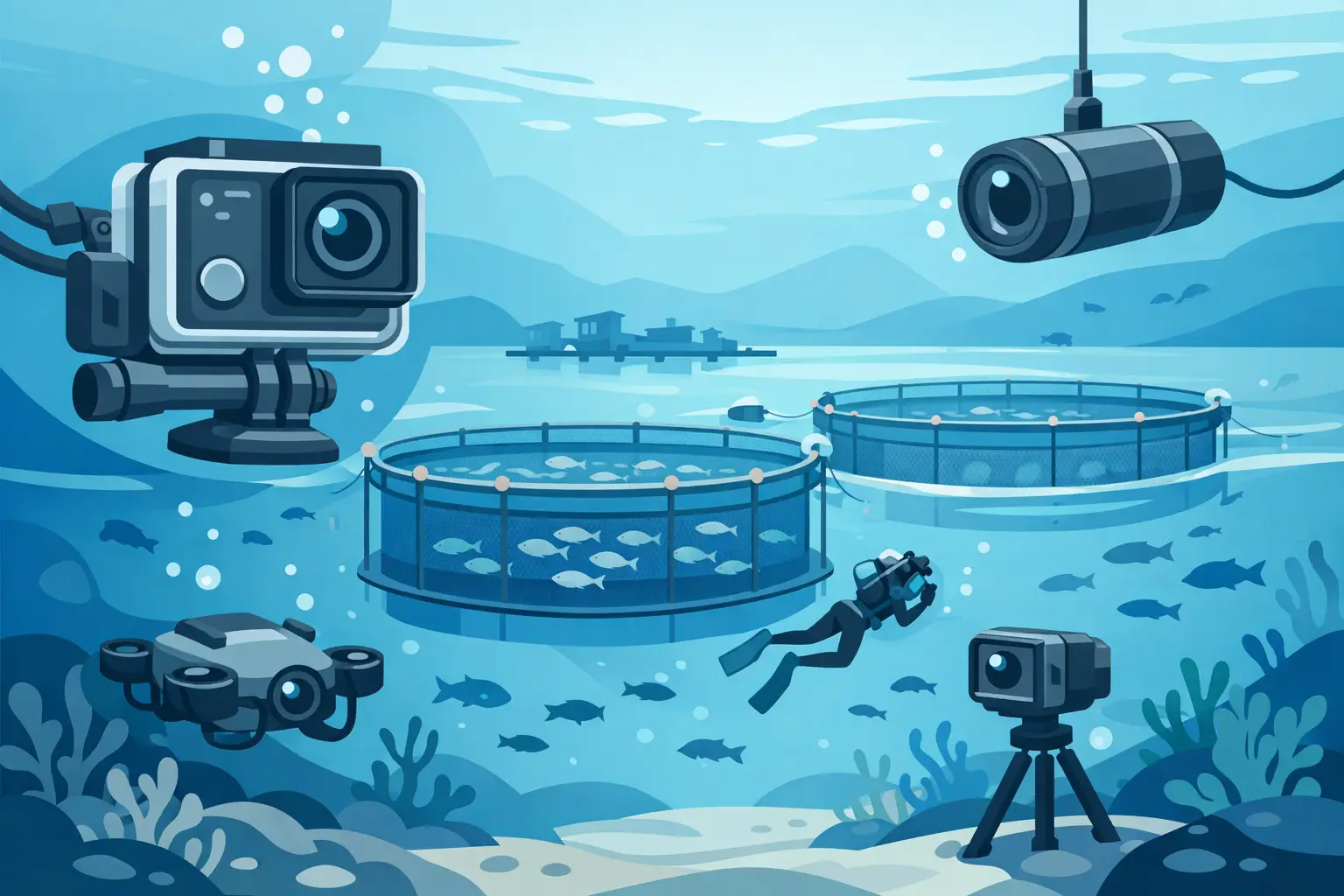
A missed net breach, a feeding issue hidden below the surface, or early fish stress can become an expensive operational problem before a crew sees it from the deck. The best underwater cameras for aquaculture give farm operators a dependable view of the conditions that matter most: stock behavior, net integrity, feed response, biofouling, and infrastructure performance.
For commercial aquaculture, camera selection is not about buying the highest advertised resolution. It is about specifying an engineered surveillance system that remains clear, connected, and serviceable in saltwater, suspended solids, low light, and continuous-duty conditions. A camera that performs well in a short demonstration but fails after months on a pen, tank, or intake line is not a cost saving. It is an operational liability.
What Makes the Best Underwater Cameras for Aquaculture?
The right system depends on the farm environment, but professional buyers should evaluate every option against the same core requirements: image usability, housing durability, lighting compatibility, network architecture, recording capacity, and maintenance access. These factors determine whether the camera delivers useful evidence and operational intelligence, rather than intermittent footage.
Image quality must work in real water conditions
Resolution is valuable only when the lens, sensor, illumination, and water clarity support it. High-definition imaging can help operators assess feeding behavior, fish distribution, net damage, and equipment condition, but excessive compression or poor low-light performance can remove the detail needed for a confident decision.
Look for a system designed to maintain usable images in variable visibility. In sea cages, the challenge may be sunlight glare, particles, algae, and changing depths. In recirculating aquaculture systems, reflections, tank geometry, aeration, and artificial lighting may create the greater problem. Low-light sensitivity and controlled supplemental lighting are often more valuable than headline resolution alone.
Color accuracy also matters when personnel are watching for abnormal behavior, injuries, fouling, or changes in feed response. However, lighting selection must be handled carefully. Overly intense light can create glare and may affect stock behavior. The best approach is a balanced camera-and-lighting package matched to the mounting position and target viewing distance.
The housing is part of the surveillance system
Aquaculture cameras operate in a corrosive and biologically active environment. Specify a housing with an appropriate depth rating for the planned installation, plus a meaningful safety margin. Material selection should support long-term exposure to saltwater, chemicals, and cleaning practices. Marine-grade stainless steel, corrosion-resistant alloys, and properly engineered seals are all relevant, depending on the installation.
Buyers should also ask how the unit manages cable entry points, pressure equalization, lens protection, and biofouling. A clear lens window is essential, but it will not remain clear without a realistic maintenance plan. Some sites need scheduled cleaning by divers or remotely operated equipment; others benefit from mounting arrangements that permit recovery and cleaning from the surface.
A low initial price can quickly disappear when a camera requires frequent replacement, difficult retrieval, or repeated service calls. Top-of-the-line offers should be judged by service life and uptime, not just by the purchase order value.
Match the Camera Format to the Farm Operation
Fixed-position underwater cameras are often the most practical choice for continuous monitoring of feeding zones, net walls, tank outlets, grading equipment, and critical process areas. They provide consistent reference views and are straightforward to integrate into a recording platform. For a site that needs to compare conditions over time, a stable fixed view can be more useful than frequent camera movement.
Pan-tilt-zoom underwater systems are better suited to larger pens, deeper structures, broad tank arrays, or inspection points where operators need to investigate changing areas from a control room. Their added coverage can reduce the number of installed camera positions, but they introduce mechanical complexity and need careful cable and mounting design. They are most valuable when operators have a defined reason to reposition the view, not simply because movement appears attractive in a specification sheet.
For recirculating facilities, compact fixed cameras may be installed at multiple process stages: broodstock tanks, larval tanks, grow-out areas, filtration zones, and discharge points. In offshore or open-water farming, fewer but more heavily engineered camera locations are common, with attention focused on depth, currents, mooring interfaces, and recovery procedures.
The best specification is therefore site-specific. A hatchery manager may prioritize close-range clarity and hygienic service access. A sea-cage superintendent may place greater value on depth-rated housings, stable transmission, and reliable observation of nets during poor weather. Procurement teams should avoid treating these as interchangeable applications.
Network Reliability Is a Production Requirement
An underwater image has limited value if it cannot reach the people responsible for making decisions. The camera network must be planned from the submerged unit through the surface connection, local control equipment, onboard or shore-side network, recording platform, and authorized remote access point.
For short runs, a properly protected cable connection to a local network enclosure may be suitable. Longer distances, electrically noisy environments, or high-risk lightning areas may call for fiber-based transmission or purpose-built conversion equipment. The correct approach depends on distance, bandwidth, power delivery, environmental exposure, and the wider communications design.
Do not assume a standard network installation is sufficient for marine use. Cable strain relief, bend radius, connectors, junction enclosures, surge protection, and penetration sealing need the same level of attention as the camera itself. A failure at one connector can take an otherwise capable surveillance system offline.
Recording should be designed around operational use. Continuous recording supports incident review and trend analysis, while event-based recording can reduce storage consumption where automated alarms or defined activity periods are available. Retention time should be agreed before purchase. If a welfare issue, equipment failure, or security event is discovered days later, the footage must still exist at a usable quality.
Remote viewing is equally valuable, but access should be controlled. Operations directors, farm managers, engineers, and approved service personnel may need live or recorded video from different locations. Role-based permissions, secure network segmentation, and clear user accountability protect both the camera system and the wider site infrastructure.
Specify the System Before Requesting Prices
A commercially sound request for quotation gives suppliers enough detail to provide a fit-for-purpose solution rather than a generic camera package. Before comparing prices, document the operating depth, water type, installation location, desired field of view, target distance, lighting conditions, cable route, available power, network connection, recording requirements, and planned maintenance method.
Also define what the footage must help the team accomplish. For example, identifying a broken net section requires a different view from monitoring feeding behavior near a central distribution point. Inspecting a submerged intake requires different lighting and depth capability than observing fish in a shallow hatchery tank.
Include these five questions in the procurement review:
- What minimum image detail is needed for the actual operating decision?
- How will the housing, lens window, and cable assembly be cleaned and inspected?
- What happens when the primary network or power supply fails?
- Where will video be recorded, for how long, and who can retrieve it?
- Can the supplier support replacement parts, configuration, and service after installation?
These questions expose gaps that a product data sheet may not reveal. They also help procurement teams compare offers on total capability rather than on a single headline feature.
Control Total Cost, Not Just Camera Cost
The lowest-priced option is rarely the least expensive system over its working life. Installation time, vessel or diver support, replacement frequency, cleaning intervals, cable repair, storage requirements, and lost visibility during failures all affect the real cost of ownership.
A well-designed underwater surveillance installation can reduce unnecessary inspections, support faster response to abnormal stock behavior, provide evidence after an incident, and give management a clearer operational picture without being physically present at every site. Those outcomes carry measurable value when farms operate across multiple pens, vessels, or facilities.
Revlight Security approaches underwater surveillance as security and operational infrastructure, not as an isolated camera sale. That means selecting equipment around the conditions, communications path, and monitoring objective that the site must support.
The strongest purchasing decision is the one that gives your team clear video on the day conditions are at their worst, not only when the water is calm and visibility is perfect.
🛡️ Secure Your Home or Business Today
Protect your home, office, shop, or business with reliable CCTV security cameras. Explore our range of CCTV cameras and find the right security solution for your needs.
Explore CCTV Cameras ✉️ Email Us

 Singapore :
+65-6708-9302
Singapore :
+65-6708-9302