
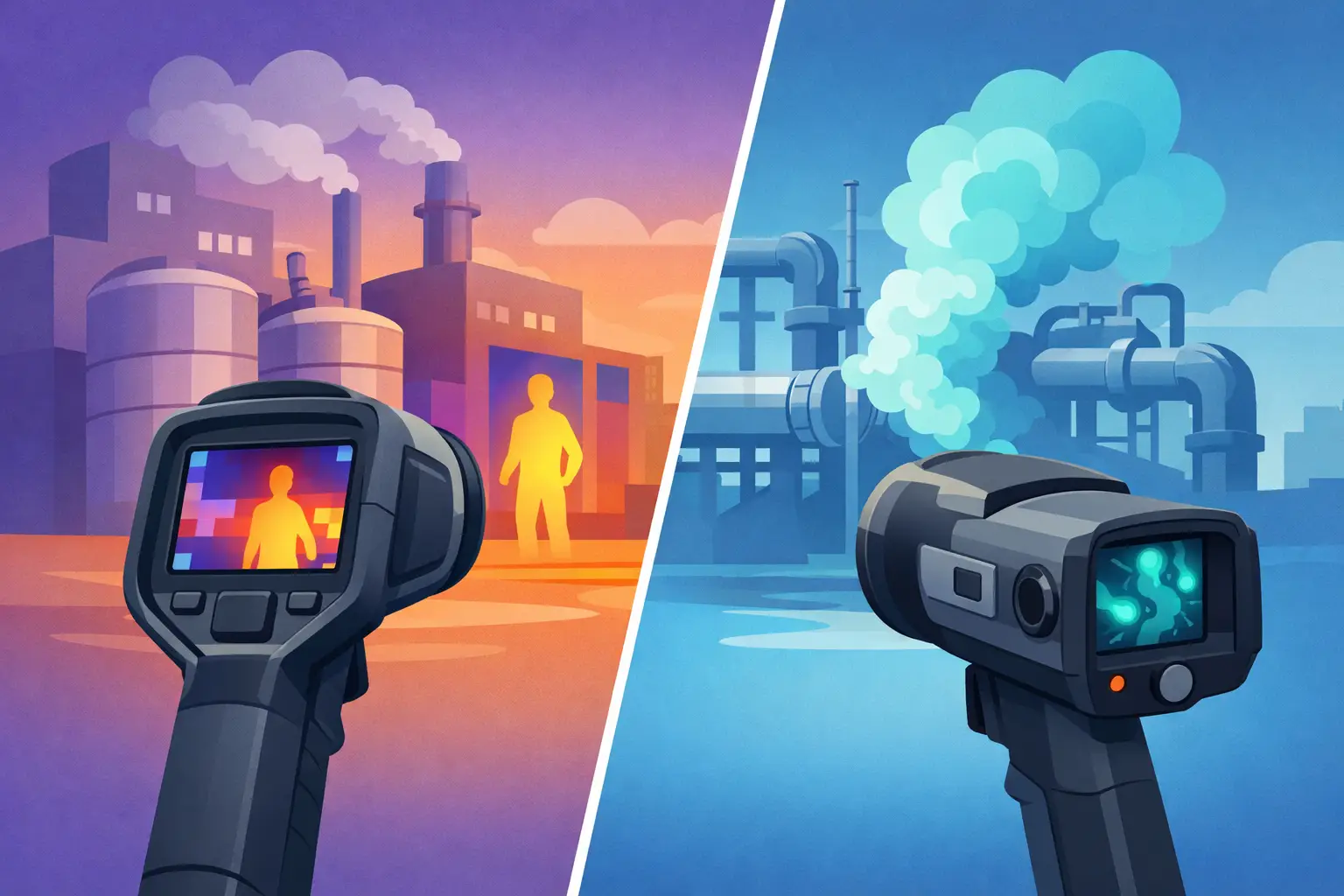
A refinery flare stack is throwing heat, a compressor skid is vibrating, and the operations team needs a faster answer than another manual inspection route. That is where the thermal vs gas leak cameras decision becomes operational, not theoretical. Choosing the wrong imaging system can slow leak response, create blind spots in compliance workflows, and waste budget on hardware that does not match the hazard.
For industrial buyers, these two camera types solve different problems. They may look similar in a specification sheet, but they are built around different detection goals. One shows temperature patterns. The other is engineered to visualize specific gas emissions. If your site is handling hydrocarbons, methane, VOCs, or process gases, that difference matters immediately.
Thermal vs gas leak cameras: the core difference
Thermal cameras detect infrared radiation associated with heat. They reveal hot spots, cold spots, insulation failures, overloaded electrical assets, bearing problems, steam issues, and process temperature anomalies. In industrial surveillance, they are often selected because they add nonstop visual monitoring and early warning where standard visible cameras cannot do the job.
Gas leak cameras, by contrast, are designed to make otherwise invisible gas plumes visible under the right conditions. They do not simply show that an area is warmer or cooler. They use narrow spectral sensitivity to identify the way specific gases absorb infrared energy, which allows operators to see emissions that would otherwise pass unnoticed.
That distinction is why thermal units are often chosen for asset condition monitoring and perimeter awareness, while gas leak units are chosen for fugitive emissions, process leak detection, and environmental safety workflows. There is overlap in industrial deployment, but there is no true one-for-one substitute.
Where thermal cameras deliver more value
Thermal systems are usually the stronger choice when your primary concern is temperature-driven risk. On an offshore platform, in a power station, or across refinery process areas, a thermal camera can continuously watch motors, transformers, pumps, tanks, pipe runs, and loading areas. If a component starts trending hotter than normal, operations teams can intervene before failure becomes downtime.
This matters commercially because thermal monitoring often supports broader asset protection. One system can help with fire detection, equipment protection, nighttime site visibility, and remote alarm verification. For procurement teams, that wider use case can improve return on investment, especially when budgets need to serve both security and maintenance goals.
Thermal cameras also perform well in low-light and difficult weather conditions where visible imaging struggles. That makes them valuable for marine operators, remote energy assets, and exposed industrial facilities where round-the-clock coverage is non-negotiable. If your site needs early indication of overheating or unauthorized presence in darkness, thermal is often the faster route to dependable results.
Still, thermal has limits. A gas leak does not always create a useful temperature contrast. If the leak is thermally neutral against the background, a standard thermal camera may show nothing meaningful. That is where buyers get caught out by assuming all infrared systems can detect gas.
Where gas leak cameras justify the premium
Gas leak cameras are built for a narrower but more critical task. In oil and gas, petrochemical, marine fuel handling, and energy operations, the ability to visualize methane or hydrocarbon leaks can directly improve safety response, maintenance prioritization, and emissions management. If your concern is not just equipment temperature but actual gas release, a dedicated gas leak system is the right class of technology.
These cameras are especially valuable in facilities with complex piping, valves, flanges, tanks, and compressor areas where fugitive emissions are difficult to isolate. Instead of relying only on point sensors or periodic inspection routines, operations teams can use fixed or deployed systems to identify the visible plume behavior and trace likely leak sources faster.
That speed has practical value. It can reduce the time spent searching large process areas, cut unnecessary shutdown scope, and support teams working under safety and compliance pressure. For buyers managing large sites, fewer hours spent locating leaks can translate into real operating savings.
The trade-off is that gas leak cameras are more application-specific. Performance depends on the target gas, the imaging technology, environmental conditions, background contrast, standoff distance, and the exact installation plan. They are not general-purpose security cameras with an extra feature added on. They are specialist detection tools and should be bought that way.
Thermal vs gas leak cameras in oil, gas, and marine sites
In oil and gas operations, the choice usually comes down to what event you need to see first. If overheating, fire risk, or asset condition is the priority, thermal cameras are often the better fit. If methane or hydrocarbon emissions are the risk driving your project, gas leak cameras become the stronger investment.
On marine assets, there is often a case for both. Engine room monitoring, electrical hotspots, and low-visibility perimeter coverage can justify thermal surveillance. Fuel gas systems, cargo areas, transfer points, and processing spaces may call for gas imaging where leak detection is the operational requirement. The best service provider will not force one platform into every role. They will match the technology to the hazard and operating environment.
In refineries and chemical plants, the answer is frequently layered protection. Thermal systems monitor process heat signatures and support security observation. Gas leak systems address emissions visibility and leak localization. Buying one and expecting it to replace the other usually creates a gap somewhere in the risk picture.
What buyers should compare before making a decision
A serious evaluation should start with detection objective, not camera price. Ask whether the site needs temperature anomaly detection, gas plume imaging, or both. This sounds obvious, but many procurement delays happen because stakeholders group all infrared systems into one category and only sort out the details after technical review.
Next, evaluate coverage area and mounting strategy. A thermal camera watching a broad yard or machinery corridor may deliver excellent value with fewer units. A gas leak camera often needs more careful positioning based on likely leak sources, target gas behavior, prevailing air movement, and line of sight. Installation quality matters as much as the unit itself.
Environmental protection is also critical. Offshore platforms, coastal terminals, and heavy industrial plants demand housings and network architecture built for corrosion, vibration, hazardous areas, and continuous operation. A low-cost option that fails under salt exposure or harsh process conditions is not a saving. It is a replacement cycle waiting to happen.
Integration should be part of the commercial conversation early. Can the system support remote viewing, alarm outputs, recording, and playback within the wider surveillance network? Can operators verify events from the control room without sending personnel into higher-risk zones? Buyers in energy and marine sectors do not just need image quality. They need a system that fits the site workflow.
Common buying mistakes
The biggest mistake is assuming a thermal camera will reliably identify gas leaks because both systems operate in the infrared spectrum. That shortcut leads to underperformance and disappointment. Thermal is excellent for many industrial tasks, but standard thermal imaging is not a substitute for gas-specific optical detection.
Another mistake is buying a gas leak camera without validating the gases of interest. Not every gas leak imaging platform is tuned for the same compounds. If your facility is focused on methane, VOCs, or another process gas, the technology choice must align with that target profile.
A third issue is underestimating deployment complexity. On paper, a camera may meet the specification. In practice, background conditions, weather, heat sources, and process layout affect results. That is why experienced industrial suppliers put so much emphasis on application fit, not just headline features.
Which system is right for your facility?
If your operation needs continuous monitoring of overheating assets, fire risk indicators, dark-area visibility, and general industrial surveillance support, thermal cameras are usually the stronger buy. They are versatile, proven, and often easier to justify across multiple departments.
If your operation needs to detect and visualize actual gas emissions, especially in hydrocarbon or methane-sensitive environments, gas leak cameras are the correct investment. They cost more for a reason. They are purpose-built for a problem that standard thermal systems do not solve well.
For many large facilities, the right answer is not thermal vs gas leak cameras as an either-or decision. It is deciding where each technology creates the most protection, the fastest response, and the best long-term value. That is how industrial buyers avoid overspending in one area while leaving critical exposure somewhere else.
When the hazard is specific, the equipment should be specific too. Buyers who match camera technology to site risk get better visibility, better uptime, and better control of the budget after installation, not just on purchase day.
🛡️ Secure Your Home or Business Today
Protect your home, office, shop, or business with reliable CCTV security cameras. Explore our range of CCTV cameras and find the right security solution for your needs.
Explore CCTV Cameras ✉️ Email Us

 Singapore :
+65-6708-9302
Singapore :
+65-6708-9302