
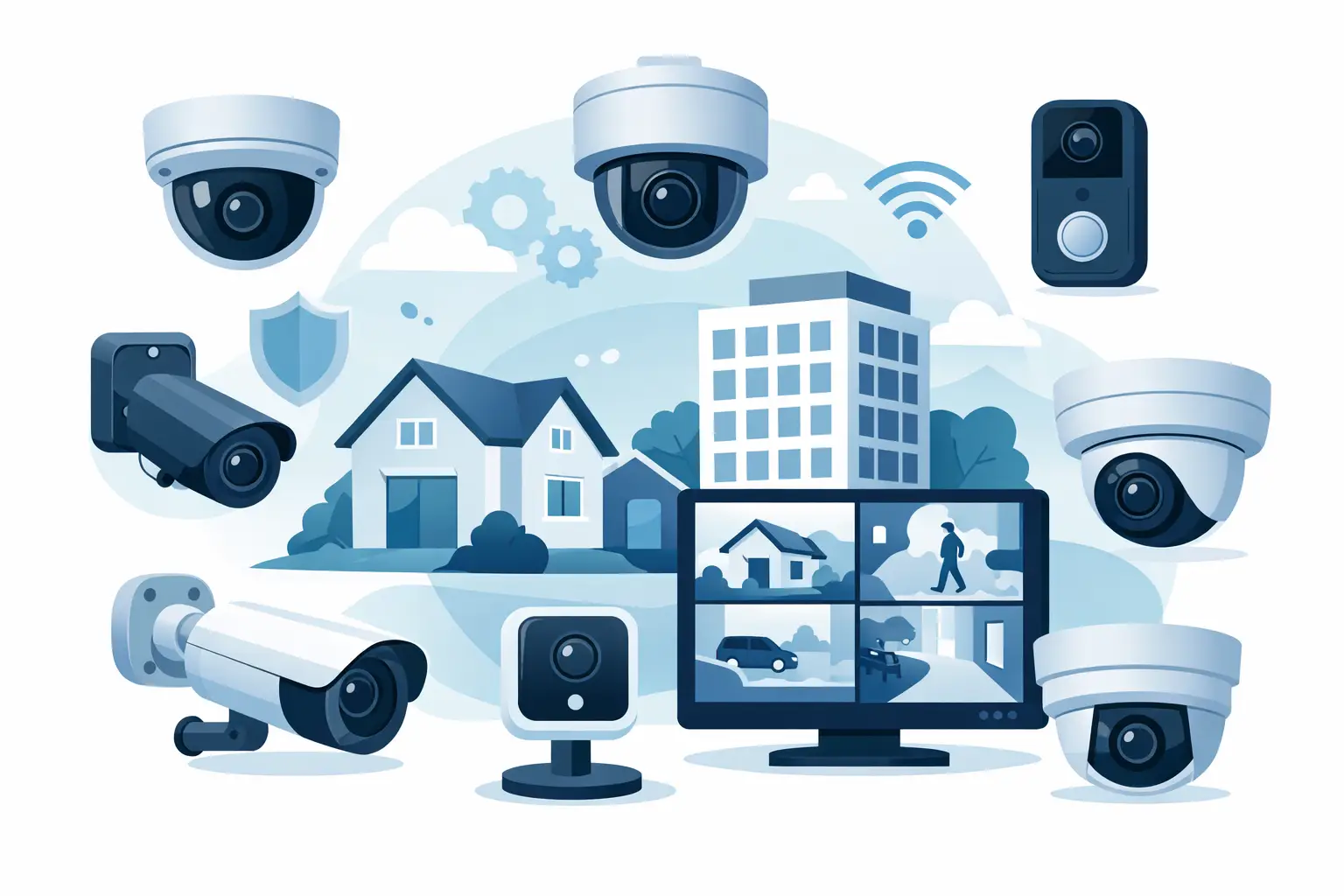
A camera that works perfectly in a retail hallway can fail fast on a refinery perimeter, offshore deck, or turbine platform. That is why understanding the main types of CCTV camera system matters before you approve a purchase order. The right system is not just about image quality – it is about network design, environmental resistance, recording strategy, maintenance cost, and how well the equipment performs under real operating pressure.
For industrial buyers, the question is rarely, “Which camera looks best on paper?” It is usually, “Which system gives us dependable coverage, manageable installation cost, and fewer surprises over the next five years?” That is a much better question, because CCTV decisions affect uptime, incident response, compliance, and long-term service budgets.
How to assess types of CCTV camera system
The first decision is not dome versus bullet. It is the system architecture behind the cameras. Some facilities need a straightforward local recorder and fixed coverage. Others need scalable IP networking, remote access across multiple assets, or specialized imaging for hazardous or marine environments. When the site includes salt spray, explosive gas risk, vibration, darkness, or long cable runs, the system type becomes even more important.
A practical evaluation usually comes down to five factors: image detail, transmission method, storage design, environmental rating, and integration. If one of those is wrong, the whole installation can become expensive to operate even if the upfront price looked attractive.
1. Analog CCTV systems
Analog systems remain in service across many industrial properties because they are familiar, cost-conscious, and easy to understand. Cameras send video over coaxial cable to a DVR, which handles recording and playback. For sites upgrading older infrastructure, analog can still make commercial sense when cable routes are already in place and the surveillance objective is general monitoring rather than high-detail analytics.
The advantage is predictable deployment. Maintenance teams often know the format well, spare parts are easy to source, and the learning curve is low. For warehouses, access gates, workshops, and secondary utility areas, analog may be enough.
The trade-off is scalability and image flexibility. Once buyers need sharper identification, wide-area remote access, or more advanced integration with alarms and network systems, analog starts to show its limits. It is often a good budget option, but not always the best long-term platform for complex industrial estates.
2. IP CCTV systems
IP systems are now the preferred choice for many professional buyers because they offer stronger image quality, easier remote access, and better expansion. Instead of sending video to a DVR over coax, each camera communicates over a network to an NVR or centralized video management platform. That opens the door to higher resolutions, smarter monitoring, and easier multi-site visibility.
For operation directors and procurement teams, the commercial value is clear. IP systems can reduce the need for separate infrastructure as the system grows, especially when the wider facility already relies on structured networking. They also support more advanced functions such as intelligent detection, event tagging, and centralized management across plants, terminals, vessels, or utility sites.
That said, IP is not automatically the cheapest route. Network planning matters. Bandwidth, cybersecurity, switch capacity, and storage calculations all need to be handled correctly. A poorly designed IP system can create performance issues that have nothing to do with the cameras themselves.
3. Wired CCTV systems
Wired CCTV is still the strongest fit for sites where reliability takes priority over convenience. Industrial compounds, refineries, port facilities, power stations, and marine terminals often prefer wired systems because they deliver stable transmission and less interference risk. When cameras are critical to perimeter control, process monitoring, or incident review, hardwired links are usually the safer investment.
This category overlaps with both analog and IP. A wired system can use coaxial or network cable, depending on the design. What matters is that the signal path is fixed and controlled. For high-risk zones, that consistency is valuable.
The downside is installation complexity. Long-distance cable routes, trenching, conduit work, and hazardous area compliance can add cost quickly. Still, for major industrial assets, the higher installation effort often pays back through performance and uptime.
4. Wireless CCTV systems
Wireless CCTV systems are attractive when cable installation is difficult, expensive, or operationally disruptive. Temporary works, remote compounds, maintenance projects, and selected marine applications may benefit from wireless transmission, especially when a rapid deployment is needed.
The main benefit is flexibility. Cameras can be positioned with fewer civil works, and system changes are easier during evolving site operations. For buyers managing phased expansions or interim security gaps, that can produce real savings.
But wireless should be chosen carefully. Signal interference, range limitations, structural obstructions, and weather exposure all affect performance. In dense industrial environments full of steel structures and electrical equipment, wireless may not deliver the same consistency as a wired backbone. It is a useful option, not a universal replacement.
5. Fixed CCTV camera systems
Fixed camera systems are built for constant coverage of defined zones such as entry points, loading bays, process lines, deck areas, and fenced perimeters. They are straightforward, effective, and often the most commercially efficient way to cover predictable activity areas.
Because the viewing angle stays set, fixed cameras are easier to manage and record. Operators know exactly what each channel is monitoring, and evidence review is more consistent. This makes them especially useful where compliance, incident reconstruction, and routine oversight are key requirements.
The limitation is coverage flexibility. If the scene changes, the camera will not follow it. Large open areas may require more units to eliminate blind spots. Even so, fixed systems remain one of the best-value options for dependable, always-on surveillance.
6. PTZ CCTV camera systems
PTZ stands for pan, tilt, and zoom. These systems allow operators to move the camera and zoom in on activity in real time. For wide yards, offshore structures, dockside operations, and large industrial perimeters, PTZ cameras offer a level of control that fixed cameras cannot match.
A well-placed PTZ can monitor a broad area, reduce the number of cameras needed in certain zones, and give security teams better live response capability. This is particularly valuable when operators need to verify alarms, inspect distant activity, or support incident management from a control room.
The trade-off is that PTZ performance depends on active operation or smart presets. If the camera is looking one way, it is not watching another. That is why many serious sites use PTZ alongside fixed cameras rather than instead of them. The strongest systems combine constant coverage with active zoom capability where it matters most.
7. Specialized CCTV systems for hazardous, marine, and extreme environments
For industrial sectors, this is often the category that separates a standard security setup from a serious surveillance solution. Hazardous-area systems, explosion-protected cameras, corrosion-resistant marine units, thermal cameras, and underwater inspection cameras are all part of the broader types of CCTV camera system used in demanding environments.
These systems are built for conditions that destroy standard equipment – explosive atmospheres, chemical exposure, heavy vibration, salt-laden air, washdown zones, extreme temperatures, and submerged inspection points. In oil and gas, marine, energy, and chemical facilities, the camera housing and certification can be just as important as the imaging specification.
This is where engineering-backed selection matters. Buyers should look closely at ingress protection, hazardous area ratings, material construction, heating or cooling support, low-light performance, and network compatibility. A cheaper camera that fails early in a hostile environment is not a saving. It is a repeat purchase, a maintenance problem, and a security gap.
Which CCTV camera system is best for your site?
There is no single best system for every asset. A pipeline facility may need a mix of fixed wired IP cameras, thermal detection at the perimeter, and explosion-protected units in classified areas. A vessel may require marine-grade cameras with remote network access and corrosion-resistant housings. A power station may prioritize high-resolution IP coverage with long-term recording and centralized playback.
The right answer depends on what the site is protecting, how operators will use the video, and what conditions the hardware will face every day. Procurement teams should also consider serviceability. If replacement parts, recorder capacity, and system expansion are likely within the contract period, those costs should be considered at the start, not after installation.
At Revlight Security, that commercial reality is exactly why specialized buyers benefit from choosing systems based on deployment conditions rather than generic camera categories. The best service provider does not just supply equipment. It helps match camera format, housing, network structure, and recording design to the operational risk on site.
A strong CCTV decision is usually a layered one. Use fixed cameras where constant coverage is non-negotiable, PTZ where operators need control, IP where scale and remote access matter, and specialized systems where the environment demands more than standard hardware can deliver. When the system fits the site, security performs better, maintenance becomes easier to plan, and the investment works harder for the business.
If you are specifying surveillance for an industrial or marine operation, the smartest next move is to treat camera type as a performance decision, not a catalog checkbox.
🛡️ Secure Your Home or Business Today
Protect your home, office, shop, or business with reliable CCTV security cameras. Explore our range of CCTV cameras and find the right security solution for your needs.
Explore CCTV Cameras ✉️ Email Us


 Singapore :
+65-6708-9302
Singapore :
+65-6708-9302