
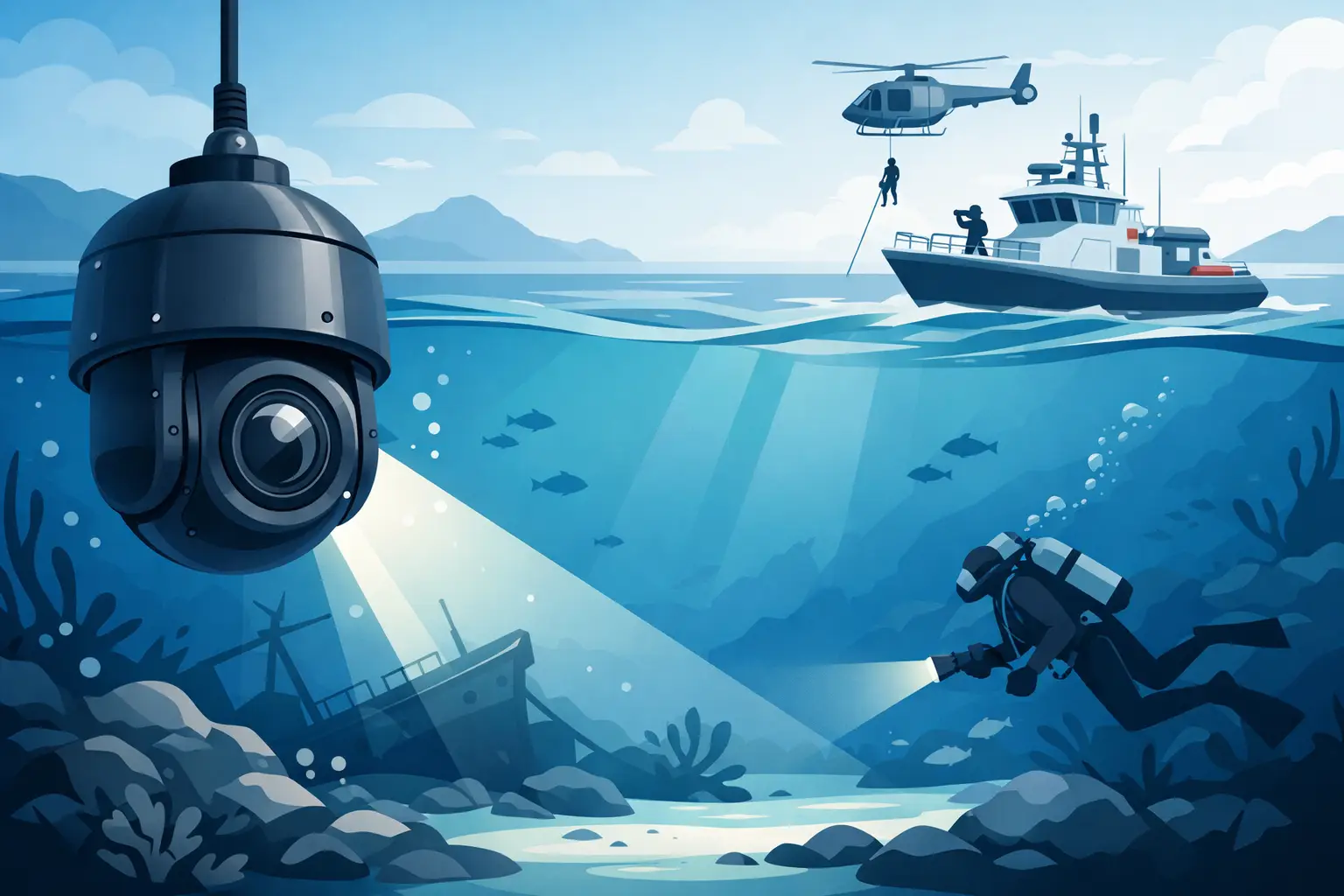
A patrol team does not get much warning when a hull inspection turns into a narcotics seizure. By the time a vessel is flagged, the inspection window is short, water conditions are rarely ideal, and any package fixed below the waterline may be placed to avoid easy visual confirmation. That is exactly why choosing the best underwater PTZ camera for coast guards to detect drugs below ship hull is not a simple camera purchase. It is an operational decision that affects search speed, evidence quality, diver safety, and boarding efficiency.
For this use case, a standard underwater viewing camera is usually not enough. Coast guard teams and marine security units need pan-tilt-zoom control, low-light performance, stable imaging in current, and a housing that survives saltwater exposure without turning into a maintenance problem after a few deployments. The right system has to work like professional inspection hardware, not like a recreational marine accessory.
What makes the best underwater PTZ camera for coast guards different
Drug concealment below a ship hull is a specialized detection problem. Packages may be taped, clamped, magnet-mounted, or hidden near sea chests, thruster tunnels, rudder assemblies, intake grilles, and structural recesses. Those are difficult angles even for trained divers, and they become harder when visibility drops or vessel geometry limits line of sight.
A true underwater PTZ camera helps because it gives operators active control over the viewing angle instead of forcing the team to reposition the entire deployment platform every few seconds. That matters when inspecting high-risk hull sections quickly. Pan and tilt let the operator scan around appendages and under ledges, while zoom allows closer inspection of suspicious shapes, straps, and fastening points without physically moving the system into contact with the hull.
The best systems also support command-level decision making. Live video can be viewed by inspection personnel, supervisors, and evidence teams at the same time. That shortens the gap between detection and action. If a suspicious package is found, the team can document it before recovery, reducing disputes later about where and how it was attached.
The core specifications that actually matter
Image quality gets the most attention, but in marine interdiction work it is only one part of the equation. A high-resolution sensor is valuable, yet resolution alone will not save a deployment if lighting is weak, if the lens fogs, or if the camera motor struggles against underwater drag.
Low-light and water clarity performance
Most hull inspections are conducted in poor visual conditions. Harbors are often turbid, night operations are common, and ship shadow reduces ambient light even during the day. A suitable underwater PTZ camera needs strong low-lux performance and integrated lighting designed to reduce backscatter. Bright light is not automatically better. In dirty water, overpowered illumination can reflect off suspended particles and reduce detail.
This is where sensor tuning and optical design become critical. A camera intended for detection work should deliver usable contrast at close and mid-range inspection distances, not just impressive spec-sheet numbers. Operators need to distinguish a natural hull feature from an attached object in real time.
PTZ precision underwater
PTZ movement on land is easy compared with PTZ movement underwater. Pressure, drag, and resistance all affect how accurately the camera can reposition. For coast guard use, smooth and repeatable movement matters more than flashy speed. If the camera overshoots, vibrates, or drifts when zoomed in, the operator loses inspection time.
A dependable unit should hold position well, respond predictably to controls, and maintain stable framing while examining weld lines, sea chests, propeller shafts, and recessed sections. Preset positions can also be valuable when teams follow a repeatable hull search pattern.
Marine-grade construction
Saltwater is unforgiving. Anti-corrosion housing, pressure-rated sealing, protected cabling, and long-service underwater connectors are not optional in this category. If a camera is being deployed from patrol craft, workboats, ROV-style mounts, poles, or diver-assisted frames, it must tolerate repeated handling, transport vibration, and wet-dry cycling.
Buyers should look beyond the headline IP rating and ask practical questions. What materials are used in the housing and fasteners? How are seals maintained? Is the unit designed for continuous submersion or short-term inspection deployment? Those answers often matter more than marketing language.
Optical zoom versus digital zoom
For below-hull contraband detection, optical zoom is the feature that counts. Digital zoom can enlarge the image, but it does not create more true detail. If the goal is to confirm straps, tape, clamps, or package contours, optical zoom gives operators a much better chance of making the right call. Digital zoom still has value for review and framing, but it should not be the main reason to buy a system.
Deployment reality: fixed camera, diver camera, or underwater PTZ
Some procurement teams ask whether a fixed underwater camera can do the job at lower cost. The honest answer is that it depends on the inspection model.
If the application is limited to a controlled inspection point, such as checking a predictable area near a berth or monitoring a stationary underwater zone, a fixed camera may be enough. But that is not the same as searching a vessel hull for hidden narcotics. Hull geometry changes from vessel to vessel, concealment points vary, and suspicious objects are often placed specifically where fixed viewing is weakest.
A diver-carried camera offers flexibility, but it depends heavily on diver line of sight and body position. In many cases, an underwater PTZ system gives the command team more control, more stable footage, and better documentation. It can also reduce diver workload by allowing remote visual confirmation before physical intervention.
How to choose the best underwater PTZ camera for coast guards to detect drugs below ship hull
The right purchase starts with mission profile, not catalog browsing. A camera for port-side inspections in shallow, relatively calm water is not necessarily the same system needed for offshore boarding support or military-grade interdiction work.
Start with depth requirement and deployment duration. If inspections are shallow and short, the available options are wider. If the unit must endure repeated extended submersion, then sealing quality, housing integrity, and thermal management move to the front of the decision.
Next, consider mounting method. Pole-mounted systems, drop systems, ROV-integrated cameras, and diver-assisted deployments all place different demands on cable management, stabilization, and control interfaces. A camera that performs well on a bench may become difficult to use if the mounting arrangement introduces sway or limits pan range.
Then look at video transmission and recording. For law enforcement and marine security operations, live viewing is only half the requirement. Clear recording for evidentiary use is just as important. The system should support reliable output to compatible recorders or command displays, with enough image integrity to document object location and condition before removal.
Control simplicity also deserves more attention than it usually gets. In the field, operators may be working in gloves, under time pressure, and in coordination with boarding teams. Menus should be straightforward, controls responsive, and preset functions easy to access. A camera with advanced features is not the best option if those features slow the operator down.
Common buying mistakes in this category
One of the biggest mistakes is buying for resolution alone. A 4K rating sounds impressive, but if the lens, lighting, and underwater visibility are limiting factors, the operational gain may be smaller than expected. A well-balanced HD or full-HD system with strong optics and stable PTZ can outperform a higher-resolution unit in real inspection conditions.
Another mistake is underestimating corrosion and serviceability. Marine security buyers should think beyond the first deployment. If maintenance is difficult, if spare parts are unclear, or if connectors fail early, ownership costs rise quickly.
A third issue is choosing a camera without considering integration. If the inspection team needs the feed on an NVR, a vessel display, or a remote command station, compatibility should be confirmed early. The best service provider in this field does not just ship hardware. They help match the underwater camera, control system, and recording environment so the deployment works under pressure.
Where the best value really comes from
For professional marine operators, value is not the lowest purchase price. Value comes from reducing inspection time, improving detection confidence, lowering diver exposure, and capturing usable evidence on the first pass. If a camera helps identify concealed packages faster and with fewer repeat inspections, it pays back operationally.
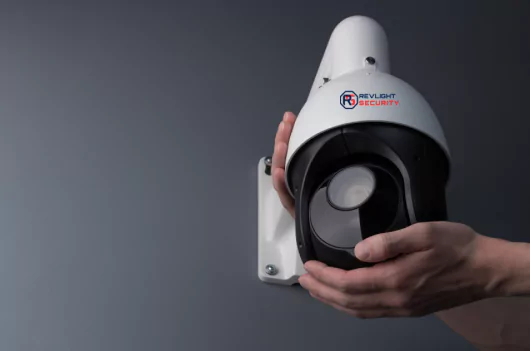
That is why serious buyers often move toward top-of-the-line offers built for demanding marine use rather than adapting consumer or hobby-grade underwater products. Coast guard and port security applications need commercial-grade reliability, stable PTZ control, and housing built for real saltwater duty. Revlight Security works in exactly these specialist surveillance categories, where environment-specific performance matters more than generic camera claims.
The best underwater PTZ camera is the one that fits the inspection method, water conditions, and evidence requirements of the unit using it. Get that match right, and the camera becomes more than a viewing tool. It becomes a force multiplier below the waterline, where small visual details can decide whether a suspicious hull mark is ignored or intercepted in time.
🛡️ Secure Your Home or Business Today
Protect your home, office, shop, or business with reliable CCTV security cameras. Explore our range of CCTV cameras and find the right security solution for your needs.
Explore CCTV Cameras ✉️ Email Us


 Singapore :
+65-6708-9302
Singapore :
+65-6708-9302