
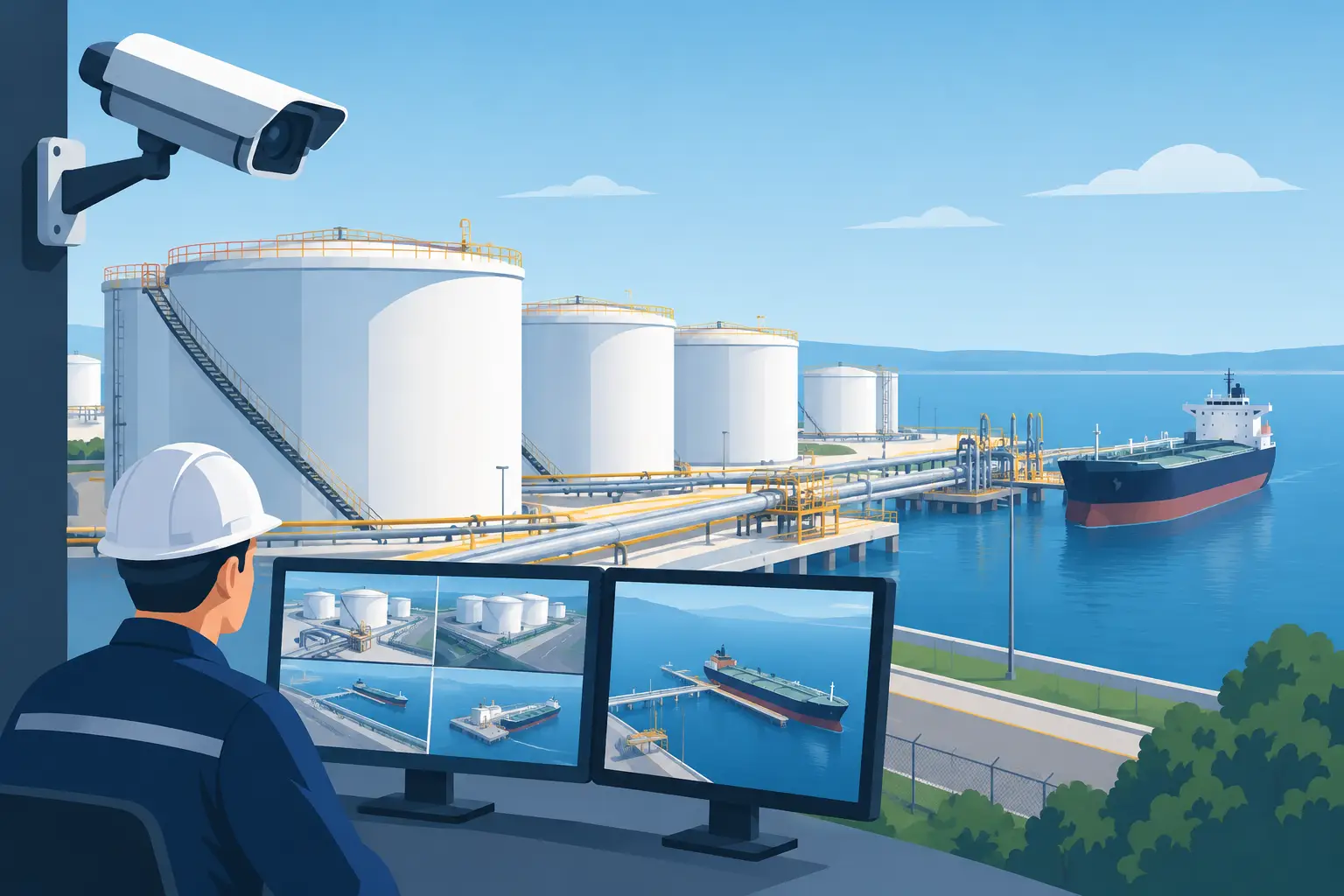
A loading arm moves, a tanker approaches the berth, and a restricted gate opens after dark. These are routine events until an operator cannot verify what happened, who entered, or whether a developing hazard was visible in time. This oil terminal surveillance guide is built for decision-makers who need more than general security coverage. They need engineered visibility across transfer operations, tank farms, marine interfaces, perimeter lines, and control rooms.
The right system reduces blind spots, shortens incident verification, supports safer work practices, and gives operations teams evidence they can use. The wrong system creates a false sense of coverage: cameras may be installed, but images fail under glare, salt spray, darkness, network loss, or an actual emergency.
Start With Operational Risk, Not Camera Count
A terminal surveillance specification should begin with the activities that create operational, security, environmental, or commercial exposure. Camera quantity is a procurement output, not the design starting point. A small terminal with complex truck loading and public-road exposure may require more purposeful coverage than a larger facility with limited access points.
Map the site by operational zones. The tank farm needs clear observation of access routes, valve manifolds, bunds, stairways, and maintenance activity. Truck and rail loading areas need identification-quality coverage at gates, driver check-in points, hose connections, metering zones, and emergency shutoff areas. Marine berths require long-range observation of vessel movements, mooring activity, gangways, loading arms, and water-side approaches.
Each zone should have a stated surveillance outcome. Ask whether the operator needs to detect movement, recognize a person, identify a vehicle or vessel marking, verify a procedure, or investigate an incident after the fact. These are different requirements. A broad overview image can show that activity occurred, while a purpose-positioned high-resolution view may be needed to confirm the sequence of events.
Prioritize the Events That Cost the Most
Terminal managers should rank scenarios by consequence and frequency. Unauthorized entry, theft, spill response, vapor release, vehicle collision, berth intrusion, cargo transfer disputes, and safety-rule violations all demand different fields of view and response times.
This approach also prevents over-specification. Not every fence line needs the same optical performance as a custody-transfer point. Conversely, a low-cost fixed unit is not an acceptable substitute where operators must identify a license plate, read container markings, or assess activity around a critical valve bank.
Build Coverage for Terminal Conditions
Oil terminals are demanding environments. Sun reflection from water and steel, night operations, vapor, dust, vibration, corrosion, wind loading, and explosive-area considerations all influence equipment selection. Standard commercial hardware may look acceptable in a brochure yet become an expensive replacement cycle on site.
For outdoor coverage, specify environmental protection suited to the local climate and exposure. Saltwater berths need corrosion-resistant housings, protected connectors, and mounting arrangements that can be inspected and serviced safely. Tank farms and process-adjacent locations may require equipment certified for the applicable hazardous-area classification. That requirement must be confirmed during design, not added after purchase.
Low-light performance also deserves close scrutiny. A terminal rarely operates only in ideal daylight. Evaluate image quality under the actual lighting conditions at gates, jetties, roadways, and transfer areas. Infrared illumination can support perimeter observation, but it may not solve every scene. Glare, long distances, reflective surfaces, fog, and airborne particles can affect usable images. Thermal imaging can be valuable for wide-area intrusion detection and visibility in low-light conditions, but it generally works best when paired with an optical camera for visual verification.
Pan-tilt-zoom units have a clear role at marine berths, tank-farm overviews, and large open areas. They should supplement fixed cameras, not replace them. A PTZ can follow an event, but only where an operator is available to control it. Fixed cameras preserve continuous evidence at critical locations while the PTZ is tracking elsewhere.
Add Gas Detection Where Video Alone Is Not Enough
Visual surveillance cannot reliably reveal an invisible hydrocarbon or methane release. At refineries and terminals where vapor hazards are a concern, gas detection imaging should be evaluated as part of the broader monitoring strategy. A properly selected optical gas imaging solution can help teams locate and visualize certain emissions, supporting faster assessment and more targeted response.
The trade-off is application specificity. Detection performance depends on the gas of concern, viewing distance, temperature contrast, weather, background conditions, and placement. These systems are not a replacement for fixed gas detection, process instrumentation, or mandated safety systems. They are a high-value layer for inspection, incident investigation, emissions monitoring programs, and areas where visual confirmation can improve decision-making.
Specify the workflow before selecting the device. Who receives the alarm or observed indication? Can the control room view the live feed? Is video recorded at sufficient quality for later review? Can maintenance teams access the relevant footage without exposing the operational network? A detection technology only delivers value when its information reaches the right person in time.
Design the Network as Critical Infrastructure
A surveillance system is only as dependable as its network, power, and recording architecture. This matters most at dispersed terminals, remote jetties, offshore loading points, and facilities where fiber routes are limited or difficult to install.
Start with a realistic bandwidth calculation based on resolution, frame rate, compression, scene complexity, and the number of concurrent viewers. Avoid designing to a marketing maximum. A busy berth with water movement, changing weather, vehicle traffic, and vessel lighting can demand more bandwidth than a static indoor scene. Recording settings should reflect risk: continuous recording may be appropriate for critical processes and access points, while event-based recording can be effective in lower-risk areas if detection is properly tuned.
Network resilience requires more than adding wireless links. Segment surveillance traffic from business and control networks. Use managed switching, strong access control, encrypted remote access, and documented device credentials. Provide local recording or edge storage where communications may be interrupted, then confirm how video is retained and synchronized when the connection returns.
For marine and remote terminal areas, industrial wireless bridges or marine WiFi systems can extend coverage efficiently. Their performance depends on line of sight, antenna alignment, radio planning, weather exposure, vessel movement, and interference conditions. A site survey is essential. Wireless can reduce civil-work costs dramatically, but it must be engineered as a production network rather than treated as a convenience connection.
Specify Recording, Playback, and Control Room Use
Procurement teams often focus on live images and underestimate retrieval. After an incident, the real question becomes whether staff can find the right footage quickly, export it securely, and establish that it has not been altered.
Set retention requirements according to risk, policy, insurer expectations, legal obligations, and available storage. Higher image quality and longer retention increase storage needs, so the decision should be deliberate. Identify which cameras require continuous recording, which need alarm-triggered recording, and which scenes require synchronized views from multiple cameras.
The operator interface matters just as much. Control room staff need practical camera names, organized maps, alarm priorities, and layouts that match the physical terminal. A screen crowded with dozens of indistinguishable thumbnails delays response. Provide incident views for each major zone, such as berth operations, truck loading, gate access, and tank-farm alarms.
Make Acceptance Testing Part of the Purchase
Do not accept a terminal system based only on installation completion. Acceptance testing should prove that the design works under real operating conditions. Include measurable tests in the scope of supply and require the installer to document the results.
Test at minimum:
- Day and night image quality at each critical observation point
- Identification performance at gates, roads, and loading locations
- PTZ presets, patrols, and manual control response
- Recording retention, playback speed, export procedures, and timestamp accuracy
- Network failover, local recording behavior, and recovery after power loss
- Alarm delivery, user permissions, and remote-access restrictions
Testing should include site personnel, not only the integrator. Operators know where vehicles stop, where glare appears, which gates are frequently bypassed, and which activities happen outside standard hours. Their input turns a technically functional installation into a usable operational tool.
Buy for Lifecycle Value, Not Lowest Initial Price
The lowest bid can become the highest-cost decision when equipment fails early, images are unusable, parts are unavailable, or the system cannot expand. Evaluate suppliers on environmental suitability, technical support, spare-part availability, commissioning capability, warranty terms, and their ability to support the full system: cameras, detection equipment, network hardware, recording, and remote access.
Revlight Security supports industrial buyers with specialist surveillance and detection equipment selected for demanding oil, gas, marine, and energy applications. The commercial advantage is a more coherent system design, where field devices and network infrastructure are considered together rather than purchased as isolated components.
A terminal does not need surveillance for its own sake. It needs verified visibility when a vessel is alongside, when a contractor enters a restricted area, when a transfer begins, or when an abnormal condition demands immediate action. Build the system around those moments, and every camera, detector, recorder, and network link has a clear job to do.
🛡️ Secure Your Home or Business Today
Protect your home, office, shop, or business with reliable CCTV security cameras. Explore our range of CCTV cameras and find the right security solution for your needs.
Explore CCTV Cameras ✉️ Email Us

 Singapore :
+65-6708-9302