
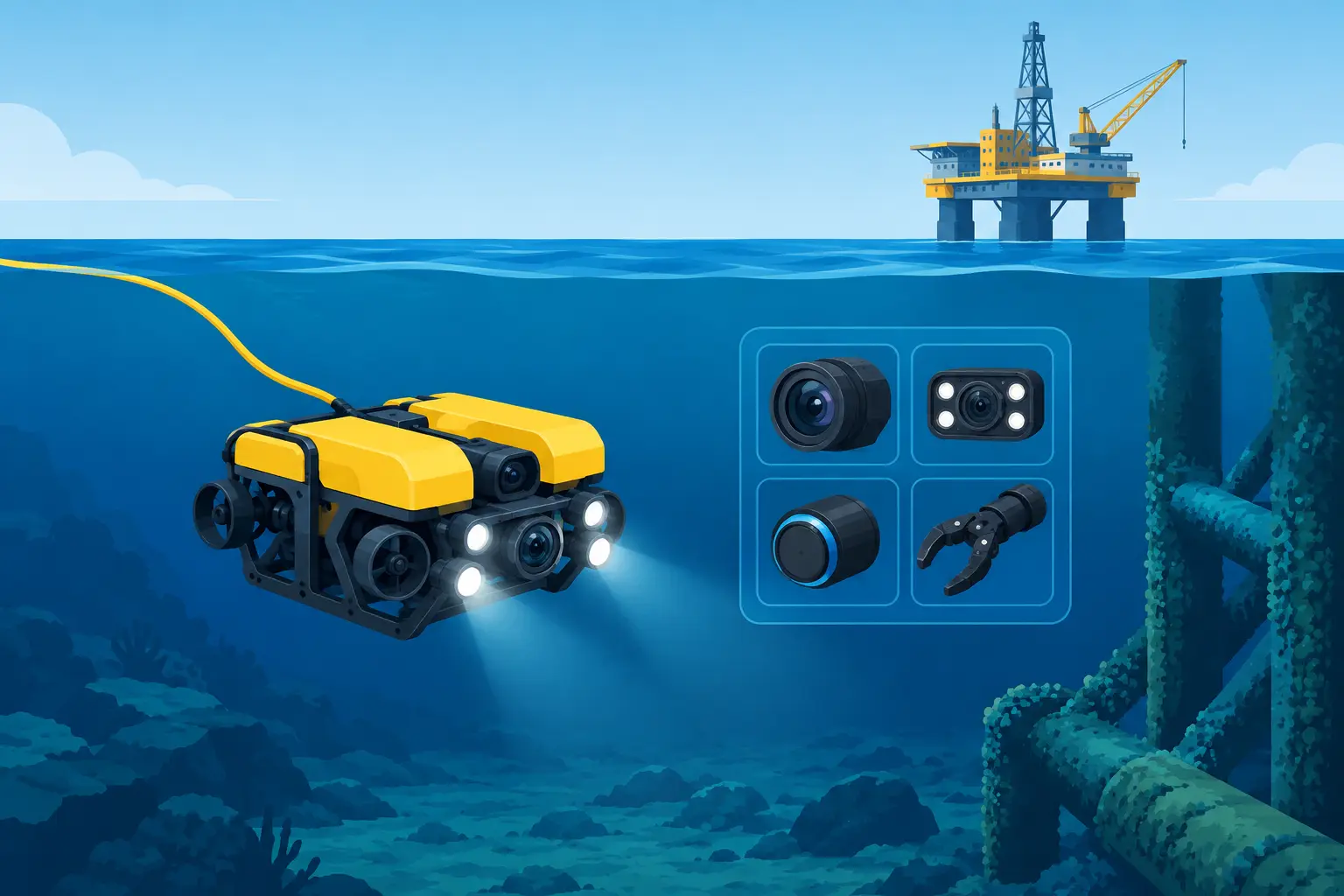
A subsea inspection can fail long before the ROV reaches the target. Poor illumination, incompatible connectors, insufficient recording capacity, or a camera that cannot hold focus in low visibility can leave a vessel with unusable evidence and an expensive return visit. This ROV camera payload guide is built for offshore teams that need to specify equipment around inspection results, asset integrity, and operational uptime.
The right payload is not simply the highest-resolution underwater camera available. It is a coordinated imaging system matched to water depth, vehicle capability, tether bandwidth, lighting conditions, and the decisions your team must make from the recorded footage. For platform legs, hull surveys, risers, pipelines, intake structures, and confined subsea assets, specification discipline protects both inspection quality and project budget.
Start the ROV Camera Payload Guide With the Inspection Objective
The first question is not, “Which camera should we buy?” It is, “What must the footage prove?” General situational awareness requires a different system than weld examination, corrosion monitoring, marine growth assessment, or verification of a suspected defect.
For broad navigation and live pilot awareness, a fixed wide-angle camera can provide dependable coverage with limited operational complexity. When the job requires close examination of anodes, flange faces, valves, structural joints, or damaged coating, teams typically need more control over field of view, focus, and illumination. A pan-and-tilt camera system can help operators frame targets without repeatedly repositioning the vehicle, reducing disturbance and improving repeatable inspection angles.
Define the smallest feature that must be visible, the expected standoff distance, and whether measurements must be supported by the imagery. A survey intended to identify a missing guard is not equivalent to an inspection intended to determine the extent of pitting. If dimensions matter, consider laser scaling or other measurement references as part of the payload rather than treating them as an afterthought.
Camera Resolution Is Only One Part of Image Quality
High resolution has commercial value when the rest of the system can preserve it. If low-quality optics, unstable lighting, signal compression, or poor recording settings reduce detail, additional pixels will not solve the problem. Procurement teams should evaluate the complete image chain: sensor performance, lens quality, focus range, transmission method, topside display, and recording format.
Low-light sensitivity is especially relevant in deep water, turbid ports, splash zones, and enclosed structures. A camera with strong low-light performance can reduce the lighting load needed for clear observation, although lighting remains essential for detailed inspection. Good color handling also matters where technicians need to differentiate coating loss, biological growth, rust staining, sediment, and foreign material.
Optical zoom can be useful when the ROV must maintain a safe distance from sensitive equipment or when maneuvering room is restricted. However, zoom magnifies vehicle movement as well as the target. If the ROV is subject to current, tether drag, or thruster vibration, stabilization and operator control become just as important as magnification. In some environments, a high-quality fixed lens positioned at the correct working distance produces more consistent results than excessive zoom capability.
Specify Lighting as a Matched Payload Component
Underwater lighting determines whether the camera can deliver inspection-grade evidence. Too little light creates noise and lost detail. Too much light can produce hotspots, backscatter, and glare from reflective surfaces. The correct output depends on visibility, water color, target reflectivity, camera sensitivity, and the distance between the ROV and the asset.
LED subsea lights are widely selected for efficient output, long service life, and controllability. Dimmable lighting gives the pilot the ability to manage changing conditions around dark recesses, bright painted surfaces, and highly reflective metal. The position of the lights is equally important. Lights mounted too close to the lens axis can illuminate suspended particles directly in front of the camera, reducing contrast in silty water.
A well-designed payload places lights to create usable texture across the target, not just brightness in the center of the frame. For close-range work, adjustable external lights may provide better results than a fixed integrated arrangement. That added flexibility comes with more cabling, mounting considerations, and possible drag, so it should be justified by the inspection scope.
Pressure Rating, Materials, and Connectors Cannot Be Assumed
Every component in the payload must be rated for the maximum operating depth with an appropriate safety margin. This includes the camera housing, lights, pan-and-tilt unit, connectors, penetrators, cabling, and any laser measurement equipment. One weak component can limit the entire deployment.
Housing materials should be selected for the operating environment, expected deployment frequency, and maintenance plan. Marine-grade metals, engineered polymers, and corrosion-resistant connector systems each have valid uses. The decision depends on depth, exposure time, galvanic compatibility, and the availability of cleaning and inspection between missions.
Connector selection deserves close attention because offshore downtime often begins with a preventable interface problem. Confirm connector series, pin count, voltage, communication protocol, cable length, and wet-mate or dry-mate requirements before purchase. A payload that needs custom adapters or field modifications may appear cost-effective initially but can create commissioning delays and future service complications.
Control, Video Transport, and Recording Requirements
A useful ROV payload must provide operators with clear live video while preserving evidence for engineers, clients, and regulatory records. These are related requirements, but they are not identical. Live video needs low latency so pilots can maneuver accurately. Recorded video needs stable, high-quality capture with time, date, and, where required, location or inspection annotations.
Before selecting a system, establish whether the vehicle supports analog video, Ethernet, fiber, serial control, or a mixed architecture. Bandwidth limitations can affect frame rate, resolution, compression, and the number of simultaneous camera feeds. A dual-camera arrangement may be valuable for combining a navigation view with a detailed inspection view, but only when the tether and topside equipment can manage both signals reliably.
Topside recording should be specified with the same care as the subsea hardware. Confirm storage capacity for full mission duration, file naming conventions, backup procedures, and playback compatibility. For critical asset inspections, record metadata should make it easy to connect footage with work orders, asset IDs, depth, and inspection observations. This creates a stronger audit trail and reduces time spent searching through unmarked video after the vessel has left site.
Match Payload Weight and Power Draw to the Vehicle
A camera payload changes ROV handling. Added weight, buoyancy, frontal area, and cable routing can affect trim, thrust demand, battery duration, and stability. This is particularly relevant for compact observation-class ROVs working around structures where precise positioning is required.
Calculate the total payload load, including brackets, cables, lights, pan-and-tilt assemblies, and protective guards. Then verify the vehicle’s available payload capacity and power budget under real operating conditions. A system may function during a short dockside test yet lose performance during a longer offshore mission when lights, thrusters, and auxiliary equipment are operating together.
The best specification balances capability against operational burden. A larger, more complex payload is justified when it replaces repeat deployments or gives engineers the evidence needed to make a maintenance decision. For routine checks, a simpler configuration may offer faster mobilization, fewer failure points, and lower service cost.
Build for Serviceability and Repeat Deployment
Offshore teams need equipment that can be inspected, cleaned, and returned to service without extended delays. Ask how easily the camera face, seals, connectors, mounting hardware, and cables can be accessed. Confirm the availability of spares and the expected maintenance intervals for the equipment operating profile.
Standardized mounting and documented configuration settings help crews reproduce proven payload setups across vessels and projects. This matters when inspections are performed by different contractors, pilots, or shifts. Consistency improves comparisons between survey records and supports better condition trending over time.
A properly specified payload is a security and asset-management investment, not an accessory mounted on an ROV. Revlight Security supports industrial buyers with underwater surveillance equipment selected around operating conditions, recording requirements, and long-term reliability. Choose the configuration that gives your operators a clear view, gives your engineers defensible evidence, and gives your operation fewer reasons to return to the same asset twice.
🛡️ Secure Your Home or Business Today
Protect your home, office, shop, or business with reliable CCTV security cameras. Explore our range of CCTV cameras and find the right security solution for your needs.
Explore CCTV Cameras ✉️ Email Us

 Singapore :
+65-6708-9302