
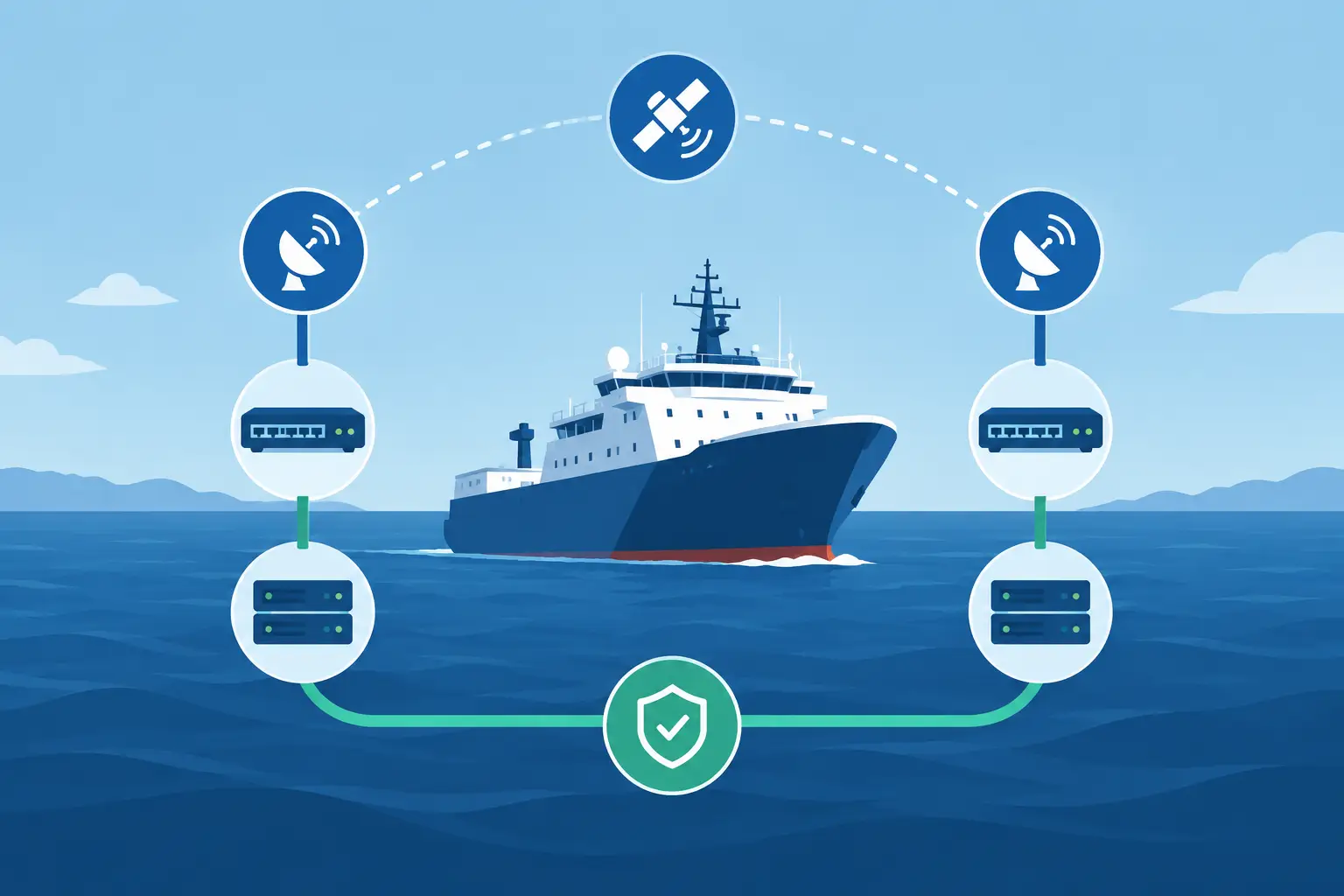
A failed network switch should not take down a vessel’s CCTV coverage, bridge communications, machinery monitoring, and crew connectivity at the same time. That is the operating principle behind this marine network redundancy guide: design every critical connection so one failure is isolated, detected, and recoverable without stopping essential operations.
For ship managers, offshore operators, and marine engineers, redundancy is not simply a matter of installing a second switch. It is an engineered approach to protecting operational visibility and communications in saltwater, vibration, heat, confined equipment rooms, and unpredictable maintenance windows. The right architecture reduces downtime, protects incident evidence, and prevents a minor hardware fault from becoming a costly operational interruption.
Why Marine Network Redundancy Matters
Marine networks increasingly carry more than office traffic. They connect IP surveillance cameras, network video recorders, radar interfaces, access control systems, machinery data, environmental sensors, Wi-Fi access points, and shore-side remote access platforms. When these services share a single path, a damaged cable, failed power supply, or misconfigured switch can create a single point of failure.
The consequences vary by vessel and operation. On a commercial vessel, the priority may be retaining bridge-to-engine-room communications and security recording. On an offshore platform or support vessel, uninterrupted coverage of restricted decks, transfer points, and critical equipment can be equally important. A refinery terminal or energy facility with marine operations may need reliable links between dockside cameras, control rooms, and remote monitoring stations.
Redundancy protects availability, but it also protects accountability. If an event occurs during a network outage, missing surveillance footage can complicate claims, investigations, safety reviews, and regulatory reporting. A well-designed system keeps critical recording and monitoring available even while technicians replace failed equipment.
Marine Network Redundancy Guide: Start With Critical Services
Not every endpoint deserves the same level of redundancy. Applying duplicate hardware to every device can raise capital cost, consume rack space, and make support more complicated. The better approach is to identify which functions must continue during a fault and design protection around those services.
Begin by separating systems into operational tiers. Life-safety and navigation-related systems require the strictest controls and should follow applicable vessel, flag-state, class, and manufacturer requirements. Security surveillance, access control, machinery observation, and operational communications may have different recovery targets, but they should still be designed around their operational value.
For example, a camera watching a low-risk storage area may tolerate a short interruption. Cameras covering an engine room entrance, cargo handling area, offshore transfer zone, or restricted control room should retain power, network connectivity, and recording through a foreseeable failure. The same logic applies to wireless coverage. Crew internet can use a lower-priority path, while operational tablets, maintenance systems, and authorized remote support need controlled, dependable service.
This assessment establishes the right level of investment. The target is not duplication for its own sake. The target is continued visibility and control where downtime creates safety, security, or commercial exposure.
Build More Than One Physical Path
The most effective redundancy begins with the physical layer. Two switches connected by the same cable route are not truly protected if that route passes through one cable tray, bulkhead penetration, or exposed deck section. A fire, flood, crush event, or cable damage can remove both links at once.
Critical network segments should use diverse cable routes wherever practical. Run primary and secondary backbone links through separate pathways, avoid shared penetrations, and protect cables in areas subject to washdown, abrasion, vibration, or mechanical impact. For longer runs between decks, machinery spaces, or separated structures, fiber can provide electrical isolation and high bandwidth. The selected cable, connectors, enclosures, and glands must be rated for the vessel environment.
Physical separation is especially relevant for marine surveillance. A network video recorder located beside the only core switch may be exposed to the same heat, water ingress, or power event. Placing recording, switching, and power equipment in a deliberate arrangement can preserve evidence when one compartment or cabinet is compromised.
Choose a Network Topology That Fails Gracefully
A simple star topology is easy to deploy but places major dependency on the central switch. If that switch fails, every connected device loses service. For low-priority networks, that may be acceptable. For security and operational systems, a ring, dual-homed, or distributed architecture provides a stronger foundation.
Ring topologies are common where devices are installed along a vessel or perimeter. When one link is interrupted, traffic can travel in the opposite direction around the ring. The recovery time depends on the protocol and configuration, so confirm that failover behavior meets the needs of live monitoring, recording, and control applications.
Dual-homing gives a critical device or access switch two independent uplinks, usually to separate distribution switches. It improves resilience but requires careful switching design to prevent loops. Managed industrial switches using appropriate loop-prevention and ring-recovery protocols are essential. An unmanaged switch has a place in simple, isolated connections, but it does not provide the visibility or control required for a critical redundant network.
Avoid assuming that redundancy is automatic. Two paths can create broadcast storms, unstable routing, or intermittent camera loss if protocols are mismatched or incorrectly configured. Document the topology, define the primary path, test the alternate path, and record the expected recovery time.
Protect Power, Not Just Data Links
A redundant network still fails if all active equipment depends on one power source. Core switches, PoE switches, recorders, wireless equipment, and high-priority cameras should be evaluated as a complete power chain.
Where equipment supports dual power inputs, connect them to independent protected supplies. Use appropriately sized uninterruptible power supplies for controlled shutdown or short-duration continuity, and consider separate feeder paths for critical cabinets. In PoE deployments, calculate the full power budget rather than relying on the maximum rating printed on the switch. Pan-tilt cameras, infrared illuminators, heaters, and multiple high-draw endpoints can exceed available PoE during startup or cold conditions.
Power redundancy also requires environmental discipline. Corroded terminals, poor grounding, inadequate ventilation, and weak surge protection can defeat an otherwise well-planned design. Marine-rated equipment and properly protected enclosures are not optional details. They are part of the availability strategy.
Keep Recording Available During Network Failures
Live video is valuable, but recorded evidence often matters more after an incident. A surveillance design should therefore consider what happens to recording when the network path between cameras and the central recorder is interrupted.
Some IP surveillance cameras support onboard edge storage. When configured correctly, they can continue recording locally during a temporary network outage and transfer missing footage after the connection returns. This does not replace centralized recording, since storage capacity, retrieval procedures, and camera configuration must be controlled. It does provide a practical extra layer for cameras in remote or high-risk locations.
Central recorders should also be designed with suitable storage resilience, controlled user access, and health monitoring. A recorder with redundant disk protection may survive a drive failure, but it remains vulnerable if its network interface, power supply, or cabinet environment is a single point of failure. The design must consider the entire recording chain from camera to storage to operator workstation.
Monitor the Network Before Operators Notice a Failure
Redundancy without monitoring can conceal problems until the second failure occurs. A network may continue operating on its backup path while a failed uplink, degraded power supply, or disconnected fiber remains unnoticed for weeks. At that point, the system is no longer redundant.
Managed switches should provide status visibility for port link state, power input condition, PoE consumption, temperature, and network errors. Alerts should identify the affected device, location, and failure type clearly enough for onboard engineers or shore-side support teams to act. Configuration backups are equally important. Replacing a failed switch is faster when its VLANs, ports, ring settings, and access controls can be restored from a verified baseline.
Periodic failover testing is the proof of performance. Schedule controlled tests of uplinks, power inputs, recorder connectivity, and remote access. Test during an approved maintenance period, document results, and correct any behavior that does not meet the operational requirement. A backup path that has never been tested is an assumption, not protection.
Specify Equipment for Marine Conditions and Serviceability
The best network design can be weakened by selecting equipment that is difficult to replace, configure, or support at sea. Standardize switch models where possible, retain approved spares, label cables and ports clearly, and maintain an up-to-date network diagram in the vessel documentation.
For exposed or industrial spaces, specify hardware with suitable temperature tolerance, vibration resistance, ingress protection, corrosion-aware installation practices, and power compatibility. Equipment selection should also account for available rack space, technician access, replacement lead time, and the skill level required to commission a spare unit.
Revlight Security supports marine operators with surveillance and network solutions selected for dependable visibility, controlled access, and demanding operational environments. The right system combines appropriate hardware with a topology that can be serviced under real vessel conditions.
Redundancy earns its value when something fails at the worst possible time. Design for that moment: separate the paths, protect the power, preserve the recording, monitor the health of every critical component, and test the recovery process before the vessel needs it.
🛡️ Secure Your Home or Business Today
Protect your home, office, shop, or business with reliable CCTV security cameras. Explore our range of CCTV cameras and find the right security solution for your needs.
Explore CCTV Cameras ✉️ Email Us

 Singapore :
+65-6708-9302
Singapore :
+65-6708-9302