

A methane leak in a refinery rarely announces itself clearly. It shows up as lost product, unexplained alarms, maintenance delays, emissions risk, and pressure from operations to find the source fast without disrupting throughput. That is exactly why knowing how to detect refinery methane leaks matters – not as a compliance exercise, but as a direct operational priority.
Refineries are dense, noisy environments with constant process movement, heat, vibration, and overlapping gas sources. That makes methane detection more complex than placing a sensor near a pipe and waiting for an alert. The right approach combines continuous monitoring, visual gas detection, disciplined inspection routines, and equipment selected for hazardous industrial service.
How to detect refinery methane leaks in real operating conditions
The first point to understand is that no single method covers every leak scenario. Small fugitive emissions from valves and flanges behave differently from a significant release at a compressor seal or storage interface. Wind, temperature, layout congestion, and release height all affect whether methane reaches a sensor, how quickly it disperses, and whether operators can localize the source without visual confirmation.
In practice, detection works best as a layered system. Fixed gas detectors provide continuous area monitoring. Optical gas imaging systems help teams confirm and locate leaks quickly. Scheduled inspections close the gaps that permanent infrastructure cannot cover. When these methods are integrated well, response times improve, unnecessary shutdowns are reduced, and product loss is easier to control.
Start with risk-based zone mapping
Before choosing hardware, refineries need a realistic map of likely leak points. High-value targets usually include compressor stations, pumps, valve manifolds, flanges, pressure relief devices, storage transfer points, tank connections, loading areas, and gas recovery systems. Older units and assets with heavy vibration or frequent cycling deserve extra attention because seals, fittings, and joints tend to degrade faster there.
A proper zone map should also reflect gas movement, not just equipment location. Open pipe racks, enclosed process buildings, elevated structures, and low-lying areas all create different detection challenges. Methane is lighter than air, but local airflow and hot process zones can produce complicated dispersion patterns. That is why detector placement should be engineered around expected plume behavior, not guessed from a plot plan.
Use fixed methane detection for continuous coverage
Fixed methane detectors are the foundation of refinery leak detection because they watch critical areas around the clock. They are best suited to high-risk zones where an immediate alert is more valuable than periodic inspection. For procurement teams, the real buying question is not whether fixed detection is necessary, but where it delivers the strongest return.
Point detectors can be highly effective in confined or semi-confined areas where gas is likely to accumulate near likely leak sources. Open-path systems can cover longer distances and may be useful across broader process corridors or perimeter sections, depending on layout. The trade-off is straightforward. Point detectors can localize concentration near a specific area, while open-path systems can detect gas crossing a beam over a wider span but may require more careful alignment and protection from physical obstruction.
Performance depends heavily on siting. A premium detector placed badly will still underperform. In refineries, detectors should be installed with service access in mind, protected from unnecessary mechanical damage, and positioned to account for ventilation, congestion, and process elevation. Maintenance access, calibration schedules, and integration with control rooms should be considered from the start, not after commissioning.
Optical imaging is often the fastest way to find the source
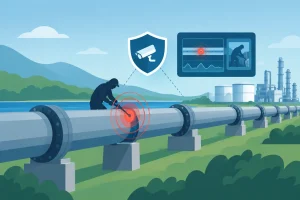
If fixed sensors tell you there is gas in an area, optical gas imaging often tells you where it is coming from. For teams dealing with large process units, this is one of the most efficient answers to how to detect refinery methane leaks without turning every investigation into a slow manual search.
Methane leak detection cameras designed for industrial use can visualize gas plumes that are invisible to the eye, allowing operators and maintenance teams to verify a leak and identify the originating component faster. That matters in a refinery because the cost of delay is not only environmental. It affects labor hours, process continuity, inspection burden, and sometimes unit availability.
The key advantage is speed. A technician can scan valves, connectors, seals, and elevated assets from a safer standoff position instead of relying only on close-proximity checks. This is especially valuable around difficult access areas, active units, and sections where working at height or near heat presents obvious constraints. For buyers, the commercial case is strong when rapid confirmation can shorten troubleshooting time and reduce repeated callouts.
That said, imaging is not magic. Detection performance depends on leak rate, background conditions, imaging angle, temperature contrast, and operator skill. A camera may confirm a plume clearly in one setting and require a different vantage point in another. The strongest results come when imaging equipment is part of a formal leak detection program, not an occasional add-on.
Combine alarm data with visual verification
The most effective refinery teams do not treat gas alarms and imaging as separate workflows. They pair them. When a fixed detector trends upward or triggers an alert, operations can direct a trained technician to inspect the zone with a gas imaging system. That shortens the path from alarm to diagnosis.
This matters commercially because every minute spent searching carries a cost. If a maintenance team can verify whether the release is coming from a flange, valve stem, connection point, or rotating equipment seal, repair planning becomes faster and more accurate. Instead of broad isolation or repeated field checks, the response is focused.
Build inspection routes around asset criticality
Even the best permanent system will not watch every fitting in a refinery. Scheduled inspection routes are still essential, especially across sprawling units, aging infrastructure, and areas where leak history suggests repeat failures. But inspection should not be generic.
High-criticality assets should be scanned more often, with clear intervals tied to process risk, emissions exposure, and repair history. Sites that organize inspections around actual leak probability usually get better outcomes than those that simply rotate through equipment on a fixed calendar. If a compressor train has a record of seal issues, it deserves a tighter cycle than a lower-risk section with stable performance.
Inspection data should also feed back into purchasing and maintenance decisions. If a certain valve type, seal material, or installation arrangement repeatedly appears in leak reports, that is a procurement signal. Detection is not only about finding gas. It is about identifying where the refinery is losing margin through recurring component weakness.
What buyers should look for in methane detection equipment
Industrial buyers should focus on reliability under refinery conditions, not brochure claims alone. Equipment needs to withstand hazardous-area requirements, weather exposure, vibration, and contamination typical of process sites. It should also support clear alarm handling, stable performance over time, and straightforward maintenance.
For methane imaging systems, practical selection criteria include image clarity, detection sensitivity, distance performance, recording capability, playback review, and compatibility with remote monitoring workflows. In a refinery environment, those functions are not luxury extras. They help document findings, support maintenance teams, and improve decision-making during live events.
For fixed systems, buyers should weigh detector type, area suitability, response time, calibration needs, integration with existing infrastructure, and lifecycle service requirements. Lower upfront pricing can look attractive, but frequent servicing, poor placement flexibility, or unreliable alarms usually erase any initial savings.
A serious supplier should be able to discuss refinery deployment scenarios in detail, including mounting strategy, zone coverage, environmental durability, and how the system supports day-to-day operations. That is the difference between buying equipment and investing in dependable surveillance infrastructure.
Training and procedures matter as much as hardware
Even top-of-the-line offers will underdeliver if operators are unsure how to interpret data or escalate findings. Detection systems need clear procedures for alarm verification, imaging follow-up, documentation, maintenance dispatch, and post-repair confirmation. Teams should know when to trust a trend, when to recheck an area, and when to treat a signal as a priority event.
Training also improves the value of visual gas detection. Experienced users are better at reading background conditions, adjusting inspection angles, and distinguishing a real plume from misleading scene effects. For operation managers and superintendents, this translates into fewer wasted hours and stronger field confidence.
Refinery methane leaks are rarely solved by one device alone. They are controlled by combining engineered detector placement, high-performance imaging, disciplined inspections, and operators who know how to act on the information. For facilities that want stronger safety performance, tighter emissions control, and less product loss, that layered model is the clearest path forward. If you are evaluating how to detect refinery methane leaks more effectively, the right system is the one that finds the problem early, shows your team exactly where to go, and keeps working when refinery conditions are at their toughest.
🛡️ Secure Your Home or Business Today
Protect your home, office, shop, or business with reliable CCTV security cameras. Explore our range of CCTV cameras and find the right security solution for your needs.
Explore CCTV Cameras ✉️ Email Us


 Singapore :
+65-6708-9302
Singapore :
+65-6708-9302